Results by title
135 books match the query 'Faith' and 5 start with c
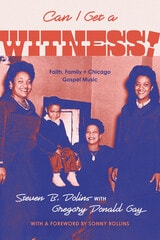
Can I Get a Witness!
Faith, Family, and Chicago Gospel MusicSteven B. Dolins with Gregory Donald Gay
University of Chicago Press, 2026
The remarkable story of pastor Donald Gay and his family’s lasting contributions to gospel music and Chicago culture.
When the preacher Gregory Donald Gay joined his sisters onstage at Carnegie Hall in 1950, on a sold-out bill they shared with Mahalia Jackson and the Clara Ward Singers, he became a participant in a landmark moment: the first concert in the venue to feature entirely gospel music. He was just five years old.
The Gay Sisters—Evelyn, Geraldine, and Mildred—were key figures in gospel’s Golden Age, and their youngest brother had a front-row seat. Evelyn and Geraldine each innovated singular approaches to gospel piano, while Mildred sang. Together, they toured and performed on a series of influential gospel recordings from 1948 to 1973, playing the Apollo Theatre and crossing paths with musical luminaries like Sister Rosetta Tharpe, Sam Cooke, Pops Staples, and Dizzy Gillespie. But despite a hit record and prodigious talent, the Gay Sisters faded from the limelight. In the ensuing years, they weathered personal trials while their mother, Fannie, devoted her attention to another family undertaking: starting a church.
Can I Get a Witness! is a call-and-response between Steven B. Dolins, founder of The Sirens Records, and Donald Gay, who vividly describes his boyhood in Chicago’s Woodlawn neighborhood, his family’s remarkable place in gospel history, his mother’s work as a faith leader, and his own calling as a pastor. The book spotlights the rich contributions of a family remembered not only for the songs they recorded but also for their unwavering kindness to others, a legacy that the legendary Sonny Rollins recounts in a moving foreword.
Chronicles Of Faith
The Autobiography of Frederick D. PattersonFrederick D. Patterson, edited by Martia Graham Goodson
University of Alabama Press, 1991
From Tuskegee to the United Negro College Fund, one man's legacy changed American education.
Chronicles of Faith: The Autobiography of Frederick D. Patterson, edited by Martia Graham Goodson, presents the remarkable life story of one of the most influential educators and institutional leaders in twentieth-century America. Based on Patterson's personal recollections, the autobiography traces his journey from a childhood marked by adversity to a distinguished career as a veterinarian, educator, college president, and visionary advocate for higher education.
Best known as president of Tuskegee Institute and founder of the United Negro College Fund, Patterson played a pivotal role in expanding educational opportunities for African Americans during an era of segregation and limited resources. The narrative chronicles his leadership in strengthening historically Black colleges and universities, promoting professional education, and developing innovative fundraising models that transformed the future of Black higher education.
Interwoven with accounts of personal determination, faith, and public service, the book offers valuable insight into the challenges and achievements that shaped American educational history. Patterson's story is both an inspiring autobiography and an important historical document, revealing the vision and perseverance required to create lasting institutional change. Essential for understanding the evolution of higher education in the United States, this volume will be especially valuable to students, scholars, educators, historians, and readers interested in African American leadership, HBCUs, philanthropy, and social progress.
Citizenship, Faith, and Feminism
Jewish and Muslim Women Reclaim Their RightsJan Feldman
Brandeis University Press, 2011

Cold Anger
A Story of Faith and Power PoliticsMary Beth Rogers
University of North Texas Press, 1990
Cultural Memory
Resistance, Faith, and IdentityBy Jeanette Rodriguez and Ted Fortier
University of Texas Press, 2007