Results by title
234 books match the query 'Families' and 8 start with c
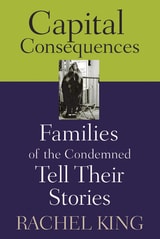
Capital Consequences
Families of the Condemned Tell Their StoriesKing, Rachel
Rutgers University Press, 2004
Those who support capital punishment often claim that they do so because it provides justice and closure for the victims’ families. In Capital Consequences, attorney Rachel King reminds us that there are other families and other victims who must be considered in the debate over the death penalty.
Combining a narrative voice with vivid, passionate, and painful accounts of the families of death row inmates, the book demonstrates that crimes that lead to death sentences also devastate the families of those convicted. These families, King argues, are the unseen victims of capital punishment.
King challenges readers to question the morality of a punishment that victimizes families of the condemned and ripples out through future generations. Chapters tell the stories of families that have lost life savings supporting an accused loved one, endured intense public scrutiny, been subjected to harassment by the media, and are struggling to live with the inhumane treatment that their loved ones receive on death row. The author also explores the unique nature of the grief that these families suffer. Because their pain tends to elicit less attention and empathy than that of the crime victims’ families, King shows how it becomes much more desperate and isolating.
On a human level, this book is a powerful reminder that tragic events have tragic consequences that far outreach their immediate victims. At the same time, the accounts illustrate many of the flaws inherent in the judicial system—racial and economic bias, incompetent counsel, prosecutorial misconduct, the execution of juveniles, and wrongful convictions, some of which are only now being overturned because of recent advances in DNA technology.
Regardless of which side of the death penalty issue you are on, this book will lead you to pause and consider that all acts—criminal and retributive—have broader human implications than we are sometimes willing to realize.
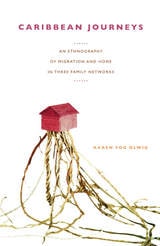
Caribbean Journeys
An Ethnography of Migration and Home in Three Family NetworksKaren Fog Olwig
Duke University Press, 2007
The migratory journeys of the families in this study began more than sixty years ago, when individuals in the three families left home in a British colonial town in Jamaica, a French Creole rural community in Dominica, and an African-Caribbean village of small farmers on Nevis. Olwig follows the three family networks forward in time, interviewing family members living under highly varied social and economic circumstances in locations ranging from California to Barbados, Nova Scotia to Florida, and New Jersey to England. Through her conversations with several generations of these far-flung families, she gives insight into each family’s educational, occupational, and socioeconomic trajectories. Olwig contends that terms such as “Caribbean diaspora” wrongly assume a culturally homogeneous homeland. As she demonstrates in Caribbean Journeys, anthropologists who want a nuanced understanding of how migrants and their descendants perceive their origins and identities must focus on interpersonal relations and intimate spheres as well as on collectivities and public expressions of belonging.
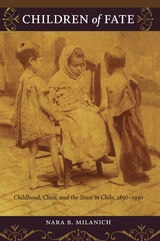
Children of Fate
Childhood, Class, and the State in Chile, 1850–1930Nara B. Milanich
Duke University Press, 2009
Milanich pays particular attention to family law, arguing that liberal legal reforms wrought in the 1850s, which left the paternity of illegitimate children purposely unrecorded, reinforced not only patriarchal power but also hierarchies of class. Through vivid stories culled from judicial and notarial sources and from a cache of documents found in the closet of a Santiago orphanage, she reveals how law and bureaucracy helped create an anonymous underclass bereft of kin entitlements, dependent on the charity of others, and marginalized from public bureaucracies. Milanich also challenges the recent scholarly emphasis on state formation by highlighting the enduring importance of private, informal, and extralegal relations of power within and across households. Children of Fate demonstrates how the study of children can illuminate the social organization of gender and class, liberalism, law, and state power in modern Latin America.
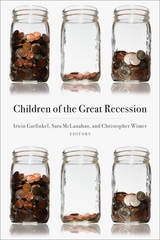
Children of the Great Recession
Irwin Garfinkel
Russell Sage Foundation, 2016
Several contributors examine the recession’s impact on the economic well-being of families, including changes to income, poverty levels, and economic insecurity. Irwin Garfinkel and Natasha Pilkauskas find that in cities with high unemployment rates during the recession, incomes for families with a college-educated mother fell by only about 5 percent, whereas families without college degrees experienced income losses three to four times greater. Garfinkel and Pilkauskas also show that the number of non-college-educated families enrolled in federal safety net programs—including Medicaid, the Earned Income Tax Credit, and the Supplemental Nutrition Assistance Program (or food stamps)—grew rapidly in response to the Great Recession.
Other researchers examine how parents’ physical and emotional health, relationship stability, and parenting behavior changed over the course of the recession. Janet Currie and Valentina Duque find that while mothers and fathers across all education groups experienced more health problems as a result of the downturn, health disparities by education widened. Daniel Schneider, Sara McLanahan and Kristin Harknett find decreases in marriage and cohabitation rates among less-educated families, and Ronald Mincy and Elia de la Cruz-Toledo show that as unemployment rates increased, nonresident fathers’ child support payments decreased. William Schneider, Jeanne Brooks-Gunn, and Jane Waldfogel show that fluctuations in unemployment rates negatively affected parenting quality and child well-being, particularly for families where the mother did not have a four-year college degree.
Although the recession affected most Americans, Children of the Great Recession reveals how vulnerable parents and children paid a higher price. The research in this volume suggests that policies that boost college access and reinforce the safety net could help protect disadvantaged families in times of economic crisis.
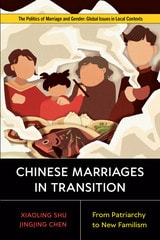
Chinese Marriages in Transition
From Patriarchy to New FamilismXiaoling Shu
Rutgers University Press, 2023
This book is freely available in an open access edition thanks to TOME (Toward an Open Monograph Ecosystem)— a collaboration of the Association of American Universities, the Association of University Presses, and the Association of Research Libraries—and the generous support of the University of California, Davis. Learn more at the TOME website, available at: openmonographs.org.
Download the open access book here.
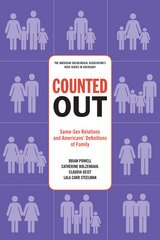
Counted Out
Same-Sex Relations and Americans' Definitions of FamilyBrian Powell
Russell Sage Foundation, 2011
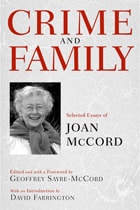
Crime and Family
Selected Essays of Joan McCordJoan McCord, introduction by David Farrington, foreword by Geoffrey Sayre-McCord
Temple University Press, 2007
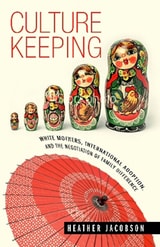
Culture Keeping
White Mothers, International Adoption, and the Negotiation of Family DifferenceHeather Jacobson
Vanderbilt University Press, 2008
Heather Jacobson examines these adoptions by focusing on a relatively new social phenomenon, the practice by international adoptive parents, mothers in particular, of incorporating aspects of their children's cultures of origin into their families' lives. "Culture keeping" is now standard in the adoption world, though few adoptive parents, the majority of whom are white and native-born, have experience with the ethnic practices of their children's homelands prior to adopting.
Jacobson follows white adoptive mothers as they navigate culture keeping: from their motivations, to the pressures and constraints they face, to the content of their actual practices concerning names, food, toys, travel, cultural events, and communities of belonging. Through her interviews, she explores how women think about their children, their families, and themselves as mothers as they labor to construct or resist ethnic identities for their children, who may be perceived as birth children (because they are white) or who may be perceived as adopted (because of racial difference).
The choices these women make about culture, Jacobson argues, offer a window into dominant ideas of race and the "American Family," and into how social differences are conceived and negotiated in the United States.