Results by title
1726 books match the query 'Film' and 147 start with c
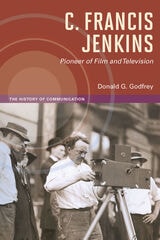
C. Francis Jenkins, Pioneer of Film and Television
Donald G. Godfrey
University of Illinois Press, 2014
This is the first biography of the important but long-forgotten American inventor Charles Francis Jenkins (1867-1934). Historian Donald G. Godfrey documents the life of Jenkins from his childhood in Indiana and early life in the West to his work as a prolific inventor whose productivity was cut short by an early death. Jenkins was an inventor who made a difference.
As one of America's greatest independent inventors, Jenkins's passion was to meet the needs of his day and the future. In 1895 he produced the first film projector able to show a motion picture on a large screen, coincidentally igniting the first film boycott among his Quaker viewers when the film he screened showed a woman's ankle. Jenkins produced the first American television pictures in 1923, and developed the only fully operating broadcast television station in Washington, D.C. transmitting to ham operators from coast to coast as well as programming for his local audience.
Godfrey's biography raises the profile of C. Francis Jenkins from his former place in the footnotes to his rightful position as a true pioneer of today's film and television. Along the way, it provides a window into the earliest days of both motion pictures and television as well as the now-vanished world of the independent inventor.

Call Me by Your Name
Perspectives on the FilmEdited by Edward Lamberti and Michael Williams
Intellect Books, 2026
This edited collection explores how Luca Guadagnino’s film Call Me by Your Name speaks powerfully to questions of contemporary sexual identity and romance.
Adapted by James Ivory from André Aciman’s novel and directed by Luca Guadagnino, the film Call Me by Your Name has been passionately received among audiences and critics ever since its 2017 release. A love story between seventeen-year-old Elio (Timothée Chalamet) and graduate student Oliver (Armie Hammer) set in 1983 “somewhere in northern Italy,” Call Me by Your Name presents a gay relationship in a romantic idyll seemingly untroubled by outside pressures, prejudices, or tragedy.
While this means it offers audiences welcome opportunities to swoon in front of an LGBTQ+ romance that equals classic heterosexual romances onscreen, its relevance or political significance today may not be immediately apparent. This edited collection points out the ways in which the film is abundantly infused with narrative, thematic, and stylistic elements that can be interpreted as speaking powerfully to contemporary audiences on questions of sexual identity. How does this love story explore wider tensions that exist between the specific and the general, between the open and the hidden, and between the past and the present? The contributors to this collection provide stimulating and contemplative responses to this question.
Capitalism Hates You
Marxism and the New Horror FilmJoshua Gooch
University of Minnesota Press, 2025
What contemporary horror films teach us about the cruelties of capitalist society
Capitalism Hates You uses the horror film genre as a tool to diagnose and expose the hostile conditions of life under capitalism. Through incisive critical analyses of popular films such as Get Out, Drag Me to Hell, Hereditary, The Babadook, and many others, Joshua Gooch draws connections between Marxist theory and contemporary narratives of psychological unease.
Gooch highlights the work of women, trans, and nonwhite filmmakers to show how the remarkable diversity of twenty-first-century horror cinema can provide an expansive catalog of capitalism’s varying forms of oppression. Studying films that interrogate such urgent topics as gentrification, climate change, and reproductive labor, he demonstrates how contemporary horror films give affective shape to the negative undercurrents of our present socioeconomic system.
Capitalism Hates You argues that these films and their material conditions can deepen our understanding of essential concepts in contemporary Marxism, from the theory of value and changing forms of commodification to the labor of social reproduction, the abolition of the family, and the necessity of ecosocialism. Synthesizing various strands of Marxist thought, Gooch sheds light on the growing field of socially conscious horror films, examining how they pinpoint and exaggerate latent feelings of dread and discomfort to reflect the ills of society.
Retail e-book files for this title are screen-reader friendly with images accompanied by short alt text and/or extended descriptions.
Career Movies
American Business and the Success MystiqueBy Jack Boozer
University of Texas Press, 2002
Achieving the American Dream became inextricably linked with career/business success after World War II, as an increasingly consumerist America learned to define the dream through possessions and status. Not surprisingly, Hollywood films in the postwar years reflected the country's preoccupation with work and career success, offering both dramatic and comedic visions of the career quest and its effects on personal fulfillment, family relations, women's roles, and the creation (or destruction) of just and caring communities.
In this book, Jack Boozer argues that the career/business film achieved such variety and prominence in the years between 1945 and 2001 that it should be considered a legitimate film genre. Analyzing numerous well-known films from the entire period, he defines the genre as one in which a protagonist strives for career success that often proves to be either elusive despite hard work, or unfulfilling despite material rewards and status. Boozer also explores several distinct subgenres of the career movie—the corporate executive films of the 1950s; the career struggles of (single, married, and/or parenting) women; the entrepreneurial film as it is also embodied in texts about immigrants and racial and ethnic minorities and business-oriented femmes fatales; the explosion of promotionalism and the corporatization of employment; and, finally, the blurring of work and private life in the brave new world of the televirtuality film.

Cartographic Cinema
Tom Conley
University of Minnesota Press, 2006
Cartomancy and Tarot in Film
1940-2010Emily E. Auger
Intellect Books, 2016
Casting a Shadow
Creating the Alfred Hitchcock FilmEdited by Will Schmenner and Corinne Granof
Northwestern University Press, 2007
Scott Curtis considers the four functions of Hitchcock’s sketches and storyboards and how they undermine the impression of Hitchcock as a lone artist. Tom Gunning examines the visual vocabulary and cultural weight of Hitchcock’s movies. Bill Krohn focuses sharply on the film I Confess, tracking its making over a very cooperative path.
Finally, Jan Olsson draws on the television series, Alfred Hitchcock Presents, to show the ways that collaboration contributes to the formation of his well known public persona. Anchored by editor Will Schmenner’s introduction, this book represents an important contribution to Hitchcock scholarship and a provocative glimpse at his unsung strength as a collaborative artist.
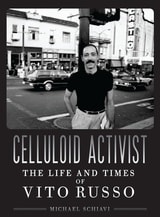
Celluloid Activist
The Life and Times of Vito RussoMichael Schiavi
University of Wisconsin Press, 2011
“Schiavi tells a compelling story in this biography—from his re-creation of life on the streets of East Harlem and in Greenwich Village of the 1960s and 1970s to the way he conveys Russo’s excitement about his film research and popular education to his account of the AIDS years in New York City.”—John D’Emilio, Italian American Review
“In [Schiavi’s] hands Russo’s life is both fascinating in its own right and a window into a larger milieu of activism during two critical decades.”—Italian American Review
Best Books for General Audiences, selected by the Public Library Reviewers
Finalist, Gay Memoir/Biography, Lambda Literary Awards
Finalist, Over the Rainbow Selection, American Library Association
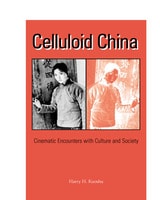
Celluloid China
Cinematic Encounters with Culture and SocietyHarry H. Kuoshu
Southern Illinois University Press, 2002
Celluloid China: Cinematic Encounters with Culture and Society by Harry H. Kuoshu is a lucid introduction to the cinema of mainland China from the early 1930s to the early 1990s. Emphasizing both film contexts and film texts, this study invites film scholars and students to a broad cinematic analysis that includes investigations of cultural, cross-cultural, intellectual, social, ethnic, and political issues. Such a holistic evaluation allows for a better understanding of both the genesis of a special kind of film art from the People’s Republic of China and the culture exemplified in those films.
The fifteen films include: Two Stage Sisters; Hibiscus Town; Farewell My Concubine; Street Angel; Three Women; Human, Woman, Demon; Judou; Girl from Hunan; Sacrificed Youth; Horse Thief; Yellow Earth; Old Well; Red Sorghum; Black Cannon Incident; and Good Morning, Beijing. Discussions of each film have an introduction, passages from the director’s own notes whenever available, and a scholarly article. Discussion questions are found in an appendix. Within its complete bibliography, the book also features a suggested reading list for Chinese film classes. Celluloid China is the first book to provide such an exhaustive study of the art and cultural context of Chinese cinema.
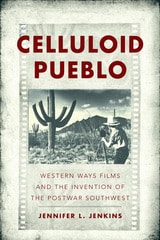
Celluloid Pueblo
Western Ways Films and the Invention of the Postwar SouthwestJennifer L. Jenkins
University of Arizona Press, 2016
Celluloid Pueblo tells the story of Western Ways Features and its role in the invention of the Southwest of the imagination. Active during a thirty-year period of profound growth and transformation, the Herberts created a dynamic visual record of the region, and their archival films now serve as a time capsule of the Sunbelt in the mid-twentieth century. Drawing upon a ten-year career with Fox, Western Ways owner-operator Charles Herbert brought a newshound’s sensibility and acute skill at in-camera editing to his southwestern subjects. The Western Ways films provided counternarratives to Hollywood representations of the West and established the regional identity of Tucson and the borderlands.
Jennifer L. Jenkins’s broad-sweeping book examines the Herberts’ work on some of the first sound films in the Arizona borderlands and their ongoing promotion of the Southwest. The book covers the filmic representation of Native and Mexican lifeways, Anglo ranching and leisure, Mexican missions and tourism, and postwar borderlands prosperity and progressivism. The story of Western Ways closely follows the boom-and-bust arc of the midcentury Southwest and the constantly evolving representations of an exotic—but safe and domesticated—frontier.
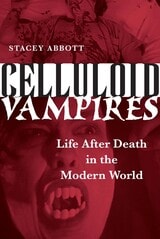
Celluloid Vampires
Life After Death in the Modern WorldBy Stacey Abbott
University of Texas Press, 2007
In 1896, French magician and filmmaker George Méliès brought forth the first celluloid vampire in his film Le manoir du diable. The vampire continues to be one of film's most popular gothic monsters and in fact, today more people become acquainted with the vampire through film than through literature, such as Bram Stoker's classic Dracula. How has this long legacy of celluloid vampires affected our understanding of vampire mythology? And how has the vampire morphed from its folkloric and literary origins?
In this entertaining and absorbing work, Stacey Abbott challenges the conventional interpretation of vampire mythology and argues that the medium of film has completely reinvented the vampire archetype. Rather than representing the primitive and folkloric, the vampire has come to embody the very experience of modernity. No longer in a cape and coffin, today's vampire resides in major cities, listens to punk music, embraces technology, and adapts to any situation. Sometimes she's even female.
With case studies of vampire classics such as Nosferatu, Martin, Blade, and Habit, the author traces the evolution of the American vampire film, arguing that vampires are more than just blood-drinking monsters; they reflect the cultural and social climate of the societies that produce them, especially during times of intense change and modernization. Abbott also explores how independent filmmaking techniques, special effects makeup, and the stunning and ultramodern computer-generated effects of recent films have affected the representation of the vampire in film.
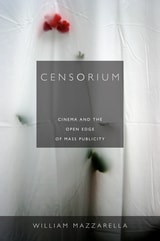
Censorium
Cinema and the Open Edge of Mass PublicityWilliam Mazzarella
Duke University Press, 2013
At the intersection of anthropology, media studies, and critical theory, Censorium is a pathbreaking analysis of Indian film censorship. The book encompasses two moments of moral panic: the consolidation of the cinema in the 1910s and 1920s, and the global avalanche of images unleashed by liberalization since the early 1990s. Exploring breaks and continuities in film censorship across colonial and postcolonial moments, William Mazzarella argues that the censors' obsessive focus on the unacceptable content of certain images and the unruly behavior of particular audiences displaces a problem that they constantly confront yet cannot directly acknowledge: the volatile relation between mass affect and collective meaning. Grounded in a close analysis of cinema regulation in the world's largest democracy, Censorium ultimately brings light to the elusive foundations of political and cultural sovereignty in mass-mediated societies.
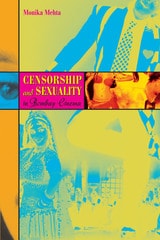
Censorship and Sexuality in Bombay Cinema
By Monika Mehta
University of Texas Press, 2011
India produces an impressive number of films each year in a variety of languages. Here, Monika Mehta breaks new ground by analyzing Hindi films and exploring the censorship of gender and heterosexuality in Bombay cinema. She studies how film censorship on various levels makes the female body and female sexuality pivotal in constructing national identity, not just through the films themselves but also through the heated debates that occur in newspapers and other periodicals. The standard claim is that the state dictates censorship and various prohibitions, but Mehta explores how relationships among the state, the film industry, and the public illuminate censorship's role in identity formation, while also examining how desire, profits, and corruption are generated through the act of censoring.
Committed to extending a feminist critique of mass culture in the global south, Mehta situates the story of censorship in a broad social context and traces the intriguing ways in which the heated debates on sexuality in Bombay cinema actually produce the very forms of sexuality they claim to regulate. She imagines afresh the theoretical field of censorship by combining textual analysis, archival research, and qualitative fieldwork. Her analysis reveals how central concepts of film studies, such as stardom, spectacle, genre, and sound, are employed and (re)configured within the ambit of state censorship, thereby expanding the scope of their application and impact.
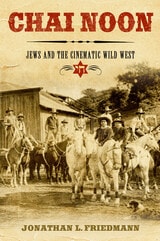
Chai Noon
Jews and the Cinematic Wild WestJonathan L. Friedmann
University of Wisconsin Press, 2025
This volume joins other reconsiderations of outsider and minority representations in Westerns to offer a more nuanced view of the genre. Friedmann engages with larger themes of Jewish identity in popular film, including depictions of race, ethnicity, and foreignness. He also identifies similar concerns within the invention and creation of the imaginary West writ large in American culture. The juxtapositions prove to be both unexpected and intuitively understandable.
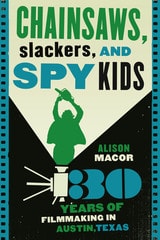
Chainsaws, Slackers, and Spy Kids
Thirty Years of Filmmaking in Austin, TexasBy Alison Macor
University of Texas Press, 2010
Winner, Peter C. Rollins Book Award, Southwest Texas Popular Culture Association/American Culture Association, 2011
During the 1990s, Austin achieved "overnight" success and celebrity as a vital place for independent filmmaking. Directors Richard Linklater and Robert Rodriguez proved that locally made films with regional themes such as Slacker and El Mariachi could capture a national audience. Their success helped transform Austin's homegrown film community into a professional film industry staffed with talented, experienced filmmakers and equipped with state-of-the art-production facilities. Today, Austin struggles to balance the growth and expansion of its film community with an ongoing commitment to nurture the next generation of independent filmmakers.
Chainsaws, Slackers, and Spy Kids chronicles the evolution of this struggle by re-creating Austin's colorful movie history. Based on revealing interviews with Richard Linklater, Robert Rodriguez, Mike Judge, Quentin Tarantino, Matthew McConaughey, George Lucas, and more than one hundred other players in the local and national film industries, Alison Macor explores how Austin has become a proving ground for contemporary independent cinema. She begins in the early 1970s with Tobe Hooper's horror classic, The Texas Chainsaw Massacre, and follows the development of the Austin film scene through 2001 with the production and release of Rodriguez's $100-million blockbuster, Spy Kids. Each chapter explores the behind-the-scenes story of a specific movie, such as Linklater's Dazed and Confused and Judge's Office Space, against the backdrop of Austin's ever-expanding film community.
Change Mummified
Cinema, Historicity, TheoryPhilip Rosen
University of Minnesota Press, 2001
An innovative study of the intersections between history and film.
Exploring the modern category of history in relation to film theory, film textuality, and film history, Change Mummified makes a persuasive argument for the centrality of historicity to film as well as the special importance of film in historical culture. What do we make of the concern for recovering the past that is consistently manifested in so many influential modes of cinema, from Hollywood to documentary and postcolonial film? How is film related to the many modern practices that define themselves as configuring pastness in the present, such as architectural preservation, theme parks, and, above all, professional historical research? What is the relation of history in film to other media such as television and digital imaging? How does emphasizing the connection between film and modern historicity affect the theorization and historicization of film and modern media culture?
Pursuing the full implications of film as cultural production, Philip Rosen reconceptualizes modern historicity as a combination of characteristic epistemological structures on the one hand, and the social imperative to regulate or manage time on the other. Emphasizing a fundamental constellation of pursuit of the real, indexical signification and the need to control time, he interrogates a spectrum of film theory and film texts. His argument refocuses the category of temporality for film and cultural theory while rethinking the importance of historicity. An original and sustained meditation on the historiographic status of cinematic signs, Change Mummified is both an intervention in film and media studies and an argument for the continuing necessity of modern historical thinking in its contradictions.
Charlie Chaplin, Director
Donna Kornhaber
Northwestern University Press, 2014
Charlie Chaplin was one of the cinema’s consummate comic performers, yet he has long been criticized as a lackluster film director. In this groundbreaking work—the first to analyze Chaplin’s directorial style—Donna Kornhaber radically recasts his status as a filmmaker. Spanning Chaplin’s career, Kornhaber discovers a sophisticated "Chaplinesque" visual style that draws from early cinema and slapstick and stands markedly apart from later, "classical" stylistic conventions. His is a manner of filmmaking that values space over time and simultaneity over sequence, crafting narrative and meaning through careful arrangement within the frame rather than cuts between frames. Opening up aesthetic possibilities beyond the typical boundaries of the classical Hollywood film, Chaplin’s filmmaking would profoundly influence directors from Fellini to Truffaut. To view Chaplin seriously as a director is to re-understand him as an artist and to reconsider the nature and breadth of his legacy.
Chaucer on Screen
Absence, Presence, and Adapting the Canterbury TalesEdited by Kathleen Coyne Kelly and Tison Pugh
The Ohio State University Press, 2016
Chicago TV Horror Movie Shows
From Shock Theatre to SvengoolieTed Okuda and Mark Yurkiw
Southern Illinois University Press, 2007
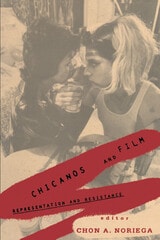
Chicanos And Film
Representation and ResistanceChon A. Noriega
University of Minnesota Press, 1992
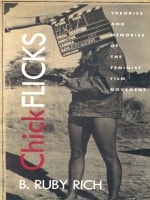
Chick Flicks
Theories and Memories of the Feminist Film MovementB. Ruby Rich
Duke University Press, 1998
For over three decades Rich has been one of the most important voices in feminist film criticism. Her presence at film festivals (such as Sundance, where she is a member of the selection committee), her film reviews in the Village Voice, Elle, Out, and the Advocate, and her commentaries on the public radio program “The World” have secured her a place as a central figure in the remarkable history of what she deems “cinefeminism.” In the hope that a new generation of feminist film culture might be revitalized by reclaiming its own history, Rich introduces each essay with an autobiographical prologue that describes the intellectual, political, and personal moments from which the work arose. Travel, softball, sex, and voodoo all somehow fit into a book that includes classic Rich articles covering such topics as the antiporn movement, the films of Yvonne Rainer, a Julie Christie visit to Washington, and the historically evocative film Maedchen in Uniform. The result is a volume that traces the development not only of women’s involvement in cinema but of one of its key players as well.
The first book-length work from Rich—whose stature and influence in the world of film criticism and theory continue to grow—Chick Flicks exposes unexplored routes and forgotten byways of a past that’s recent enough to be remembered and far away enough to be memorable.
Children of Cuarón
Speculative Futures Through Cinematic FictionMatt Garcia
Rutgers University Press, 2027
Alfonso Cuarón’s Children of Men thrusts readers into a gripping near-future world where environmental collapse and global infertility have fortified borders and torn apart the fabric of society. Its stark depictions of mass deportation, lawless border zones, and the desperate fight for survival echo powerfully through Octavia Butler’s prophetic novels Parable of the Sower and Parable of the Talents, where environmental breakdown, migration, childbirth, and the resilience of women’s bodies form the core of her visionary storytelling. Remarkably, the futures imagined in these works are no longer distant—Butler’s 2024 has arrived, and Cuarón’s 2027 is nearly here. Children of Cuarón: Speculative Futures Through Cinematic Fiction ignites bold, necessary conversations about borders, immigration, and the urgent political, environmental, and social challenges facing our world today. By examining how speculative fiction dares to imagine what comes next, this book invites readers to confront the realities of our present—and the possibilities of our future—with fresh eyes and uncompromising clarity.
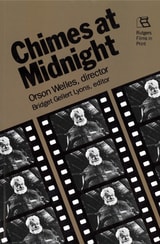
Chimes at Midnight
Orson Welles, DirectorLyons, Bridget G
Rutgers University Press, 1988
This volume offers a complete continuity script of Chimes at Midnight, including its famous battle sequence. Each shot is described in detail and is keyed to the original Shakesperian sources, thus making the volume an invaluable guide to Welles as an adaptor and creator of texts. The first complete transcription of the continuity script of Chimes is accompanied by the editor's critical introduction on Welles's transformation of Shakespeare; a special interview with Keith Baxter, one of the film's principal actors, which discusses its production history; reviews and articles; and a biographical sketch of Welles, a filmography, and a bibliography.

China Forever
The Shaw Brothers and Diasporic CinemaEdited by Poshek Fu
University of Illinois Press, 2007
Chinatown Film Culture
The Appearance of Cinema in San Francisco’s Chinese NeighborhoodKim K. Fahlstedt
Rutgers University Press, 2020

Chinese Cinema
Identity, Power, and GlobalizationEdited by Jeff Kyong-McClain, Russell Meeuf, and Jing Jing Chang
Hong Kong University Press, 2022
In Chinese Cinema: Identity, Power, and Globalization, a variety of scholars explore the history, aesthetics, and politics of Chinese cinema as the Chinese film industry grapples with its place as the second-largest film industry in the world. Exploring the various ways that Chinese cinema engages with global politics, market forces, and film cultures, this edited volume places Chinese cinema against an array of contexts informing the contours of Chinese cinema today. The book also demonstrates that Chinese cinema in the global context is informed by the intersections and tensions found in Chinese and world politics, national and international co-productions, the local and global in representing Chineseness, and the lived experiences of social and political movements versus screened politics in Chinese film culture.
Chinese Connections
Critical Perspectives on Film, Identity, and DiasporaGina Marchetti
Temple University Press, 2009
Chinese Connections is a valuable new anthology that provides a prismatic look at the cross-fertilization between Chinese film and global popular culture. Leading film scholars consider the influence of world cinema on China-related and Chinese-related cinema over the last five decades. Highlighting the neglected connections between Chinese films and American and European cinema, the editors and contributors examine popular works such as Ang Lee’s The Hulk and Olivier Assayas’ Irma Vep to show the nexus of international film production and how national, political, social and sexual identities are represented in the Chinese diaspora.
With talent flowing back and forth between East and West, Chinese Connections explores how issues of immigration, class, race and economic displacement are viewed on a global level, ultimately providing a greater understanding of the impact of Chinese filmmaking at home and abroad.
Contributors include: Grace An, Aaron Anderson, Chris Berry, Evans Chan, Li-Mei Chang, Frances Gateward, Andrew Grossman, Peter Hitchcock, Chuck Kleinhans, Jenny Kwok Wah Lau, Helen Leung, Aaron Magnan-Park, Gayle Wald, Esther C.M. Yau, Emilie Yueh-yu Yeh, Xuelin Zhou and the editors.
Chinese Film
Realism and Convention from the Silent Era to the Digital AgeJason McGrath
University of Minnesota Press, 2022
A tour de force chronicling the development of realism in Chinese cinema
The history of Chinese cinema is as long and complicated as the tumultuous history of China itself. Be it the silent, the Communist, or the contemporary, each Chinese cinematic era has necessitated its own form in conversation with broader trends in politics and culture.
In Chinese Film, Jason McGrath tells this fascinating story by tracing the varied claims to cinematic realism made by Chinese filmmakers, officials, critics, and scholars. Understanding realism as a historical dynamic that is both enabled and mitigated by aesthetic conventions of the day, he analyzes it across six different types of claims: ontological, perceptual, fictional, social, prescriptive, and apophatic.
Through this method, McGrath makes major claims not just about Chinese cinema but also about realism as an aesthetic form that negotiates between cultural conventions and the ever-evolving real. He comes to envision it as more than just a cinematic question, showing how the struggle for realism is central to the Chinese struggle for modernity itself.
Chris Marker
Nora M. Alter
University of Illinois Press, 2006
The maverick filmmaker's personal and political relationships with film
Best known in the United States for his visionary short film La Jetée, Chris Marker spearheaded the bourgeoning Nouvelle Vague scene in the late 1950s. His distinctive style and use of still images place him among the postwar era's most influential European filmmakers. His fearless political cinema, meanwhile, provided a bold model for other activist filmmakers.
Nora M. Alter investigates the core themes and motivations behind an unpredictable and transnational career that defies easy classification. A photographer, multimedia artist, writer, broadcaster, producer, and organizer, Marker cultivated an artistic dynamism and always-changing identity. ""I am an essayist,"" Marker once said, and his 1953 debut filmic essay The Statues Also Die (with Alain Resnais) exposed the European art market's complicity in atrocities in the former Belgian Congo. Ranging geographically as well as artistically, Marker's travels led to films like the classic Sans Soleil and Sunday in Peking. His decades-long struggle against global injustice involved him with Night and Fog, Le Joli Mai, Far from Vietnam, Le fond du l'air est Rouge, and Prime Time in the Camps.
Insightful and revealing, Chris Marker includes interviews with the notoriously private director.
Chris Marker
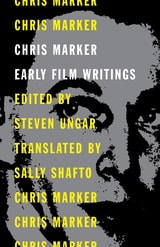
Early Film WritingsChris Marker
University of Minnesota Press, 2024
Formative writings by French avant-garde filmmaker Chris Marker
It is hard to imagine French cinema without La Jetée (1962), the time-travel short feature by the reclusive French filmmaker Christian François Bouche-Villeneuve, better known as Chris Marker. He not only influenced artists ranging from David Bowie to J. G. Ballard but also inspired the cult film 12 Monkeys. Marker’s influence expanded beyond his own films through his writings for the French monthly Esprit as well as anthologies and newly founded film publications.
This first English translation of Marker’s early writings on film brings together reviews and essays, published between 1948 and 1955, that span the topics of film style, adaptation, and ideology, as well as animation and the debates surrounding 3-D and wide-screen technologies, ranging from late silent-era films to postwar Hollywood’s efforts to contend with the rise of television. Readers will find commentary on Laurence Olivier’s 1944 screen adaptation of Henry V, a scathing review of Robert Montgomery’s Lady in the Lake (1947), critiques of Walt Disney productions, a discussion of the pitfalls of prioritizing commercial success over aesthetic values, and more.
An indispensable resource for cinephiles and scholars alike, these texts document the emergence of Marker’s critical voice and situate him alongside such contemporaries as André Bazin and Eric Rohmer, as well as the future French New Wave figures Jean-Luc Godard and François Truffaut. They show how his remarks on individual films open onto his engagement with films as social and cultural phenomena.
Christian Petzold
Jaimey Fisher
University of Illinois Press, 2013
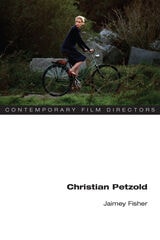
In the first book-length study on Petzold in English, Jaimey Fisher frames Petzold's cinema at the intersection of international art cinema and sophisticated genre cinema. This approach places his work in the context of global cinema and invites comparisons to the work of directors like Pedro Almodovar and Rainer Werner Fassbinder, who repeatedly deploy and reconfigure genre cinema to their own ends. These generic aspects constitute a cosmopolitan gesture in Petzold's work as he interprets and elaborates on cult genre films and popular genres, including horror, film noir, and melodrama. Fisher explores these popular genres while injecting them with themes like terrorism, globalization, and immigration, central issues for European art cinema. The volume also includes an extended original interview with the director about his work.
Christoph Schlingensief
Art without BordersEdited by Tara Forrest and Anna Teresa Scheer
Intellect Books, 2010
The work of acclaimed German artist Christoph Schlingensief spans three decades and a diverse range of fields, including, film, television, activism, opera, and theatre. Christoph Schlingensief: Art Without Borders is the first book to be published in English on Schlingensief’s groundbreaking, politically engaged body of work. Leading scholars in the field offer a critical assessment of Schlingensief’s hybrid practice, and an interview with Schlingensief himself provides the reader with insight into past and present projects. The book will be an essential resource for artists, curators, students, and academics in the fields of theater and performance studies, film studies, cultural studies, German studies, political activism, and art history.
Cindy Sherman's Office Killer
Another Kind of MonsterDahlia Schweitzer
Intellect Books, 2014
The first book on this neglected piece of an esteemed artist’s oeuvre, Cindy Sherman’s “Office Killer” rescues the film from critical oblivion and situates it next to the artist’s other iconic works.
Cine-Ethiopia
The History and Politics of Film in the Horn of AfricaMichael W. Thomas
Michigan State University Press, 2018
Cineaste on Film Criticism, Programming, and Preservation in the New Millennium
Edited by Cynthia Lucia and Rahul Hamid
University of Texas Press, 2017
Digital technology and the Internet have revolutionized film criticism, programming, and preservation in deeply paradoxical ways. The Internet allows almost everyone to participate in critical discourse, but many print publications and salaried positions for professional film critics have been eliminated. Digital technologies have broadened access to filmmaking capabilities, as well as making thousands of older films available on DVD and electronically. At the same time, however, fewer older films can be viewed in their original celluloid format, and newer, digitally produced films that have no “material” prototype are threatened by ever-changing servers that render them obsolete and inaccessible.
Cineaste, one of the oldest and most influential publications focusing on film, has investigated these trends through a series of symposia with the top film critics, programmers, and preservationists in the United States and beyond. This volume compiles several of these symposia: “Film Criticism in America Today” (2000), “International Film Criticism Today” (2005), “Film Criticism in the Age of the Internet” (2008), “Film Criticism: The Next Generation” (2013), “The Art of Repertory Film Exhibition and Digital Age Challenges” (2010), and “Film Preservation in the Digital Age” (2011). It also includes interviews with the late, celebrated New Yorker film critic Pauline Kael and the critic John Bloom (“Joe Bob Briggs”), as well as interviews with the programmers/curators Peter von Bagh and Mark Cousins and with the film preservationist George Feltenstein. This authoritative collection of primary-source documents will be essential reading for scholars, students, and film enthusiasts.
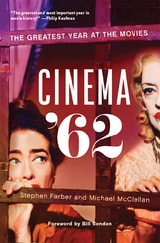
Cinema '62
The Greatest Year at the MoviesStephen Farber
Rutgers University Press, 2024
Lawrence of Arabia, The Miracle Worker, To Kill a Mockingbird, The Manchurian Candidate, Gypsy, Sweet Bird of Youth, The Longest Day, The Music Man, What Ever Happened to Baby Jane, and more.
Most conventional film histories dismiss the early 1960s as a pallid era, a downtime between the heights of the classic studio system and the rise of New Hollywood directors like Scorsese and Altman in the 1970s. It seemed to be a moment when the movie industry was floundering as the popularity of television caused a downturn in cinema attendance. Cinema ’62 challenges these assumptions by making the bold claim that 1962 was a peak year for film, with a high standard of quality that has not been equaled since.
Stephen Farber and Michael McClellan show how 1962 saw great late-period work by classic Hollywood directors like John Ford, Howard Hawks, and John Huston, as well as stars like Bette Davis, James Stewart, Katharine Hepburn, and Barbara Stanwyck. Yet it was also a seminal year for talented young directors like Sidney Lumet, Sam Peckinpah, and Stanley Kubrick, not to mention rising stars like Warren Beatty, Jane Fonda, Robert Redford, Peter O’Toole, and Omar Sharif. Above all, 1962—the year of To Kill a Mockingbird and The Manchurian Candidate—gave cinema attendees the kinds of adult, artistic, and uncompromising visions they would never see on television, including classics from Fellini, Bergman, and Kurosawa. Culminating in an analysis of the year’s Best Picture winner and top-grossing film, Lawrence of Arabia, and the factors that made that magnificent epic possible, Cinema ’62 makes a strong case that the movies peaked in the Kennedy era.
Cinema 1
The Movement-ImageGilles Deleuze
University of Minnesota Press, 1986
Cinema 2
The Time-ImageGilles Deleuze
University of Minnesota Press, 1989
Cinema 2: The Time-Image brings to completion Gilles Deleuze’s work on the theoretical implications of the cinematographic image. In Cinema 1: The Movement-Image, Deleuze proposed a new way to understand narrative cinema, based on Henri Bergson’s notion of the movement-image and C. S. Peirce’s classification of images and signs. In Cinema 2, he explains why, since World War II, time has come to dominate film: the fragment or solitary image, in supplanting narrative cinema’s rational development of events, illustrates this new significance of time.
Deleuze ascribes this shift to the condition of postwar Europe: the situations and spaces “we no longer know how to describe”—buildings deserted but inhabited, cities undergoing demolition or reconstruction—and the new race of characters who emerged from this rubble, mutants, who “saw rather than acted.” Deleuze discusses the films of Rossellini, De Sica, Fellini, Godard, Resnais, Antonioni, Pasolini, Rohmer, Ophuls, and many others, suggesting that contemporary cinema, far from being dead, is only beginning to find new ways to capture time in the image.Cinema Babel
Translating Global CinemaAbe Mark Nornes
University of Minnesota Press, 2007
The original foreign film—its sights and sounds—is available to all, but the viewer is utterly dependent on a translator and an untold number of technicians who produce the graphic text or disconnected speech through which we must approach the foreign film. A bad translation can ruin a film’s beauty, muddy its plot, and turn any joke sour.
In this wide-ranging work, Abé Mark Nornes examines the relationships between moving-image media and translation and contends that film was a globalized medium from its beginning and that its transnational traffic has been greatly influenced by interpreters. He discusses the translation of film theory, interpretation at festivals and for coproductions, silent era practice, “ talkies,” subtitling, and dubbing.
Nornes—who has written subtitles for Japanese cinema—looks at the ways misprision of theory translations produced stylistic change, how silent era lecturers contributed to the construction of national cinemas, how subtitlers can learn from anime fans, and how ultimately interpreters can be, in his terms, “traders or traitors.”
Abé Mark Nornes is associate professor of Asian languages and cultures and film and video studies at the University of Michigan. He is the author of Japanese Documentary Film (Minnesota, 2003) and Forest of Pressure (Minnesota, 2007).
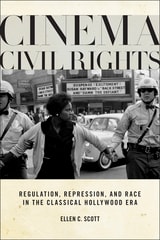
Cinema Civil Rights
Regulation, Repression, and Race in the Classical Hollywood EraScott, Ellen C
Rutgers University Press, 2015
Cinema Futures
Cain, Abel or Cable?: The Screen Arts in the Digital AgeEdited by Kay Hoffmann
Amsterdam University Press, 1998
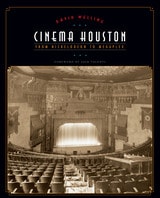
Cinema Houston
From Nickelodeon to MegaplexBy David Welling
University of Texas Press, 2007
Cinema Houston celebrates a vibrant century of movie theatres and moviegoing in Texas's largest city. Illustrated with more than two hundred historical photographs, newspaper clippings, and advertisements, it traces the history of Houston movie theatres from their early twentieth-century beginnings in vaudeville and nickelodeon houses to the opulent downtown theatres built in the 1920s (the Majestic, Metropolitan, Kirby, and Loew's State). It also captures the excitement of the neighborhood theatres of the 1930s and 1940s, including the Alabama, Tower, and River Oaks; the theatres of the 1950s and early 1960s, including the Windsor and its Cinerama roadshows; and the multicinemas and megaplexes that have come to dominate the movie scene since the late 1960s.
While preserving the glories of Houston's lost movie palaces—only a few of these historic theatres still survive—Cinema Houston also vividly re-creates the moviegoing experience, chronicling midnight movie madness, summer nights at the drive-in, and, of course, all those tasty snacks at the concession stand. Sure to appeal to a wide audience, from movie fans to devotees of Houston's architectural history, Cinema Houston captures the bygone era of the city's movie houses, from the lowbrow to the sublime, the hi-tech sound of 70mm Dolby and THX to the crackle of a drive-in speaker on a cool spring evening.
Cinema Illuminating Reality
Media Philosophy through BuddhismVictor Fan
University of Minnesota Press, 2022
A new critical approach to cinema and media based on Buddhism as a philosophical discourse
How can a philosophical discourse generated in Asia help us reframe and renew cinema and media theory? Cinema Illuminating Reality provides a possible way to do this by using Buddhist ideas to examine the intricate relationship between technicity and consciousness in the cinema. The resulting dialogue between Buddhism and Euro-American philosophy is the first of its kind in film and media studies.
Victor Fan examines cinema’s ontology and ontogenetic formation and how such a formational process produces knowledge, political agency, and in-aesthetics. Buddhism allows Fan to deconstruct binary thinking and reimagine media as an ecology, rethinking cinema in relational terms between the human and the machine. Along the way, Fan considers a wide variety of case studies from around the globe, while paying special attention to how contemporary Tibeto-Sinophone filmmakers have adopted relational thinking to detail ways of rebuilding a world that appears to be beyond repair.
From Chinese queer cinema to a reexamination of Japanese master Ozu’s work and its historical reception to Christian Petzold’s 2018 existential thriller Transit, CinemaIlluminating Reality forges a remarkable path between Buddhist studies and cinema studies, casting vital new light on both of these important subjects.

Cinema India
The Visual Culture of Hindi FilmRachel Dwyer and Divia Patel
Rutgers University Press, 2002
The economic influence of advertising in actually determining film content and the dissemination of its imagery are also discussed. Film studies scholars recently have begun to investigate advertising in the film industry and this book makes an important contribution to this emerging subfield in its engagement with Indian cinema and the impact of advertising on the culture at large.
Cinema Novo x 5
Masters of Contemporary Brazilian FilmBy Randal Johnson
University of Texas Press, 1984
With such stunning films as Dona Flor and Her Two Husbands, Bye Bye Brazil, and Pixote, Brazilian cinema achieved both critical acclaim and popular recognition in the 1970s and 1980s, becoming the premier cinema of Latin America and one of the largest film producers in the western world. But the success of Brazilian film at home and abroad came after many years of struggle by filmmakers determined to create a strong film industry in Brazil. At the forefront of this struggle were the filmmakers of Cinema Novo, the internationally acclaimed movement whose flowering in the 1960s marked the birth of modern Brazilian film.
Cinema Novo x 5 places the success of Brazilian cinema in perspective by examining the films of the five leaders of this groundbreaking movement—Andrade, Diegues, Guerra, Rocha, and dos Santos. By exploring the individuality of these masters of contemporary Brazilian film, Randal Johnson reveals the astonishing stylistic and thematic diversity of Cinema Novo. His emphasis is on the films themselves, as well as their makers’ distinctive cinematic vision and views of what cinema should be and is. At the same time, he provides a wealth of valuable background information to enhance readers’ understanding of the historical, cultural, and economic context in which Cinema Novo was born and flourished.
Cinema Today
A Conversation with Thirty-nine Filmmakers from around the WorldOumano, Elena
Rutgers University Press, 2011
Can't spare the time from work or class? Travel expense too great? What? You can't even find such a collaborative event?
Then imagine curling up with a good book, maybe a shot of espresso in hand, and becoming engrossed in the exciting and informative conversation that Elena Oumano has ingeniously crafted from her personal and individual interviews with these artists. Straying far from the usual choppy question-and-answer format, Cinema Today saves you from plowing through another tedious read, in which the same topics and issues are directed to each subject, over and over-an experience that is like being trapped in a revolving door.
Oumano stops that revolving door by following a lively symposium-in-print format, with the filmmakers' words and thoughts grouped together under various key cinema topics. It is as though these experts are speaking to each other and you are their audience--collectively they reflect on and explore issues and concerns of modern filmmaking, from the practical to the aesthetic, including the process, cinematic rhythm and structure, and the many aspects of the media: business, the viewer, and cinema's place in society. Whether you are a movie lover, a serious student of cinema, or simply interested in how we communicate in today's global village through films that so profoundly affect the world, Cinema Today is for you.
Cinema and Landscape
Edited by Graeme Harper and Jonathan Rayner
Intellect Books, 2010
The notion of landscape is a complex one, but it has been central to the art and artistry of the cinema. After all, what is the French New Wave without Paris? What are the films of Sidney Lumet, Woody Allen, Martin Scorsese, and Spike Lee without New York? Cinema and Landscape frames contemporary film landscapes across the world, in an exploration of screen aesthetics and national ideology, film form and cultural geography, cinematic representation and the human environment. Written by well-known cinema scholars, this volume both extends the existing field of film studies and stakes claims to overlapping, contested territories in the humanities and social sciences.
Cinema and Modernity
Pomerance, Murray
Rutgers University Press, 2006
The modern impulse gave us captivating technology and dark anxiety, rampant mobility and a world filled with strangers, the futuristic city and a fragmentation of experience. Motion pictures––the quintessence of modernism––entered into this cultural, technical, and philosophical richness with a vast public appeal and a jarring new vision of what life could be.
In Cinema and Modernity, Murray Pomerance brings together new essays by seventeen leading scholars to explore the complexity of the essential connection between film and modernity. Among the many films considered are Detour, Shock Corridor, The Last Laugh, Experiment in Terror, The Great Dictator, Leave Her to Heaven, The Talented Mr. Ripley, Eyes Wide Shut, Sunrise, The Crowd, The Shape of Things to Come, The War of the Worlds, The Day the Earth Stood Still, Scarlet Street, Shadow of a Doubt, Stella Dallas, The Blue Angel, Sullivan’s Travels, and Catch Me If You Can.
Cinema and Painting
How Art Is Used in FilmBy Angela Dalle Vacche
University of Texas Press, 1996
The visual image is the common denominator of cinema and painting, and indeed many filmmakers have used the imagery of paintings to shape or enrich the meaning of their films. In this discerning new approach to cinema studies, Angela Dalle Vacche discusses how the use of pictorial sources in film enables eight filmmakers to comment on the interplay between the arts, on the dialectic of word and image, on the relationship between artistic creativity and sexual difference, and on the tension between tradition and modernity.
Specifically, Dalle Vacche explores Jean-Luc Godard's iconophobia (Pierrot Le Fou) and Andrei Tarkovsky's iconophilia (Andrei Rubleov), Kenji Mizoguchi's split allegiances between East and West (Five Women around Utamaro), Michelangelo Antonioni's melodramatic sensibility (Red Desert), Eric Rohmer's project to convey interiority through images (The Marquise of O), F. W. Murnau's debt to Romantic landscape painting (Nosferatu), Vincente Minnelli's affinities with American Abstract Expressionism (An American in Paris), and Alain Cavalier's use of still life and the close-up to explore the realms of mysticism and femininity (Thérèse).
While addressing issues of influence and intentionality, Dalle Vacche concludes that intertextuality is central to an appreciation of the dialogical nature of the filmic medium, which, in appropriating or rejecting art history, defines itself in relation to national traditions and broadly shared visual cultures.
Cinema and Social Change in Latin America
Conversations with FilmmakersEdited by Julianne Burton
University of Texas Press, 1986
Since the late 1960s, films from Latin America have won widening audiences in North America and Europe. Until now, no single book has offered an introduction to the diverse personalities and practices that make up this important regional film movement.
In Cinema and Social Change in Latin America, Julianne Burton presents twenty interviews with key figures of Latin American cinema, covering three decades and ranging from Argentina to Mexico. Interviews with pioneers Fernando Birri, Nelson Pereira dos Santos, and Glauber Rocha, renowned feature filmmakers Tomás Gutiérrez Alea and Carlos Diegues, prize-winning documentarists Patricio Guzmán and Helena Solberg-Ladd, among others, endeavor to balance personal achievement against the backdrop of historical, political, social, and economic circumstances that have influenced each director's career. Presented also are conversations that cast light on the related activities of acting, distribution, theory, criticism, and film-based community organizing.
More than their counterparts in other regions of the world, Latin American artists and intellectuals acknowledge the degree to which culture is shaped by history and politics. Since the mid-1950s, a period of rising nationalism and regional consciousness, talented young artists and activists have sought to redefine the uses of the film medium in the Latin American context. Questioning the studio and star systems of the Hollywood industrial model, these innovators have developed new forms, content, and processes of production, distribution, and reception.
The specific approaches and priorities of the New Latin American Cinema are far from monolithic. They vary from realism to expressionism, from observational documentary to elaborate fictional constructs, from "imperfect cinema" to a cinema that emulates the high production values of the developed sectors, from self-reflexive to "transparent" cinematic styles, from highly industrialized modes of production to purely artisanal ones. What does not vary is the commitment to film as a vehicle for social transformation and the expression of national and regional cultural autonomy.
From early alternative cinema efforts in Argentina, Brazil, and Cuba to a contemporary perspective from within the Mexican commercial industry to the emerging cinema and video production from Central America, Cinema and Social Change in Latin America offers the most comprehensive look at Latin American film available today.