Results by title
67 books match the query 'Fish, Stanley' and 7 start with c
Chicana Feminisms
A Critical ReaderGabriela F. Arredondo, Aida Hurtado, Norma Klahn, Olga Nájera-Ramírez, and Patricia Zavella, eds.
Duke University Press, 2003
The contributors contemplate a number of facets of Chicana experience: life on the Mexico-U.S. border, bilingualism, the problems posed by a culture of repressive sexuality, the ranchera song, and domesticana artistic production. They also look at Chicana feminism in the 1960s and 1970s, the history of Chicanas in the larger Chicano movement, autobiographical writing, and the interplay between gender and ethnicity in the movie Lone Star. Some of the essays are expansive; others—such as Norma Cantú’s discussion of the writing of her fictionalized memoir Canícula—are intimate. All are committed to the transformative powers of critical inquiry and feminist theory.
Contributors. Norma Alarcón, Gabriela F. Arredondo, Ruth Behar, Maylei Blackwell, Norma E. Cantú, Sergio de la Mora, Ann duCille, Michelle Fine, Rosa Linda Fregoso, Rebecca M. Gámez, Jennifer González, Ellie Hernández, Aída Hurtado, Claire Joysmith, Norma Klahn, Amalia Mesa-Bains, Olga Nájera-Ramírez, Anna Nieto Gomez, Renato Rosaldo, Elba Rosario Sánchez, Marcia Stephenson, Jose Manuel Valenzuela, Patricia Zavella
Chinese Modern
The Heroic and the QuotidianXiaobing Tang
Duke University Press, 2000
Tang uncovers crucial clues to modern Chinese literary and cultural practices through readings of Wu Jianren’s 1906 novel The Sea of Regret and works by canonical writers Lu Xun, Ding Ling, and Ba Jin. For the midcentury, he broadens his investigation by considering theatrical, cinematic, and visual materials in addition to literary texts. His reading of the 1963 play The Young Generation reveals the anxiety and terror underlying the exhilarating new socialist life portrayed on the stage. This play, enormously influential when it first appeared, illustrates the utopian vision of China’s lyrical age and its underlying discontents—both of which are critical for understanding late-twentieth-century China. Tang closes with an examination of post–Cultural Revolution nostalgia for the passion of the lyrical age.
Throughout Chinese Modern Tang suggests a historical and imaginative affinity between apparently separate literatures and cultures. He thus illuminates not only Chinese modernity but also the condition of modernity as a whole, particularly in light of the postmodern recognition that the market and commodity culture are both angel and devil.
This elegantly written volume will be invaluable to students of China, Asian studies, literary criticism, and cultural studies, as well as to readers who study modernity.
Class Fictions
Shame and Resistance in the British Working Class Novel, 1890–1945Pamela Fox
Duke University Press, 1994
With a focus on certain classics in the working-class literary "canon," such as The Ragged Trousered Philanthropists and Love on the Dole, as well as lesser-known texts by working-class women, Fox uncovers the anxieties that underlie representations of class and consciousness. Shame repeatedly emerges as a powerful counterforce in these works, continually unsettling the surface narrative of protest to reveal an ambivalent relation toward the working-class identities the novels apparently champion.
Class Fictions offers an equally rigorous analysis of cultural studies itself, which has historically sought to defend and value the radical difference of working-class culture. Fox also brings to her analysis a strong feminist perspective that devotes considerable attention to the often overlooked role of gender in working-class fiction. She demonstrates that working-class novels not only expose master narratives of middle-class culture that must be resisted, but that they also reveal to us a need to create counter narratives or formulas of working-class life. In doing so, this book provides a more subtle sense of the role of resistance in working class culture. While of interest to scholars of Victorian and working-class fiction, Pamela Fox’s argument has far-reaching implications for the way literary and cultural studies will be defined and practiced.
Colonial Fantasies
Conquest, Family, and Nation in Precolonial Germany, 1770-1870Susanne Zantop
Duke University Press, 1997
From as early as the sixteenth century, Germans preoccupied themselves with an imaginary drive for colonial conquest and possession that eventually grew into a collective obsession. Zantop illustrates the gendered character of Germany’s colonial imagination through critical readings of popular novels, plays, and travel literature that imagine sexual conquest and surrender in colonial territory—or love and blissful domestic relations between colonizer and colonized. She looks at scientific articles, philosophical essays, and political pamphlets that helped create a racist colonial discourse and demonstrates that from its earliest manifestations, the German colonial imagination contained ideas about a specifically German national identity, different from, if not superior to, most others.
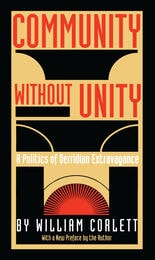
Community Without Unity
A Politics of Derridian ExtravaganceWilliam Corlett
Duke University Press, 1989
Now available in paperback with a new preface by the author, this award-winning book breaks new ground by challenging traditional concepts of community in political theory. William Corlett brings the diverse (and sometimes contradictory) work of Foucault and Derrida to bear on the thought of Pocock, Burke, Lincoln, and McIntyre, among others, to move beyond the conventional dichotomy of "individual vs. community," arguing instead that community is best advanced within a politics of difference.
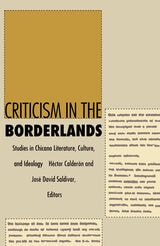
Criticism in the Borderlands
Studies in Chicano Literature, Culture, and IdeologyHéctor Calderón and José David Saldívar, eds.
Duke University Press, 1991
The editors have organized essays around four board themes: the situation of Chicano literary studies within American literary history and debates about the “canon”; representations of the Chicana/o subject; genre, ideology, and history; and the aesthetics of Chicano literature. The volume as a whole aims at generating new ways of understanding what counts as culture and “theory” and who counts as a theorist. A selected and annotated bibliography of contemporary Chicano literary criticism is also included.
By recovering neglected authors and texts and introducing readers to an emergent Chicano canon, by introducing new perspectives on American literary history, ethnicity, gender, culture, and the literary process itself, Criticism in the Borderlands is an agenda-setting collection that moves beyond previous scholarship to open up the field of Chicano literary studies and to define anew what is American literature.
Contributors. Norma Alarcón, Héctor Calderón, Angie Chabram, Barbara Harlow, Rolando Hinojosa, Luis Leal, José E. Limón, Terese McKenna, Elizabeth J. Ordóñez, Genero Padilla, Alvina E. Quintana, Renato Rosaldo, José David Saldívar, Sonia Saldívar-Hull, Rosaura Sánchez, Roberto Trujillo
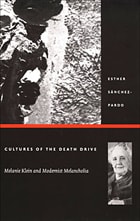
Cultures of the Death Drive
Melanie Klein and Modernist MelancholiaEsther Sánchez-Pardo
Duke University Press, 2003
Sánchez-Pardo argues that the troubled political atmosphere leading to both world wars created a melancholia fueled by “cultures of the death drive” and the related specters of object loss—loss of coherent and autonomous selves, of social orders where stability reigned, of metaphysical guarantees, and, in some cases, loss and fragmentation of empire. This melancholia permeated, and even propelled, modernist artistic discourses. Sánchez-Pardo shows how the work of Melanie Klein, the theorist of melancholia par excellence, uniquely illuminates modernist texts, particularly their representations of gender and sexualities. She offers a number of readings—of works by Virginia Woolf, René Magritte, Lytton Strachey, Djuna Barnes, and Countee Cullen—that reveal the problems melancholia posed for verbal and visual communication and the narrative and rhetorical strategies modernist artists derived to either express or overcome them. In her afterword, Sánchez-Pardo explicates the connections between modernist and contemporary melancholia.
A valuable contribution to psychoanalytic theory, gender and sexuality studies, and the study of representation in literature and the visual arts, Cultures of the Death Drive is a necessary resource for those interested in the work of Melanie Klein.