Results by title
835 books match the query 'France' and 51 start with c

C'est la Guerre
Louis Calaferte
Northwestern University Press, 1999

COALITION GOVERNMENT, SUBNATIONAL STYLE
Multiparty Politics in Europe’s Regional ParliamentsWilliam M. Downs
The Ohio State University Press, 1998
Coalition Government, Subnational Style examines parliamentary democracy in subnational legislative assemblies. Comparing three different European democracies—Germany, France, and Belgium—William M. Downs provides a powerful account of the ways politicians and political parties negotiate the composition of new governments following elections in which no single party wins a clear majority.
Downs argues that postelection alliance building is a window onto many of the political processes fundamental to representative democracy: the interpretations of electoral verdicts; the compromises of campaign pledges; the trade-offs between policy and power; the temporary cooperation between long-term adversaries; the collective decision making; and the blurring of lines of accountability through collective responsibility.
The study reports findings from an unprecedented collection of information, including cross-national survey responses, interviews with political elites, and three decades of postelection studies of coalition building in the German state parliaments, the French regional assemblies, and the Belgian provincial councils and regional parliaments. Coalition Government, Subnational Style conclusively demonstrates that the struggles for government status at subnational levels are profoundly important to both parties and voters and that the outcomes of these struggles can result in governments of varying political complexions. Downs's findings question key assumptions of democratic theory and raise important concerns about individual and organizational behavior in changing institutional and electoral environments, ultimately allowing for a deeper understanding of representation, power, and cooperation outside the more familiar arena of national parliamentary politics.

Cadaverland
Inventing a Pathology of Catastrophe for Holocaust Survival [The Limits of Medical Knowledge and Historical Memory in France]Michael Dorland
Brandeis University Press, 2009

Cages of Reason
The Rise of the Rational State in France, Japan, the United States, and Great BritainBernard S. Silberman
University of Chicago Press, 1993
Whereas Weber contends that the administration of all modern nation-states would eventually converge in one form characterized by rationality and legal authority, Silberman argues that the process of bureaucratic rationalization took, in fact, two courses. One path is characterized by permeable organizational boundaries and the allocation of information by "professionals." The other features well-defined boundaries and the allocation of information by organizational rules. Through case studies of France, Japan, the United States, and Great Britain, Silberman demonstrates that this divergence stems from differences in leadership structure and in levels of uncertainty about leadership succession in the nineteenth century.
Silberman concludes that the rise of bureacratic rationality was primarily a response to political problems rather than social and economic concerns. Cages of Reason demonstrates how rationalization can have occurred over a wide range of cultures at various levels of economic development. It will be of considerable interest to readers in a number of disciplines: political science, sociology, history, and public administration.
"Silberman has produced an invaluable, densely packed work that those with deep knowledge of public administrative development will find extremely rewarding." —David H. Rosenbloom, American Political Science Review
"An erudite, incisive, and vibrant book, the product of intensive study and careful reflection. Given its innovative theoretical framework and the wealth of historical materials contained in it, this study will generate debate and stimulate research in sociology, political science, and organizational theory. It is undoubtedly the best book on the comparative evolution of the modern state published in the last decade."—Mauro F. Guillen, Contemporary Sociology
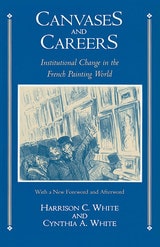
Canvases and Careers
Institutional Change in the French Painting WorldHarrison C. White and Cynthia A. White
University of Chicago Press, 1993
Originally published in 1965, this ground-breaking work is a classic piece of empirical research in the sociology of art. In this edition, Harrison C. White's new Foreword compares the marketing approaches of two contemporary painters, while Cynthia A. White's new Afterword reviews recent scholarship in the field.
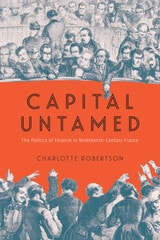
Capital Untamed
The Politics of Finance in Nineteenth-Century FranceCharlotte Robertson
University of Chicago Press, 2026
The story of a bold political experiment in nineteenth-century France to establish power through finance.
Amid the rise of industrial capitalism and revolutionary upheaval, French reformers asserted that finance should be reimagined as an instrument of economic and social transformation rather than left to the logic of private profit and speculation. In the 1850s, under Napoleon III’s authoritarian regime, this vision took institutional form as the Bonapartist state strategically deployed finance, broadened market participation, and sponsored new banks with the promise of directing investment toward infrastructure and industry. Yet this effort to harness and mobilize capital ran into a problem: The financial markets refused to be tamed.
Drawing on rich archival sources—from police surveillance and courtroom transcripts to investment manuals and petitions for incorporation—Capital Untamed reveals how the financial markets became an instrument of political power, frustrated state ambitions, and ultimately escaped attempts at mastery. In this striking debut, historian Charlotte Robertson shows how the French state and its citizens navigated a turbulent era of European capitalism animated by debates over the social purpose of financial capital. Ultimately, politicians’ efforts to establish legitimacy by reorganizing finance—and their confrontations with the limits of that project—set the stage for a form of modern discontent with the financial system that survives to this day.
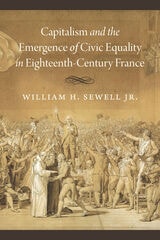
Capitalism and the Emergence of Civic Equality in Eighteenth-Century France
William H. Sewell Jr.
University of Chicago Press, 2021
William H. Sewell Jr. argues that the flourishing of commercial capitalism in eighteenth-century France introduced a new independence, flexibility, and anonymity to French social life. By entering the interstices of this otherwise rigidly hierarchical society, expanded commodity exchange colored everyday experience in ways that made civic equality thinkable, possible, even desirable, when the crisis of the French Revolution arrived. Sewell ties together masterful analyses of a multitude of interrelated topics: the rise of commerce, the emergence of urban publics, the careers of the philosophes, commercial publishing, patronage, political economy, trade, and state finance. Capitalism and the Emergence of Civic Equality in Eighteenth-Century France offers an original interpretation of one of history’s pivotal moments.

Carnal Art
Orlan’s RefacingC. Jill O'Bryan
University of Minnesota Press, 2005

Cartography in France, 1660-1848
Science, Engineering, and StatecraftJosef Konvitz
University of Chicago Press, 1987
Concentrating on how and why new concepts and techniques of making and using maps were introduced, Josef Konvitz skillfully traces the modernization of cartography during the French Enlightenment. The story he unfolds is not merely a narrative of who did what, but an analysis of how the map itself influenced attitudes toward the land and the consequent effects on planning and the development of resources. Throughout, Konvitz demonstrates the significant relationship between cartography and political, economic, and military life. He emphasizes efforts to enlarge the practical applications of maps in government and the impact of government policy on the evolution of cartography.

Cartophilia
Maps and the Search for Identity in the French-German BorderlandCatherine Tatiana Dunlop
University of Chicago Press, 2015
Turning to a previously undiscovered archive of popular maps, Cartophilia reveals Alsace-Lorraine’s lively world of citizen mapmakers that included linguists, ethnographers, schoolteachers, hikers, and priests. Together, this fresh group of mapmakers invented new genres of maps that framed French and German territory in original ways through experimental surveying techniques, orientations, scales, colors, and iconography. In focusing on the power of “bottom-up” maps to transform modern European identities, Cartophilia argues that the history of cartography must expand beyond the study of elite maps and shift its emphasis to the democratization of cartography in the modern world.

Casanova's Lottery
The History of a Revolutionary Game of ChanceStephen M. Stigler
University of Chicago Press, 2022
In the 1750s, at the urging of famed adventurer Giacomo Casanova, the French state began to embrace risk in adopting a new Loterie. The prize amounts paid varied, depending on the number of tickets bought and the amount of the bet, as determined by each individual bettor. The state could lose money on any individual Loterie drawing while being statistically guaranteed to come out on top in the long run. In adopting this framework, the French state took on risk in a way no other has, before or after. At each drawing the state was at risk of losing a large amount; what is more, that risk was precisely calculable, generally well understood, and yet taken on by the state with little more than a mathematical theory to protect it.
Stephen M. Stigler follows the Loterie from its curious inception through its hiatus during the French Revolution, its renewal and expansion in 1797, and finally to its suppression in 1836, examining throughout the wider question of how members of the public came to trust in new financial technologies and believe in their value. Drawing from an extensive collection of rare ephemera, Stigler pieces together the Loterie’s remarkable inner workings, as well as its implications for the nature of risk and the role of lotteries in social life over the period 1700–1950.
Both a fun read and fodder for many fields, Casanova's Lottery shines new light on the conscious introduction of risk into the management of a nation-state and the rationality of playing unfair games.
Cash, Crisis, and Corporate Governance
The Role of National Financial Systems in Industrial RestructuringVictoria Marklew
University of Michigan Press, 1995

Catching Nature in the Act
Réaumur and the Practice of Natural History in the Eighteenth CenturyMary Terrall
University of Chicago Press, 2014
At the center of Terrall’s study is René-Antoine Ferchault de Réaumur (1683–1757)—the definitive authority on natural history in the middle decades of the eighteenth century—and his many correspondents, assistants, and collaborators. Through a close examination of Réaumur’s publications, papers, and letters, Terrall reconstructs the working relationships among these naturalists and shows how observing, collecting, and experimenting fit into their daily lives. Essential reading for historians of science and early modern Europe, Catching Nature in the Act defines and excavates a dynamic field of francophone natural history that has been inadequately mined and understood to date.

Cezanne and the End of Impressionism
A Study of the Theory, Technique, and Critical Evaluation of Modern ArtRichard Shiff
University of Chicago Press, 1984
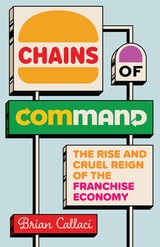
Chains of Command
The Rise and Cruel Reign of the Franchise EconomyBrian Callaci
University of Chicago Press, 2026
A surprising look at the big business of owning small businesses and what America’s franchise economy means for its workers.
Walk into a McDonald’s anywhere in the United States, and it will be identical to every other McDonald’s in the country. Yet, that particular store is almost certainly owned and operated by an “independent” franchisee. While McDonald’s presents an image of centralized uniformity to the consumer, it shows a different face to the small business owners operating its stores under its control and the workers preparing its product to its standards. How then does McDonald’s—and its big business peers—manage to be two things at once?
In this revelatory work, economist Brian Callaci shows how franchisors have altered the legal treatment of corporations in their favor through a decades-long crusade of lobbying and litigation. Their efforts subsequently unleashed a slew of legal and economic sins upon the US economy and labor force, allowing multinational corporations to control continent-spanning empires while outsourcing employment and scapegoating legal responsibilities onto small businesses. The result: the unfettered growth of some of America’s most recognizable businesses, at the aggregate expense of America’s workers.
Remarkable in both its scale and synthesis, Callaci’s story is the first chronicle of this business movement—initially resisted by US courts before experiencing a dramatic reversal of fortune after decades of campaigning by some of America’s most established entrepreneurs. An urgent and erudite history, Chains of Command reveals how the US labor market was tamed one small business at a time.
Chamfort
A BiographyClaude Arnaud
University of Chicago Press, 1992

Changing Identities in Early Modern France
Michael Wolfe, ed.
Duke University Press, 1997
After examining the interplay between competing ideologies and public institutions, from the monarchy to the Parlement of Paris to the aristocratic household, the volume explores the dynamics of deviance and dissent, particularly in regard to women’s roles in religious reform movements and such sensationalized phenomena as the witch hunts and infanticide trials. Concluding essays examine how regional and confessional identities reshaped French identity in response to the discovery of the New World and the spectacular spread of Calvinism.
Contributors. Charmarie Blaisdell, William Bouwsma, Lawrence M. Bryant, Denis Crouzet, Robert Descimon, Barbara B. Diefendorf, Richard M. Golden, Sarah Hanley, Mack P. Holt, Donald R. Kelley, Kristen B. Neuschel, J. H. M. Salmon, Zachary Sayre Schiffman, Silvia Shannon, Alfred Soman, Michael Wolfe

Charlotte Delbo
A Life ReclaimedGhislaine Dunant, Translated by Kathryn M. Lachman
University of Massachusetts Press, 2021
Ghislaine Dunant's unforgettable biography of Delbo, La vie retrouvée (2016), captivated French readers and was awarded the Prix Femina. Now translated into English for the first time, Charlotte Delbo: A Life Reclaimed depicts Delbo's lifelong battles as a working-class woman, as a survivor, as a leftist who broke from the Communist Party, and most of all, as a writer whose words compelled others to see.

Chateaubriand Across Empires
Fabienne Moore
Bucknell University Press, 0
What happens when the liberty of ancient nobility collides with the revolutionary ideals of equality? This groundbreaking study explores how the American, French, Haitian, and Greek Revolutions redefined freedom—and how French Romantic figure Chateaubriand grappled with that transformation. Tracing his travels across England, North America, and the Mediterranean, this book uncovers Chateaubriand’s seductive visions of “paradises lost,” which were taken up, challenged, and reimagined by Anglophone and Hispanic writers.
From Charlotte Brontë to Harriet Beecher Stowe, from Byron to Bolaño authors found in Chateaubriand a conflicted but powerful voice at the crossroads of liberty, race, religion, and empire. This is the first comprehensive study to situate Chateaubriand within the histories of colonialism and global revolution, revealing a literary legacy that remains startlingly relevant in today’s struggles over equality.
Published by Bucknell University Press. Distributed worldwide by Rutgers University Press.

Cheffes de Cuisine
Women and Work in the Professional French KitchenRachel E. Black
University of Illinois Press, 2021
Works of Distinction, LDEI M.F.K. Fisher Prize for Excellence in Culinary Media Content, 2022
A rare woman’s-eye-view of working in the professional French kitchen
Though women enter France’s culinary professions at higher rates than ever, men still receive the lion’s share of the major awards and Michelin stars. Rachel E. Black looks at the experiences of women in Lyon to examine issues of gender inequality in France’s culinary industry. Known for its female-led kitchens, Lyon provides a unique setting for understanding the gender divide, as Lyonnais women have played a major role in maintaining the city’s culinary heritage and its status as a center for innovation. Voices from history combine with present-day interviews and participant observation to reveal the strategies women use to navigate male-dominated workplaces or, in many cases, avoid men in kitchens altogether. Black also charts how constraints imposed by French culture minimize the impact of #MeToo and other reform-minded movements.
Evocative and original, Cheffes de Cuisine celebrates the successes of women inside the professional French kitchen and reveals the obstacles women face in the culinary industry and other male-dominated professions.
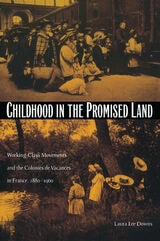
Childhood in the Promised Land
Working-Class Movements and the Colonies de Vacances in France, 1880–1960Laura Lee Downs
Duke University Press, 2002
At the heart of the study lie the municipal colonies de vacances, organized by the working-class cities of the Paris red belt. Located in remote villages or along the more inexpensive stretches of the Atlantic coast, the municipal colonies gathered their young clientele into variously structured "child villages," within which they were to live out particular, ideal visions of the collective life of children throughout the long summer holiday. Focusing on the creation of and participation in these summer camps, Laura Lee Downs presents surprising insights into the location and significance of childhood in French working-class cities and, ultimately, within the development of modern France.
Drawing on a rich array of historical sources, including dossiers and records of municipal colonies discovered in remote town halls of the Paris suburbs, newspaper accounts, and interviews with adults who participated in the colonies as children, Downs reveals how diverse groups—including local Socialist and Communist leaders and Catholic seminarians—seized the opportunity to shape the minds and bodies of working-class youth. Childhood in the Promised Land shows how, in creating the summer camps, these various groups combined pedagogical theories, religious convictions, political ideologies, and theories about the relationship between the countryside and children's physical and cognitive development. At the same time, the book sheds light on classic questions of social control, highlighting the active role of the children in shaping their experiences.
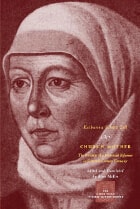
Church Mother
The Writings of a Protestant Reformer in Sixteenth-Century GermanyKatharina Schütz Zell
University of Chicago Press, 2006
Though a commoner, Schütz Zell participated actively in public life and wrote prolifically, including letters of consolation, devotional writings, biblical meditations, catechetical instructions, a sermon, and lengthy polemical exchanges with male theologians. The complete translations of her extant publications, except for her longest, are collected here in Church Mother, offering modern readers a rare opportunity to understand the important work of women in the formation of the early Protestant church.

Cine-Ethnography
Jean Rouch
University of Minnesota Press, 2003

Cinema, Colonialism, Postcolonialism
Perspectives from the French and Francophone WorldsEdited by Dina Sherzer
University of Texas Press, 1996
In this first major study of French colonial and postcolonial cinema, Dina Sherzer compiles essays by some of the foremost scholars on the subject who interrogate and analyze the realities behind the images of the nation's past and present. Through an examination of France and its colonies, multiethnic contemporary France, and cinematic discourses which have been and are being produced about France's colonial past, these authors explore how the images relay underlying assumptions and their relation to historical and political facts. A variety of subjects and viewpoints inform these studies, which cover the entire range of films on that topic.
The authors expound upon the role French and Francophone films are currently playing in reconstructing and imagining France's colonial past. Not only do the essays examine how French cinema has represented the encounter of French citizens with individuals from former colonies during the colonial era; they examine how French cinema has portrayed and has come to terms with the immigration of former colonial subjects to France. In addition, the book features another postcolonial facet by analyzing films of directors from the former colonies who give their own representation of colonialism and presentation of their culture.
This study is a major contribution to postcolonial research. Race, gender, and geography are central themes throughout this book that presents innovative material that contributes to the history of French cinema and emphasizes how cinema participates in and is a part of national culture.

Citoyennes
Women and the Ideal of Citizenship in Eighteenth-Century FranceAnnie K. Smart
University of Delaware Press, 2012
Did women have a civic identity in eighteenth-century France? In Citoyennes: Women and the Ideal of Citizenship in Eighteenth-Century France, Annie Smart contends that they did. While previous scholarship has emphasized the ideal of domestic motherhood or the image of the republican mother, Smart argues persuasively that many pre-revolutionary and revolutionary texts created another ideal for women–the ideal of civic motherhood. Smart asserts that women were portrayed as possessing civic virtue, and as promoting the values and ideals of the public sphere.
Contemporary critics have theorized that the eighteenth-century ideal of the Republic intentionally excluded women from the public sphere. According to this perspective, a discourse of “Rousseauean” domestic motherhood stripped women of an active civic identity, and limited their role to breastfeeding and childcare. Eighteenth-century France marked thus the division between a male public sphere of political action and a female private sphere of the home.
Citoyennes challenges this position and offers an alternative model of female identity. This interdisciplinary study brings together a variety of genres to demonstrate convincingly that women were portrayed as civic individuals. Using foundational texts such as Jean-Jacques Rousseau’s Emile, or on Education (1762), revolutionary gouaches of Lesueur, and vaudeville plays of Year II of the Republic (1793/1794), this study brilliantly shows that in text and image, women were represented as devoted to both the public good and their families.
In addition, Citoyennes offers an innovative interpretation of the home. Through re-examining sphere theory, this study challenges the tendency to equate the home with private concerns, and shows that the home can function as a site for both private life and civic identity.
Citoyennes breaks new ground, for it both rectifies the ideal of domestic Rousseauean motherhood, and brings a fuller understanding to how female civic identity operated in important French texts and images.
Published by University of Delaware Press. Distributed worldwide by Rutgers University Press.
City of Noise
Sound and Nineteenth-Century ParisAimee Boutin
University of Illinois Press, 2015
Aimée Boutin tours the sonic space that orchestrated the different, often conflicting sound cultures that defined the street ambience of Paris. Mining accounts that range from guidebooks to verse, Boutin braids literary, cultural, and social history to reconstruct a lost auditory environment. Throughout, impressions of street noise shape writers' sense of place and perception of modern social relations. As Boutin shows, the din of the Cris contrasted economic abundance with the disparities of the capital, old and new traditions, and the vibrancy of street commerce with an increasing bourgeois demand for quiet. In time, peddlers who provided the soundtrack for Paris's narrow streets yielded to modernity, with its taciturn shopkeepers and wide-open boulevards, and the fading songs of the Cris became a dirge for the passing of old ways.
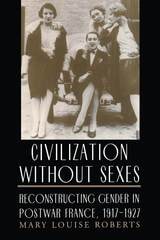
Civilization without Sexes
Reconstructing Gender in Postwar France, 1917-1927Mary Louise Roberts
University of Chicago Press, 1994
In sources as diverse as parliamentary records, newspaper articles, novels, medical texts, writings on sexology, and vocational literature, Roberts discovers a central question: how to come to terms with rapid economic, social, and cultural change and articulate a new order of social relationships. She examines the role of French trauma concerning the War in legislative efforts to ban propaganda for abortion and contraception, and explains anxieties about the decline of maternity by a crisis in gender relations that linked soldiery, virility, and paternity.
Through these debates, Roberts locates the seeds of actual change. She shows how the willingness to entertain, or simply the need to condemn, nontraditional gender roles created an indecisiveness over female identity that ultimately subverted even the most conservative efforts to return to traditional gender roles and irrevocably altered the social organization of gender in postwar France.

Claude Levi-Strauss
Edmund Leach
University of Chicago Press, 1989

Colonial Madness
Psychiatry in French North AfricaRichard C. Keller
University of Chicago Press, 2007
Nineteenth-century French writers and travelers imagined Muslim colonies in North Africa to be realms of savage violence, lurid sexuality, and primitive madness. Colonial Madness traces the genealogy and development of this idea from the beginnings of colonial expansion to the present, revealing the ways in which psychiatry has been at once a weapon in the arsenal of colonial racism, an innovative branch of medical science, and a mechanism for negotiating the meaning of difference for republican citizenship.
Drawing from extensive archival research and fieldwork in France and North Africa, Richard Keller offers much more than a history of colonial psychology. Colonial Madness explores the notion of what French thinkers saw as an inherent mental, intellectual, and behavioral rift marked by the Mediterranean, as well as the idea of the colonies as an experimental space freed from the limitations of metropolitan society and reason. These ideas have modern relevance, Keller argues, reflected in French thought about race and debates over immigration and France’s postcolonial legacy.

Colonial Transactions
Imaginaries, Bodies, and Histories in GabonFlorence Bernault
Duke University Press, 2019

Console and Classify
The French Psychiatric Profession in the Nineteenth CenturyJan E. Goldstein
University of Chicago Press, 2001
"Goldstein has raised our understanding of the politics of psychiatric professionalization on to a new plane."—Roy Porter, Times Higher Education Supplement
"[A]n historiographical tour de force, quite simply the most insightful work on the subject in English or any other language. . . . [A] work of distinctive originality. . . . It is written with lucidity and elegance, even a certain confident scholarly panache, that make it a pleasure to read."—Toby Gelfand, Social History
"Exhaustively researched, elegantly written, and persuasively argued, Console and Classify is an excellent example of the . . . sociologically informed intellectual history, stimulated by Kuhn and Foucault."—Robert Alun Jones, American Journal of Sociology

Constance Pascal (1877–1937)
Authority, Femininity and Feminism in French PsychiatryFelicia Gordon
University of London Press, 2014

Constructing Muslims in France
Discourse, Public Identity, and the Politics of CitizenshipJennifer Fredette
Temple University Press, 2014

Contesting Sacrifice
Religion, Nationalism, and Social Thought in FranceIvan Strenski
University of Chicago Press, 2002
Strenski suggests that the annihilating spirituality rooted in the Catholic model of Eucharistic sacrifice persuaded the judges in the Dreyfus Case to overlook or play down his possible innocence because a scapegoat was needed to expiate the sins of France and save its army from disgrace. Strenski also suggests that the French army's strategy in World War I, French fascism, and debates over public education and civic morals during the Third Republic all owe much to Catholic theology of sacrifice and Protestant reinterpretations of it. Pointing out that every major theorist of sacrifice is French, including Bataille, Durkheim, Girard, Hubert, and Mauss, Strenski argues that we cannot fully understand their work without first taking into account the deep roots of sacrificial thought in French history.

Continental Drift
From National Characters to Virtual SubjectsEmily Apter
University of Chicago Press, 1999
Among the many topics Apter explores are the fate of national literatures in an increasingly transnational literary climate; the volatile stakes of Albert Camus's life and reputation against the backdrop of Algerian civil strife; the use of literary and theatrical productions to "script" national character for the colonies; belly-dancing and aesthetic theory; and the impact of new media on colonial and postcolonial representation, from tourist photography to the videos of Digital Diaspora.
Continental Drift advances debates not just in postcolonial studies, but also in gender, identity, and cultural studies; ethnography; psychoanalysis; and performance studies.

Continental Films
French Cinema under German ControlChristine Leteux
University of Wisconsin Press, 2022
Using recently opened archival documents, including reams of testimony from the épuration (purification) hearings conducted shortly after the war, Christine Leteux has produced the most authoritative and complete history of the company and its impact on the French film industry—both during the war and after. She captures the wide range of responses to the firm from those who were eager to work for a company whose ideology matched their own, to others who reluctantly accepted contracts out of necessity, to those who abhorred the company but felt compelled to participate in order to protect family members from Nazi reprisals. She examines not only the formation and management of Continental Films but also the personalities involved, the fraught and often deadly political circumstances of the period, the critical reception of the films, and many of the more notorious and controversial events.
As Bertrand Tavernier explains in his foreword, Leteux overturns many of the preconceptions and clichés that have come to be associated with Continental Films. Published to rave reviews in French and translated by the author into English, this work shatters expectations and will reinvigorate study of a lesser-known but significant period of French film history.
Controversial Concordats
The Vatican's Relations with Napoleon, Mussolini, and HitlerFrank J. Coppa
Catholic University of America Press, 1999

Conversations with Claude Levi-Strauss
Claude Lévi-Strauss and Didier Eribon
University of Chicago Press, 1991
Now available in English, the conversations are rich in Lévi-Strauss's candid appraisals of some of the best-known figures of the Parisian intelligentsia: surrealists André Breton and Max Ernst, with whom Lévi-Strauss shared a bohemian life in 1940s Manhattan; de Beauvoir, Sartre, and Camus, the stars of existentialism; Leiris, Foucault, Dumézil, Jacob, Lacan, and others. His long friendships with Jakobson and Merleau-Ponty are recalled, as well as his encounters with prominent figures in American anthropology: Lowie, Boas (who suddenly died in his chair beside Lévi-Strauss at a banquet at Columbia University), Benedict, Linton, Mead, and Kroeber.
Lévi-Strauss speaks frankly about how circumstances and his own inclinations, after his early fieldwork in Brazil, led him to embrace theoretical work. His straightforward answers to Eribon's penetrating questions—What is a myth? What is structuralism? Are you a philosopher?—clarify his intellectual motives and the development of his research; his influential role as an administrator, including the founding of the Laboratory of Social Anthropology and of the journal L'Homme; the course of his writings, from Elementary Structures of Kinship to The Jealous Potter; and his thoughts on the conduct of anthropology today.
Never before has Lévi-Strauss spoken so freely on so many aspects of his life: his initial failure to be elected to the Collège de France; his reaction to the events of May 1968; his regrets at not being a great investigative reporter or playwright; his deep identification with Wagner, Proust, and Rousseau. This is a rare opportunity to become acquainted with a great thinker in all his dimensions.

Courbet's Realism
Michael Fried
University of Chicago Press, 1990
Courbet's Realism is clearly a major contribution to the highly active field of Courbet studies. . . . But to contribute here and now is necessarily also to contribute to central debates about art history itself, and so the book is also—I hesitate to say 'more importantly,' because of the way object and method are woven together in it—a major contribution to current attempts to rethink the foundations and objects of art history. . . . It will not be an easy book to come to terms with; for all its engagement with contemporary literary theory and related developments, it is not an application of anything, and its deeply thought-through arguments will not fall easily in line with the emerging shapes of the various 'new art histories' that tap many of the same theoretical resources. At this moment, there may be nothing more valuable than such a work."—Stephen Melville, Art History

Courtly Song in Late Sixteenth-Century France
Jeanice Brooks
University of Chicago Press, 2001
Brooks concentrates on a period in which the court's importance in projecting the symbolic centrality of monarchy was growing rapidly and considers the role of the air in defining patronage hierarchies at court and in enhancing courtly visions of masculine and feminine virtue. Her study illuminates the court's relationship to the world beyond its own confines, represented first by Italy, then by the countryside. In addition to the 40 editions of airs de cour printed between 1559 and 1589, Brooks draws on memoirs, literary works, and iconographic evidence to present a rounded vision of French Renaissance culture.
The first book-length examination of the history of air de cour, this work also sheds important new light on a formative moment in French history.
Crafting Medicine
Artisans, Knowledge, and the Common Man in Hieronymus Brunschwig's Books on Surgery and DistillationTillmann Taape
University of Chicago Press, 2025
Between 1497 and 1512, Hieronymus Brunschwig (ca. 1450–ca. 1530), an obscure craftsman from Strasbourg, wrote books on surgery and pharmacy that transformed medical expertise, how it was codified in print, and how it was communicated to new audiences. Brunschwig was an unlikely author. He apprenticed as a surgeon in the local guild and dispensed medicines from his own shop. But he was remarkably well-read in surgery, alchemy, and medical theory, even if he lacked a university education. His unique authorial voice spoke to the healing practices of craftsmen and common people in a down-to-earth German dialect.
Crafting Medicine, by Tillmann Taape, is the first in-depth study of Brunschwig and his works. In it, Taape argues that Brunschwig’s writings shaped a nascent tradition of vernacular medicine. Brunschwig’s books represent a key moment in the history of medical print, for they conveyed medical expertise to a new readership of nonacademic practitioners, who became a key audience for a flood of vernacular medical publications during the sixteenth century. Using Brunschwig’s books as a unique window into the past, Crafting Medicine beautifully reconstructs the world of science inhabited by Brunschwig, his fellow craftsmen, his translators, and his readers.

Credit, Fashion, Sex
Economies of Regard in Old Regime FranceClare Haru Crowston
Duke University Press, 2013
Credit economies constituted "economies of regard" in which reputation depended on embodied performances of credibility. Crowston explores the role of fashionable appearances and sexual desire in leveraging credit and reconstructs women's vigorous participation in its gray markets. The scandalous relationship between Queen Marie Antoinette and fashion merchant Rose Bertin epitomizes the vertical loyalties and deep social divides of the credit regime and its increasingly urgent political stakes.

Creole Medievalism
Colonial France and Joseph Bédier’s Middle AgesMichelle R. Warren
University of Minnesota Press, 2010
In Creole Medievalism, Michelle Warren demonstrates that Bédier's relationship to this multicultural and economically peripheral colony motivates his nationalism in complex ways. Simultaneously proud of his French heritage and nostalgic for the island, Bédier defends French sovereignty based on an ambivalent resistance to his creole culture. Warren shows that in the early twentieth century, influential intellectuals from Réunion helped define the new genre of the "colonial novel," adopting a pro-colonial spirit that shaped both medieval and Francophone studies. Probing the work of a once famous but little understood cultural figure, Creole Medievalism illustrates how postcolonial France and Réunion continue to grapple with histories too varied to meet expectations of national unity.
Cul de Sac
Patrimony, Capitalism, and Slavery in French Saint-DominguePaul Cheney
University of Chicago Press, 2017
Focusing on correspondence between the Ferronnayses and their plantation managers, Cul de Sac proposes that the Caribbean plantation system, with its reliance on factory-like production processes and highly integrated markets, was a particularly modern expression of eighteenth-century capitalism. But it rested on a foundation of economic and political traditionalism that stymied growth and adaptation. The result was a system heading toward collapse as planters, facing a series of larger crises in the French empire, vainly attempted to rein in the inherent violence and instability of the slave society they had built. In recovering the lost world of the French Antillean plantation, Cul de Sac ultimately reveals how the capitalism of the plantation complex persisted not as a dynamic source of progress, but from the inertia of a degenerate system headed down an economic and ideological dead end.
Cultural Anxieties
Managing Migrant Suffering in FranceStéphanie Larchanche
Rutgers University Press, 2020
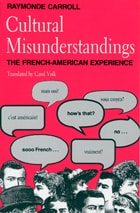
Cultural Misunderstandings
The French-American ExperienceRaymonde Carroll
University of Chicago Press, 1990
Raymonde Carroll presents an intriguing and thoughtful analysis of the many ways French and Americans—and indeed any members of different cultures—can misinterpret each other, even when ostensibly speaking the same language.Cultural misunderstandings, Carroll points out, can arise even where we least expect them—in our closest relationships. The revealing vignettes that Carroll relates, and her perceptive comments, bring to light some fundamental differences in French and American presuppositions about love, friendship, and raising children, as well as such everyday activities as using the telephone or asking for information.
Culture and Content in French
Frameworks for Innovative CurriculaAurélie Chevant-Aksoy
Lever Press, 2022

Culture and Identity in Early Modern Europe (1500-1800)
Essays in Honor of Natalie Zemon DavisBarbara B. Diefendorf and Carla Hesse, Editors
University of Michigan Press, 1993
Culture and Power
The Sociology of Pierre BourdieuDavid Swartz
University of Chicago Press, 1997
David Swartz focuses on a central theme in Bourdieu's work—the complex relationship between culture and power—and explains that sociology for Bourdieu is a mode of political intervention. Swartz clarifies Bourdieu's difficult concepts, noting where they have been misinterpreted by critics and where they have fallen short in resolving important analytical issues. The book also shows how Bourdieu has synthesized his theory of practices and symbolic power from Durkheim, Marx, and Weber, and how his work was influenced by Sartre, Levi-Strauss, and Althusser.
Culture and Power is the first book to offer both a sympathetic and critical examination of Bourdieu's work and it will be invaluable to social scientists as well as to a broader audience in the humanities.

Cultured Force
Makers and Defenders of the French Colonial EmpireBarnett Singer and John Langdon
University of Wisconsin Press, 2008