Results by title
69 books match the query 'Genocide' and 5 start with c
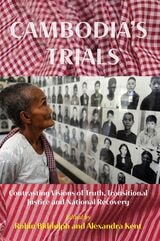
Cambodia's Trials
Contrasting Visions of Truth, Transitional Justice and National RecoveryEdited by Robin Biddulph and Alexandra Kent
National University of Singapore Press, 2023
More than four decades have passed since the end of Khmer Rouge rule in Cambodia in 1979. Even so, the country is still coming to terms with the destruction wrought by the Khmer Rouge during both the time they were in power and during the period of guerrilla resistance that lasted until 1998. The Khmer Rouge Tribunal, or the Extraordinary Chambers in the Court of Cambodia (ECCC), was established in 2006 to bring the Khmer Rouge leadership to justice. In many ways a product of the 1990s, when liberal democracy appeared to be on the rise both in Cambodia and internationally, the ECCC was imagined as a transitional justice initiative that would help ease the transition to liberal democracy.
The ECCC has long been the focus of scholarly attention in Cambodia’s recovery, but this compelling study argues that such an approach is dated, noting that the political circumstances in which the ECCC was born have since changed profoundly, both globally and locally. Cambodia’s current situation can no longer be analyzed solely in terms of transitional justice narratives or the work of the ECCC, and other ways in which Cambodians have come to terms with their past and built new lives must be considered. By decentering the ECCC in the scholarly narrative of Cambodia’s recovery, the volume’s authors offer fascinating new insights into the Khmer Rouge period and more recent years of social, cultural, and political change in Cambodia.
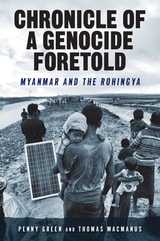
Chronicle of a Genocide Foretold
Myanmar and the RohingyaPenny Green
Rutgers University Press, 2027
Chronicle of a Genocide Foretold is a powerful account of one of the most devastating human crises of the 21st century. Drawing on firsthand research conducted in Burma (Myanmar) and neighboring countries, the book uncovers how the Rohingya Muslims have been systematically isolated, impoverished, and targeted in a state-led genocidal campaign. Through more than 150 interviews with survivors, local officials, religious leaders, and international actors, the authors reveal how discrimination, mass displacement, and organized brutality have created conditions that meet the legal, criminological, and moral definition of genocide. The book also challenges the silence and complicity of the international community. Accessible and grounded in rigorous research, this book speaks to scholars, activists, policymakers, and anyone concerned with justice, human rights, and the global failure to prevent genocide.
Colonial Genocide in Indigenous North America
Andrew Woolford, Jeff Benvenuto and Alexander Laban Hinton, eds.
Duke University Press, 2014
Contributors. Jeff Benvenuto, Robbie Ethridge, Theodore Fontaine, Joseph P. Gone, Alexander Laban Hinton, Tasha Hubbard, Margaret D. Jabobs, Kiera L. Ladner, Tricia E. Logan, David B. MacDonald, Benjamin Madley, Jeremy Patzer, Julia Peristerakis, Christopher Powell, Colin Samson, Gray H. Whaley, Andrew Woolford
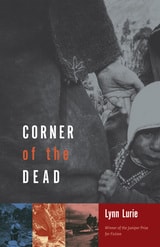
Corner of the Dead
Lynn Lurie
University of Massachusetts Press, 2008
"I use the camera to block my view," says Lisette. This is the start of her double vision—trying to forget and trying to recall—and her struggle to come to terms with the human capacity for cruelty. But the grim reality in Peru is so overpowering that she carries it with her back to New York and through the rest of her life. Having abandoned a lover along with the fight, she desperately tries to find meaning beyond that of mere survival.
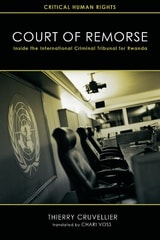
Court of Remorse
Inside the International Criminal Tribunal for RwandaThierry Cruvellier
University of Wisconsin Press, 2010
Fascinated by the Tribunal’s rich complexities, journalist Thierry Cruvellier came back day after day to watch the proceedings, spending more time there than any other outside observer. Gradually he gained the confidence of the victims, defendants, lawyers, and judges. Drawing on interviews with these protagonists and his close observations of their interactions, Cruvellier takes readers inside the courtroom to witness the motivations, mechanisms, and manipulations of justice as it unfolded on the stage of high-stakes, global politics. It is this ground-level view that makes his account so valuable—and so absorbing. A must-read for those who want to understand the dynamics of international criminal tribunals, Court of Remorse reveals both the possibilities and the challenges of prosecuting human rights violations.
Best Books for General Audiences, selected by the American Association for School Libraries and the Public Library Association
Best Books for High Schools, selected by the American Association for School Libraries