Results by title
97 books match the query 'Geopolitics' and 14 start with c
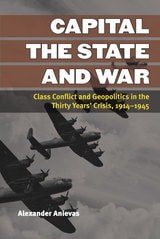
Capital, the State, and War
Class Conflict and Geopolitics in the Thirty Years' Crisis, 1914-1945Alexander Anievas
University of Michigan Press, 2014
The history of the modern social sciences can be seen as a series of attempts to confront the challenges of social disorder and revolution wrought by the international expansion of capitalist social relations. Alexander Anievas focuses on one particularly significant aspect of this story: the intersocietal or geosocial origins of the two world wars, and, more broadly, the confluence of factors behind the Thirty Years’ Crisis between 1914 and 1945.
Anievas presents the Thirty Years’ Crisis as a result of the development of global capitalism with all its destabilizing social and geopolitical consequences, particularly the intertwined and co-constitutive nature of imperial rivalries, social revolutions, and anti-colonial struggles. Building on the theory of uneven and combined development, he unites geopolitical and sociological explanations into a single framework, thereby circumventing the analytical stalemate between primacy of domestic politics and primacy of foreign policy approaches.
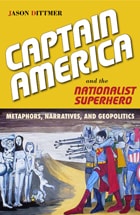
Captain America and the Nationalist Superhero
Metaphors, Narratives, and GeopoliticsJason Dittmer
Temple University Press, 2012
Nationalist superheroes—such as Captain America, Captain Canuck, and Union Jack—often signify the “nation-state” for readers, but how do these characters and comic books address issues of multiculturalism and geopolitical order? In his engaging book Captain America and the Nationalist Superhero, geographer Jason Dittmer traces the evolution of the comic book genre as it adapted to new national audiences. He argues that these iconic superheroes contribute to our contemporary understandings of national identity, the righteous use of power, and the role of the United States, Canada, and Britain in the world.
Tracing the nationalist superhero genre from its World War II origins to contemporary manifestations throughout the world, Captain America and the Nationalist Superhero analyzes nearly one thousand comic books and audience responses to those books. Dittmer also interviews key comic book writers from Stan Lee and J. M. DeMatteis to Steve Englehart and Paul Cornell.
At a time when popular culture is saturated with superheroes and their exploits, Captain America and the Nationalist Superhero highlights the unique relationship between popular culture and international relations.

Central Peripheries
Nationhood in Central AsiaMarlene Laruelle
University College London, 2021
Committed to internationalism, Kazakhstan and other central Asian states nevertheless embrace classically nationalist conceptions of the nation-state. Their unabashed celebration of borders and citizenship challenges Western views of nationalism as a dying ideology transcended by cosmopolitanism. Drawing on twenty years of fieldwork, Central Peripheries reveals the origin of central Asian national consciousness in imaginary and ritualized efforts to grapple with the Soviet past.
Champassak Royalty and Sovereignty
Within and between Nation-States in Mainland Southeast AsiaIan G. Baird
University of Wisconsin Press, 2024
In re-creating this story, Baird draws not only on a dazzling variety of primary sources in English, French, Lao, and Thai but also on many years spent in conversation with members of the Na Champassak family, who are now spread across a wide geographical area, from Laos and Thailand to France and the United States. Each chapter treats one historical period, identifying the Champassak approach to sovereignty during that time. Through this deep history, Baird shows how sovereign power, even within one case, takes a wide range of forms, always contingent, contested, and uneven across space and time.

Checkerboards and Shatterbelts
The Geopolitics of South AmericaBy Philip Kelly
University of Texas Press, 1997
Geography has always played a major role in world politics. In this study, Philip Kelly maps the geopolitics of South America, a continent where relative isolation from the power centers in North America and Eurasia and often forbidding internal terrain have given rise to a fascinating and unique geopolitical structure.
Kelly uses the geographical concepts of "checkerboards" and "shatterbelts" to characterize much of South America's geopolitics and to explain why the continent has never been unified nor dominated by a single nation. This approach accounts for both historical relationships among South American countries and for such current situations as Brazil's inability to extend its authority across the continent from Atlantic to Pacific, its traditional competition with Argentina, its territorial expansion toward the continental heartlands, its encirclement by neighbors fearful of such expansion, and its recent rapprochement with Argentina.
An important component of this book is the incorporation of the thinking and writing of South American geopolitical analysts, which leads to an interesting inventory of viewpoints on frontier conflicts, territorial expansion, industrial development, economic cooperation, and United States and European relations. Kelly's findings will be important reading for geographers, political scientists, and students and scholars of Latin American history.
Coalition of the unWilling and unAble
European Realignment and the Future of American GeopoliticsJohn R. Deni
University of Michigan Press, 2022
Why does the United States need European allies, and why is it getting more difficult for those allies to partner with Washington in standing up to China, pushing back against Russia, and pursuing other common interests around the world? This book addresses the economic, demographic, political, and military trends that are fundamentally upending the ability and willingness of European allies to work with Washington. Brexit and its impact on Britain’s economy and its military, Germany’s seemingly relentless economic and political rise, France’s continuing economic malaise, Italy’s aging population and its withdrawal from major overseas operations, and Poland’s demographic decline and single-minded obsession with Russia will combine to make partnership with Washington nearly impossible. In short, the constellation of allies and partners the United States has relied on since 9/11 will look very different a decade from now. How should Washington respond? It doesn’t hold all the cards, but this book offers an array of practical recommendations for American leaders. By leveraging these proposals, U.S. policy-makers can avoid the worst-case scenarios and make the most of limited opportunities.

Cold War Broadcasting
Impact on the Soviet Union and Eastern EuropeR. Eugene Parta
Central European University Press, 2010
Communications in Turkey and the Ottoman Empire
A Critical HistoryBurçe Çelik
University of Illinois Press, 2023
The history of communications in the Ottoman Empire and Turkey contradicts the widespread belief that communications is a byproduct of modern capitalism and other Western forces. Burçe Çelik uses a decolonial perspective to analyze the historical commodification and militarization of communications and how it affected production and practice for oppressed populations like women, the working class, and ethnic and religious minorities. Moving from the mid-nineteenth century through today, Çelik places networks within the changing geopolitical landscape and the evolution of modern capitalism in relationship to struggles involving a range of social and political actors. Throughout, she challenges Anglo- and Eurocentric assumptions that see the non-West as an ahistorical imitation of, or aberration from, the development of Western communications.
Ambitious and comprehensive, Communications in Turkey and the Ottoman Empire merges political economy with social history to challenge Western-centered assumptions about the origins and development of modern communications.
Complex Rivalry
The Dynamics of India-Pakistan ConflictSurinder Mohan
University of Michigan Press, 2022
While a substantial body of research explains how the conflict between India and Pakistan originated and developed over time, a systematic and multivariate inquiry cutting across different IR paradigms to understand this rivalry is rare or limited. Surinder Mohan contributes to the understanding of India and Pakistan’s rivalry by presenting a new type of framework, also known as complex rivalry model. This comprehensive model, by not limiting its theoretical tool-kit to any single paradigm, is unique in its approach and better positioned to debate and answer baffling questions that the single-paradigm-based studies address rather inadequately and in isolation.
This book, through an examination of fifty-seven militarized disputes between 1947 and 2021, explains the life cycle of India-Pakistan rivalry in four phases: initiation; development; maintenance; and a possible transformation/termination. Mohan delineates five specific conditions that evolved the subcontinental conflict into a complex rivalry: first, its survival in spite of the Bangladesh War and the end of the Cold War; second, its linkage with other rivalries; third, the inclusion of nuclear factor; fourth, the dyadic stability in the militarized disputes and hostility level despite changes in the regime type; and fifth, the dyad’s involvement in a multilayered conflict pattern. To break this deadlock and mitigate their longstanding differences, Mohan proposes that India and Pakistan must reframe their national priorities and political goals so that the new situation or combinations of conditions would assist their peace strategists to downgrade the dyadic hostility and implement risky policies to make headway to a promising transformation.
Concrete Revolution
Large Dams, Cold War Geopolitics, and the US Bureau of ReclamationChristopher Sneddon
University of Chicago Press, 2015
Founded in 1902, the Bureau became enmeshed in the US State Department’s push for geopolitical power following World War II, a response to the Soviet Union’s increasing global sway. By offering technical and water resource management advice to the world’s underdeveloped regions, the Bureau found that it could not only provide them with economic assistance and the United States with investment opportunities, but also forge alliances and shore up a country’s global standing in the face of burgeoning communist influence. Drawing on a number of international case studies—from the Bureau’s early forays into overseas development and the launch of its Foreign Activities Office in 1950 to the Blue Nile investigation in Ethiopia—Concrete Revolution offers insights into this historic damming boom, with vital implications for the present. If, Sneddon argues, we can understand dams as both technical and political objects rather than instruments of impartial science, we can better participate in current debates about large dams and river basin planning.

Constructing the Pluriverse
The Geopolitics of KnowledgeBernd Reiter, editor
Duke University Press, 2018
Contributors. Zaid Ahmad, Manuela Boatcă, Hans-Jürgen Burchardt, Raewyn Connell, Arturo Escobar, Sandra Harding, Ehsan Kashfi, Venu Mehta, Walter D. Mignolo, Ulrich Oslender, Issiaka Ouattara, Bernd Reiter, Manu Samnotra, Catherine E. Walsh, Aram Ziai
Critical Geopolitics
The Politics of Writing Global SpaceGearoid O'Tuathail
University of Minnesota Press, 1996
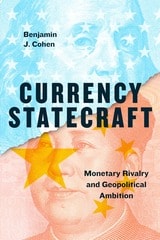
Currency Statecraft
Monetary Rivalry and Geopolitical AmbitionBenjamin J. Cohen
University of Chicago Press, 2018
In a comprehensive review that ranges from World War II to the present, Cohen convincingly argues that one goal stands out as the primary motivation for currency statecraft: the extent of a country’s geopolitical ambition, or how driven it is to build or sustain a prominent place in the international community. When a currency becomes internationalized, it generally increases the power of the nation that produces it. In the persistent contestation that characterizes global politics, that extra edge can matter greatly, making monetary rivalry an integral component of geopolitics. Today, the major example of monetary rivalry is the emerging confrontation between the US dollar and the Chinese renminbi. Cohen describes how China has vigorously promoted the international standing of its currency in recent years, even at the risk of exacerbating relations with the United States, and explains how the outcome could play a major role in shaping the broader geopolitical engagement between the two superpowers.

Cyprus
The Post-Imperial ConstitutionVassilis K. Fouskas and Alex O. Tackie
Pluto Press, 2009