Results by title
149 books match the query 'Group identity' and 15 start with c
Choosing an Identity
A General Model of Preference and Belief FormationSun-Ki Chai
University of Michigan Press, 2001
City Dreams, Country Schemes
Community and Identity in the American WestKathleen A. Brosnan
University of Nevada Press, 2011
The American West, from the beginning of Euro-American settlement, has been shaped by diverse ideas about how to utilize physical space and natural environments to create cohesive, sometimes exclusive community identities. When westerners developed their towns, they constructed spaces and cultural identities that reflected alternative understandings of modern urbanity. The essays in City Dreams, Country Schemes utilize an interdisciplinary approach to explore the ways that westerners conceptualized, built, and inhabited urban, suburban, and exurban spaces in the twentieth century.
The contributors examine such topics as the attractions of open space and rural gentrification in shaping urban development; the role of tourism in developing national parks, historical sites, and California's Napa Valley; and the roles of public art, gender, and ethnicity in shaping urban centers. City Dreams, Country Schemes reveals the values and expectations that have shaped the West and the lives of the people who inhabit it.
Collective Biologies
Healing Social Ills through Sexual Health Research in MexicoEmily A. Wentzell
Duke University Press, 2021
Collision of Wills
How Ambiguity about Social Rank Breeds ConflictRoger V. Gould
University of Chicago Press, 2003
This, he maintains, is because violence most often occurs when someone wants to achieve superiority or dominance over someone else, even if there is no substantive reason for doing so. In making the case for this original idea, Gould explores a diverse range of examples, including murders, blood feuds, vendettas, revolutions, and the everyday disagreements that compel people to act violently. The result is an intelligent and provocative work that restores the study of conflict to the center of social inquiry.
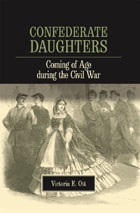
Confederate Daughters
Coming of Age during the Civil WarVictoria E. Ott
Southern Illinois University Press, 2008
Confederate Daughters: Coming of Age during the Civil War explores gender, age, and Confederate identity by examining the lives of teenage daughters of Southern slaveholding, secessionist families. These young women clung tenaciously to the gender ideals that upheld marriage and motherhood as the fulfillment of female duty and to the racial order of the slaveholding South, an institution that defined their status and afforded them material privileges. Author Victoria E. Ott discusses how the loyalty of young Southern women to the fledgling nation, born out of a conservative movement to preserve the status quo, brought them into new areas of work, new types of civic activism, and new rituals of courtship during the Civil War.
Social norms for daughters of the elite, their preparation for their roles as Southern women, and their material and emotional connections to the slaveholding class changed drastically during the Civil War. When differences between the North and South proved irreconcilable, Southern daughters demonstrated extraordinary agency in seeking to protect their futures as wives, mothers, and slaveholders.
From a position of young womanhood and privilege, they threw their support behind the movement to create a Confederate identity, which was in turn shaped by their participation in the secession movement and the war effort. Their political engagement is evident from their knowledge of military battles, and was expressed through their clothing, social activities, relationships with peers, and interactions with Union soldiers.
Confederate Daughters also reveals how these young women, in an effort to sustain their families throughout the war, adjusted to new domestic duties, confronting the loss of slaves and other financial hardships by seeking paid work outside their homes.
Drawing on their personal and published recollections of the war, slavery, and the Old South, Ott argues that young women created a unique female identity different from that of older Southern women, the Confederate bellehood. This transformative female identity was an important aspect of the Lost Cause mythology—the version of the conflict that focused on Southern nationalism—and bridged the cultural gap between the antebellum and postbellum periods.
Augmented by twelve illustrations, this book offers a generational understanding of the transitional nature of wartime and its effects on women’s self-perceptions. Confederate Daughters identifies the experiences of these teenage daughters as making a significant contribution to the new woman in the New South.
Connected Communities
Networks, Identity, and Social Change in the Ancient Cibola WorldMatthew A. Peeples
University of Arizona Press, 2018
In Connected Communities, Matthew A. Peeples examines a period of dramatic social and political transformation in the ancient Cibola region (ca. A.D. 1150–1325). He analyzes archaeological data generated during a century of research through the lens of new and original social theories and methods focused on exploring identity, social networks, and social transformation. In so doing, he demonstrates the value of comparative, synthetic analysis.
The book addresses some of the oldest enduring questions in archaeology: How do large-scale social identities form? How do they change? How can we study such processes using material remains? Peeples approaches these questions using a new set of methods and models from the broader comparative social sciences (relational sociology and social networks) to track the trajectories of social groups in terms of both networks of interactions (relations) and expressions of similarity or difference (categories). He argues that archaeological research has too often conflated these different kinds of social identity and that this has hindered efforts to understand the drivers of social change.
In his strikingly original approach, Peeples combines massive amounts of new data and comparative explorations of contemporary social movements to provide new insights into how social identities formed and changed during this key period.
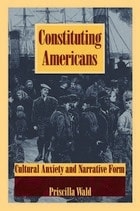
Constituting Americans
Cultural Anxiety and Narrative FormPriscilla Wald
Duke University Press, 1995
From early-nineteenth-century Supreme Court cases to turn-of-the-century Jim Crow and immigration legislation, from the political speeches of Abraham Lincoln to the historical work of Woodrow Wilson, nation-builders addressed the legal, political, and historical paradoxes of American identity. Against the backdrop of their efforts, Wald shows how works such as Douglass’s autobiographical narratives, Melville’s Pierre, Wilson’s Our Nig, Du Bois’s The Souls of Black Folks, and Stein’s The Making of Americans responded, through formal innovations, to the aggressive demands for literary participation in the building of that nation. The conversation that emerges among these literary works challenges the definitions and genres that largely determine not only what works are read, but also how they are read in classrooms in the United States today.
Offering insight into the relationship of storytelling to national identity, Constituting Americans will compel the attention of those with an interest in American literature, American studies, and cultural studies.
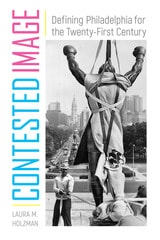
Contested Image
Defining Philadelphia for the Twenty-First CenturyLaura M. Holzman
Temple University Press, 2019
Thomas Eakins’ 1875 painting, The Gross Clinic, the Rocky Statue, andthe Barnes Foundation are all iconic in Philadelphia for different reasons. But around the year 2000, this painting, this sculpture, and this entire art collection, respectively, generated extended—and heated—controversies about the “appropriate” location for each item. Contested Image revisits the debates that surrounded these works of visual culture and how each item changed through acts of reception—through the ways that viewers looked at, talked about, and used these objects to define their city.
Laura Holzman investigates the negotiations and spirited debates that affected the city of Philadelphia’s identity and its public image. She considers how the region’s cultural resources reshaped the city’s reputation as well as delves into discussions about official efforts to boost local spirit. In tracking these “contested images,” Holzman illuminates the messy process of public envisioning of place and the ways in which public dialogue informs public meaning of both cities themselves and the objects of urban identity.
Contesting Stereotypes and Creating Identities
Social Categories, Social Identities, and Educational ParticipationAndrew J. Fuligni
Russell Sage Foundation, 2007
Contours of Israeli Politics
Jewish Ethnicity, Religious Nationalism, and DemocracyHannah M. Ridge
Temple University Press, 2025
The timely Contours of Israeli Politics focuses on the socio-political ramifications of this hierarchy within the upper stratum of Israeli society. Using public opinion studies and qualitative data, Hannah Ridge examines the effects of this social hierarchy to address attitudes on Israeli ethnicity and religious majoritarianism, support for Israeli democracy, and preference for an expanded territorial state and peace with its neighbors.
As various Jewish ethnic groups face greater pressure to assert their in-group membership (their Jewishness), they are more likely to protect the status privileges of that group. This can strengthen their ideas about identity, nationalism, democratic values, and conflict attitudes. Ridge’s findings reveal the ways in which Jewish ethnicity continues to influence the politics of Israel, a Jewish ethno-religious state.
Crafting Selves
Power, Gender, and Discourses of Identity in a Japanese WorkplaceDorinne K. Kondo
University of Chicago Press, 1990
"Kondo's work is significant because she goes beyond disharmony, insisting on complexity. Kondo shows that inequalities are not simply oppressive-they are meaningful ways to establish identities."—Nancy Rosenberger, Journal of Asian Studies
Crossing Borders, Reinforcing Borders
Social Categories, Metaphors, and Narrative Identities on the U.S.-Mexico FrontierBy Pablo Vila
University of Texas Press, 2000
Along the U.S.-Mexico frontier, where border crossings are a daily occurrence for many people, reinforcing borders is also a common activity. Not only does the U.S. Border Patrol strive to "hold the line" against illegal immigrants, but many residents on both sides of the border seek to define and bound themselves apart from groups they perceive as "others."
This pathfinding ethnography charts the social categories, metaphors, and narratives that inhabitants of El Paso and Ciudad Juárez use to define their group identity and distinguish themselves from "others." Pablo Vila draws on over 200 group interviews with more than 900 area residents to describe how Mexican nationals, Mexican immigrants, Mexican Americans, African Americans, and Anglos make sense of themselves and perceive their differences from others.
This research uncovers the regionalism by which many northern Mexicans construct their sense of identity, the nationalism that often divides Mexican Americans from Mexican nationals, and the role of ethnicity in setting boundaries among Anglos, Mexicans, and African Americans. Vila also looks at how gender, age, religion, and class intertwine with these factors. He concludes with fascinating excerpts from re-interviews with several informants, who modified their views of other groups when confronted by the author with the narrative character of their identities.
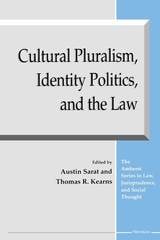
Cultural Pluralism, Identity Politics, and the Law
Austin Sarat and Thomas R. Kearns, Editors
University of Michigan Press, 2001
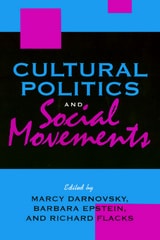
Cultural Politics
edited by Marcy Darnovsky, Barbara Epstein and Richard Flacks
Temple University Press, 1995
Bridging the worlds of activism and academia-social movement theory informed with the real experiences of activists-this volume of accessible essays brings together insights from European New Social Movement theorists, U.S. scholars of social movements, and activists involved in social movements from the 1960s to the 1990s.
Contributors: Alice Echols, Barbara Epstein, Richard A. Cloward, Marcy Darnovsky, Jeffrey Escoffier, Ilene Rose Feinman, Richard Flacks, Cynthia Hamilton, Allen Hunter, L. A. Kauffman, Rebecca E. Klatch, Margit Mayer, Alberto Melucci, Bronislaw Misztal, Osha Neumann, Frances Fox Piven, Craig Reinarman, Roland Roth, Arlene Stein, Mindy Spatt, Andrew Szasz, Noél Sturgeon, Howard Winant.
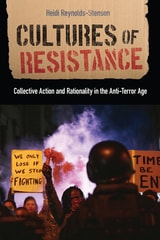
Cultures of Resistance
Collective Action and Rationality in the Anti-Terror AgeHeidi Reynolds-Stenson
Rutgers University Press, 2022
Cultures of Resistance provides new insight on a long-standing question: whether government efforts to repress social movements produce a chilling effect on dissent, or backfire and spur greater mobilization. In recent decades, the U.S. government’s repressive capacity has expanded dramatically, as the legal, technological, and bureaucratic tools wielded by agents of the state have become increasingly powerful. Today, more than ever, it is critical to understand how repression impacts the freedom to dissent and collectively express political grievances. Through analysis of activists’ rich and often deeply moving experiences of repression and resistance, the book uncovers key group processes that shape how individuals understand, experience, and weigh these risks of participating in collective action. Qualitative and quantitative analyses demonstrate that, following experiences of state repression, the achievement or breakdown of these group processes, not the type or severity of repression experienced, best explain why some individuals persist while others disengage. In doing so, the book bridges prevailing theoretical divides in social movement research by illuminating how individual rationality is collectively constructed, mediated, and obscured by protest group culture.