Results by title
90 books match the query 'Growth' and 7 start with c

Chicago
Growth of a MetropolisHarold M. Mayer and Richard C. Wade
University of Chicago Press, 1969
This volume, however, which comprises over 1,000 pictures and 50 maps, tries to do more than show physical development—it attempts to suggest how the city expanded and why it looks the way it does. Because it asks different questions, this book differs markedly from other "pictorial histories" of American cities. Instead of emphasizing society and customs, this volume deals with the physical conditions of life. In place of the conventional interest in "founding fathers" and leading families, it is more concerned with street scenes and ordinary people. Without neglecting downtown, it also reaches into the residential areas and neighborhood shopping centers. Moreover, this volume is concerned with suburbs and "satellite" towns as well as the historic city.
"Chicago: Growth of a Metropolis is an incredible book. Like its subject it is excessive, and nothing succeeds like excess. It is handsomely designed, with a thousand photographs that document the physical growth and the spatial patterns of the city. . . . A dimensionalism comes through that no other city has. Carl Sandburg sang it in his poetry, and the book does more to grasp it . . . than any other book I have seen."—Hugh Newell Jacobson, New Republic
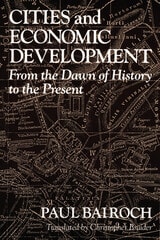
Cities and Economic Development
From the Dawn of History to the PresentPaul Bairoch
University of Chicago Press, 1988
In this revised translation of De Jéricho à Mexico, Paul Bairoch seeks the answers to these questions and provides a comprehensive study of the evolution of the city and its relation to economic life. Bairoch examines the development of cities from the dawn of urbanization (Jericho) to the explosive growth of the contemporary Third World city. In particular, he defines the roles of agriculture and industrialization in the rise of cities.
"A hefty history, from the Neolithic onward. It's ambitious in scope and rich in subject, detailing urbanization and, of course, the links between cities and economies. Scholarly, accessible, and significant."—Newsday
"This book offers a path-breaking synthesis of the vast literature on the history of urbanization."—John C. Brown, Journal of Economic Literature
"One leaves this volume with the feeling of positions intelligently argued and related to the existing state of theory and knowledge. One also has the pleasure of reading a book unusually well-written. It will long both be a standard and stimulate new thought on the central issue of urban and economic growth."—Thomas A. Reiner, Annals of the American Academy of Political and Social Science
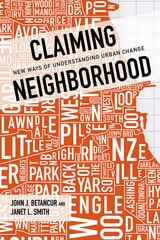
Claiming Neighborhood
New Ways of Understanding Urban ChangeJohn Betancur
University of Illinois Press, 2016
As the authors show, a diverse collection of people including urban policy experts, elected officials, investors, resident leaders, institutions, community-based organizations, and many others compete to control how neighborhoods change and are characterized. Betancur and Smith argue that neighborhoods have become sites of consumption and spaces to be consumed. Discourse is used to add and subtract value from them. The romanticized image of "the neighborhood" exaggerates or obscures race and class struggles while celebrating diversity and income mixing. Scholars and policy makers must reexamine what sustains this image and the power effects produced in order to explain and govern urban space more equitably.

Cold War Anthropology
The CIA, the Pentagon, and the Growth of Dual Use AnthropologyDavid H. Price
Duke University Press, 2016
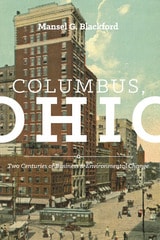
Columbus, Ohio
Two Centuries of Business and Environmental ChangeMansel G. Blackford
The Ohio State University Press, 2016
Precisely because they lived in a midsize, midwestern city, Columbus residents could learn from the earlier experiences of their counterparts in older, larger coastal metropolises, and then go beyond them. Not having large sunk costs in pre-existing water systems, Columbus residents could, for instance, develop new, world-class, state-of-the-art methods for treating water and sewage, steps essential for urban expansion. Columbus, Ohio explores how city residents approached urban challenges—especially economic and environmental ones—and how they solved them.
Columbus, Ohio: Two Centuries of Business and Environmental Change concludes that scholars and policy makers need to pay much more attention to environmental issues in the shaping of cities, and that they need to look more closely at what midwestern metropolises accomplished, as opposed to simply examining coastal cities.
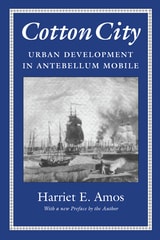
Cotton City
Urban Development in Antebellum MobileHarriet E. Amos Doss
University of Alabama Press, 2001
The exploration of the North-South relationship and the growth of of antebellum Mobile.
Cotton City offers a compelling exploration of Mobile, Alabama’s transformation into a thriving urban center during the antebellum period. Historian Harriet E. Amos examines how economic ambition, civic planning, and the cotton trade shaped the city’s development between 1819 and 1861. Through detailed archival research, Amos reveals how Mobile’s leaders sought to modernize infrastructure, expand commerce, and assert the city’s regional importance—all while navigating the tensions of slavery, class, and Southern identity.
This richly contextualized study highlights the interplay between urban growth and the broader forces of the Southern economy, making Cotton City a vital contribution to the histories of the American South, urbanization, and antebellum society.
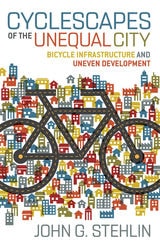
Cyclescapes of the Unequal City
Bicycle Infrastructure and Uneven DevelopmentJohn G. Stehlin
University of Minnesota Press, 2019
A critical look at the political economy of urban bicycle infrastructure in the United States
Not long ago, bicycling in the city was considered a radical statement or a last resort, and few cyclists braved the inhospitable streets of most American cities. Today, however, the urban cyclist represents progress and the urban “renaissance.” City leaders now undertake ambitious new bicycle infrastructure plans and bike share schemes to promote the environmental, social, and economic health of the city and its residents. Cyclescapes of the Unequal City contextualizes and critically examines this new wave of bicycling in American cities, exploring how bicycle infrastructure planning has become a key symbol of—and site of conflict over—uneven urban development.
John G. Stehlin traces bicycling’s rise in popularity as a key policy solution for American cities facing the environmental, economic, and social contradictions of the previous century of sprawl. Using in-depth case studies from San Francisco, Philadelphia, and Detroit, he argues that the mission of bicycle advocacy has converged with, and reshaped, the urban growth machine around a model of livable, environmentally friendly, and innovation-based urban capitalism. While advocates envision a more sustainable city for all, the deployment of bicycle infrastructure within the framework of the neoliberal city in many ways intensifies divisions along lines of race, class, and space.
Cyclescapes of the Unequal City speaks to a growing interest in bicycling as an urban economic and environmental strategy, its role in the politics of gentrification, and efforts to build more diverse coalitions of bicycle advocates. Grounding its analysis in both regional political economy and neighborhood-based ethnography, this book ultimately uses the bicycle as a lens to view major shifts in today’s American city.