Results by title
2646 books match the query 'History & Criticism' and 189 start with c
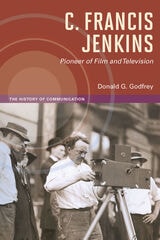
C. Francis Jenkins, Pioneer of Film and Television
Donald G. Godfrey
University of Illinois Press, 2014
This is the first biography of the important but long-forgotten American inventor Charles Francis Jenkins (1867-1934). Historian Donald G. Godfrey documents the life of Jenkins from his childhood in Indiana and early life in the West to his work as a prolific inventor whose productivity was cut short by an early death. Jenkins was an inventor who made a difference.
As one of America's greatest independent inventors, Jenkins's passion was to meet the needs of his day and the future. In 1895 he produced the first film projector able to show a motion picture on a large screen, coincidentally igniting the first film boycott among his Quaker viewers when the film he screened showed a woman's ankle. Jenkins produced the first American television pictures in 1923, and developed the only fully operating broadcast television station in Washington, D.C. transmitting to ham operators from coast to coast as well as programming for his local audience.
Godfrey's biography raises the profile of C. Francis Jenkins from his former place in the footnotes to his rightful position as a true pioneer of today's film and television. Along the way, it provides a window into the earliest days of both motion pictures and television as well as the now-vanished world of the independent inventor.
Caffe Cino
The Birthplace of Off-Off-BroadwayWendell C. Stone
Southern Illinois University Press, 2005
“It’s Magic Time!” That colorful promise began each performance at the Caffe Cino, the storied Greenwich Village coffeehouse that fostered the gay and alternative theatre movements of the 1960s and launched the careers of such stage mainstays as Sam Shepard, Lanford Wilson, Robert Heide, Harry Koutoukas, Robert Patrick, Robert Dahdah, Helen Hanft, Al Pacino, and Bernadette Peters. As Off-Off-Broadway productions enjoy a deserved resurgence, theatre historian and actor Wendell C. Stone reopens the Cino’s doors in this vibrant look at the earliest days of OOB.
Rife with insider interviews and rich with evocative photographs, Caffe Cino: The Birthplace of Off-Off-Broadway provides the first detailed account of Joe Cino’s iconic café theatre and its influence on American theatre. A hub of artistic innovation and haven for bohemians, beats, hippies, and gays, the café gave a much-sought outlet to voices otherwise shunned by mainstream entertainment. The Cino’s square stage measured only eight feet, but the dynamic ideas that emerged there spawned the numerous alternative theatre spaces that owe their origins to the risky enterprise on Cornelia Street.
Californios, Anglos, and the Performance of Oligarchy in the U.S. West
Andrew Gibb
Southern Illinois University Press, 2018
This interdisciplinary study draws on performance studies, theatre historiography, and New Western History to identify how the unique power relations of historical California were constituted and perpetuated through public performances—not only traditional theatrical productions but also social events such as elite weddings and community dances—and historical events like the U.S. seizure of the city of Monterey, the feting of Commodore Stockton in San Francisco, and the Bear Flag Revolt.
Camp TV
Trans Gender Queer Sitcom HistoryQuinlan Miller
Duke University Press, 2019
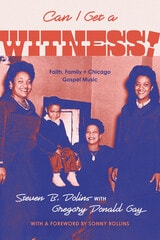
Can I Get a Witness!
Faith, Family, and Chicago Gospel MusicSteven B. Dolins with Gregory Donald Gay
University of Chicago Press, 2026
The remarkable story of pastor Donald Gay and his family’s lasting contributions to gospel music and Chicago culture.
When the preacher Gregory Donald Gay joined his sisters onstage at Carnegie Hall in 1950, on a sold-out bill they shared with Mahalia Jackson and the Clara Ward Singers, he became a participant in a landmark moment: the first concert in the venue to feature entirely gospel music. He was just five years old.
The Gay Sisters—Evelyn, Geraldine, and Mildred—were key figures in gospel’s Golden Age, and their youngest brother had a front-row seat. Evelyn and Geraldine each innovated singular approaches to gospel piano, while Mildred sang. Together, they toured and performed on a series of influential gospel recordings from 1948 to 1973, playing the Apollo Theatre and crossing paths with musical luminaries like Sister Rosetta Tharpe, Sam Cooke, Pops Staples, and Dizzy Gillespie. But despite a hit record and prodigious talent, the Gay Sisters faded from the limelight. In the ensuing years, they weathered personal trials while their mother, Fannie, devoted her attention to another family undertaking: starting a church.
Can I Get a Witness! is a call-and-response between Steven B. Dolins, founder of The Sirens Records, and Donald Gay, who vividly describes his boyhood in Chicago’s Woodlawn neighborhood, his family’s remarkable place in gospel history, his mother’s work as a faith leader, and his own calling as a pastor. The book spotlights the rich contributions of a family remembered not only for the songs they recorded but also for their unwavering kindness to others, a legacy that the legendary Sonny Rollins recounts in a moving foreword.
Career Movies
American Business and the Success MystiqueBy Jack Boozer
University of Texas Press, 2002
Achieving the American Dream became inextricably linked with career/business success after World War II, as an increasingly consumerist America learned to define the dream through possessions and status. Not surprisingly, Hollywood films in the postwar years reflected the country's preoccupation with work and career success, offering both dramatic and comedic visions of the career quest and its effects on personal fulfillment, family relations, women's roles, and the creation (or destruction) of just and caring communities.
In this book, Jack Boozer argues that the career/business film achieved such variety and prominence in the years between 1945 and 2001 that it should be considered a legitimate film genre. Analyzing numerous well-known films from the entire period, he defines the genre as one in which a protagonist strives for career success that often proves to be either elusive despite hard work, or unfulfilling despite material rewards and status. Boozer also explores several distinct subgenres of the career movie—the corporate executive films of the 1950s; the career struggles of (single, married, and/or parenting) women; the entrepreneurial film as it is also embodied in texts about immigrants and racial and ethnic minorities and business-oriented femmes fatales; the explosion of promotionalism and the corporatization of employment; and, finally, the blurring of work and private life in the brave new world of the televirtuality film.
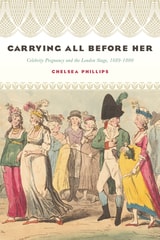
Carrying All before Her
Celebrity Pregnancy and the London Stage, 1689-1800Chelsea Phillips
University of Delaware Press, 2022
The rise of celebrity stage actresses in the long eighteenth century created a class of women who worked in the public sphere while facing considerable scrutiny about their offstage lives. Such powerful celebrity women used the cultural and affective significance of their reproductive bodies to leverage audience support and interest to advance their careers, and eighteenth-century London patent theatres even capitalized on their pregnancies. Carrying All Before Her uses the reproductive histories of six celebrity women (Susanna Mountfort Verbruggen, Anne Oldfield, Susannah Cibber, George Anne Bellamy, Sarah Siddons, and Dorothy Jordan) to demonstrate that pregnancy affected celebrity identity, impacted audience reception and interpretation of performance, changed company repertory and altered company hierarchy, influenced the development and performance of new plays, and had substantial economic consequences for both women and the companies for which they worked. Deepening the fields of celebrity, theatre, and women's studies, as well as social and medical histories, Phillips reveals an untapped history whose relevance and impact persists today.

Cartographic Cinema
Tom Conley
University of Minnesota Press, 2006
Casting a Shadow
Creating the Alfred Hitchcock FilmEdited by Will Schmenner and Corinne Granof
Northwestern University Press, 2007
Scott Curtis considers the four functions of Hitchcock’s sketches and storyboards and how they undermine the impression of Hitchcock as a lone artist. Tom Gunning examines the visual vocabulary and cultural weight of Hitchcock’s movies. Bill Krohn focuses sharply on the film I Confess, tracking its making over a very cooperative path.
Finally, Jan Olsson draws on the television series, Alfred Hitchcock Presents, to show the ways that collaboration contributes to the formation of his well known public persona. Anchored by editor Will Schmenner’s introduction, this book represents an important contribution to Hitchcock scholarship and a provocative glimpse at his unsung strength as a collaborative artist.
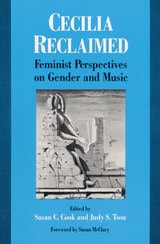
Cecilia Reclaimed
Feminist Perspectives on Gender and MusicEdited by Susan C. Cook and Judy S. Tsou
University of Illinois Press, 1994
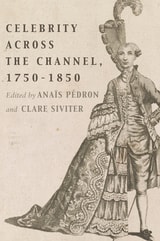
Celebrity Across the Channel, 1750–1850
Anaïs Pédron
University of Delaware Press, 2021
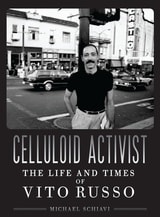
Celluloid Activist
The Life and Times of Vito RussoMichael Schiavi
University of Wisconsin Press, 2011
“Schiavi tells a compelling story in this biography—from his re-creation of life on the streets of East Harlem and in Greenwich Village of the 1960s and 1970s to the way he conveys Russo’s excitement about his film research and popular education to his account of the AIDS years in New York City.”—John D’Emilio, Italian American Review
“In [Schiavi’s] hands Russo’s life is both fascinating in its own right and a window into a larger milieu of activism during two critical decades.”—Italian American Review
Best Books for General Audiences, selected by the Public Library Reviewers
Finalist, Gay Memoir/Biography, Lambda Literary Awards
Finalist, Over the Rainbow Selection, American Library Association

Celluloid China
Cinematic Encounters with Culture and SocietyHarry H. Kuoshu
Southern Illinois University Press, 2002
Celluloid China: Cinematic Encounters with Culture and Society by Harry H. Kuoshu is a lucid introduction to the cinema of mainland China from the early 1930s to the early 1990s. Emphasizing both film contexts and film texts, this study invites film scholars and students to a broad cinematic analysis that includes investigations of cultural, cross-cultural, intellectual, social, ethnic, and political issues. Such a holistic evaluation allows for a better understanding of both the genesis of a special kind of film art from the People’s Republic of China and the culture exemplified in those films.
The fifteen films include: Two Stage Sisters; Hibiscus Town; Farewell My Concubine; Street Angel; Three Women; Human, Woman, Demon; Judou; Girl from Hunan; Sacrificed Youth; Horse Thief; Yellow Earth; Old Well; Red Sorghum; Black Cannon Incident; and Good Morning, Beijing. Discussions of each film have an introduction, passages from the director’s own notes whenever available, and a scholarly article. Discussion questions are found in an appendix. Within its complete bibliography, the book also features a suggested reading list for Chinese film classes. Celluloid China is the first book to provide such an exhaustive study of the art and cultural context of Chinese cinema.
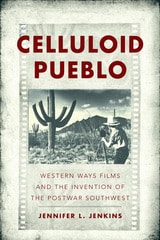
Celluloid Pueblo
Western Ways Films and the Invention of the Postwar SouthwestJennifer L. Jenkins
University of Arizona Press, 2016
Celluloid Pueblo tells the story of Western Ways Features and its role in the invention of the Southwest of the imagination. Active during a thirty-year period of profound growth and transformation, the Herberts created a dynamic visual record of the region, and their archival films now serve as a time capsule of the Sunbelt in the mid-twentieth century. Drawing upon a ten-year career with Fox, Western Ways owner-operator Charles Herbert brought a newshound’s sensibility and acute skill at in-camera editing to his southwestern subjects. The Western Ways films provided counternarratives to Hollywood representations of the West and established the regional identity of Tucson and the borderlands.
Jennifer L. Jenkins’s broad-sweeping book examines the Herberts’ work on some of the first sound films in the Arizona borderlands and their ongoing promotion of the Southwest. The book covers the filmic representation of Native and Mexican lifeways, Anglo ranching and leisure, Mexican missions and tourism, and postwar borderlands prosperity and progressivism. The story of Western Ways closely follows the boom-and-bust arc of the midcentury Southwest and the constantly evolving representations of an exotic—but safe and domesticated—frontier.
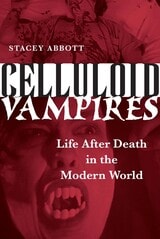
Celluloid Vampires
Life After Death in the Modern WorldBy Stacey Abbott
University of Texas Press, 2007
In 1896, French magician and filmmaker George Méliès brought forth the first celluloid vampire in his film Le manoir du diable. The vampire continues to be one of film's most popular gothic monsters and in fact, today more people become acquainted with the vampire through film than through literature, such as Bram Stoker's classic Dracula. How has this long legacy of celluloid vampires affected our understanding of vampire mythology? And how has the vampire morphed from its folkloric and literary origins?
In this entertaining and absorbing work, Stacey Abbott challenges the conventional interpretation of vampire mythology and argues that the medium of film has completely reinvented the vampire archetype. Rather than representing the primitive and folkloric, the vampire has come to embody the very experience of modernity. No longer in a cape and coffin, today's vampire resides in major cities, listens to punk music, embraces technology, and adapts to any situation. Sometimes she's even female.
With case studies of vampire classics such as Nosferatu, Martin, Blade, and Habit, the author traces the evolution of the American vampire film, arguing that vampires are more than just blood-drinking monsters; they reflect the cultural and social climate of the societies that produce them, especially during times of intense change and modernization. Abbott also explores how independent filmmaking techniques, special effects makeup, and the stunning and ultramodern computer-generated effects of recent films have affected the representation of the vampire in film.
Censorium
Cinema and the Open Edge of Mass PublicityWilliam Mazzarella
Duke University Press, 2013
At the intersection of anthropology, media studies, and critical theory, Censorium is a pathbreaking analysis of Indian film censorship. The book encompasses two moments of moral panic: the consolidation of the cinema in the 1910s and 1920s, and the global avalanche of images unleashed by liberalization since the early 1990s. Exploring breaks and continuities in film censorship across colonial and postcolonial moments, William Mazzarella argues that the censors' obsessive focus on the unacceptable content of certain images and the unruly behavior of particular audiences displaces a problem that they constantly confront yet cannot directly acknowledge: the volatile relation between mass affect and collective meaning. Grounded in a close analysis of cinema regulation in the world's largest democracy, Censorium ultimately brings light to the elusive foundations of political and cultural sovereignty in mass-mediated societies.
Censorship and Sexuality in Bombay Cinema
By Monika Mehta
University of Texas Press, 2011
India produces an impressive number of films each year in a variety of languages. Here, Monika Mehta breaks new ground by analyzing Hindi films and exploring the censorship of gender and heterosexuality in Bombay cinema. She studies how film censorship on various levels makes the female body and female sexuality pivotal in constructing national identity, not just through the films themselves but also through the heated debates that occur in newspapers and other periodicals. The standard claim is that the state dictates censorship and various prohibitions, but Mehta explores how relationships among the state, the film industry, and the public illuminate censorship's role in identity formation, while also examining how desire, profits, and corruption are generated through the act of censoring.
Committed to extending a feminist critique of mass culture in the global south, Mehta situates the story of censorship in a broad social context and traces the intriguing ways in which the heated debates on sexuality in Bombay cinema actually produce the very forms of sexuality they claim to regulate. She imagines afresh the theoretical field of censorship by combining textual analysis, archival research, and qualitative fieldwork. Her analysis reveals how central concepts of film studies, such as stardom, spectacle, genre, and sound, are employed and (re)configured within the ambit of state censorship, thereby expanding the scope of their application and impact.
Chainsaws, Slackers, and Spy Kids
Thirty Years of Filmmaking in Austin, TexasBy Alison Macor
University of Texas Press, 2010
Winner, Peter C. Rollins Book Award, Southwest Texas Popular Culture Association/American Culture Association, 2011
During the 1990s, Austin achieved "overnight" success and celebrity as a vital place for independent filmmaking. Directors Richard Linklater and Robert Rodriguez proved that locally made films with regional themes such as Slacker and El Mariachi could capture a national audience. Their success helped transform Austin's homegrown film community into a professional film industry staffed with talented, experienced filmmakers and equipped with state-of-the art-production facilities. Today, Austin struggles to balance the growth and expansion of its film community with an ongoing commitment to nurture the next generation of independent filmmakers.
Chainsaws, Slackers, and Spy Kids chronicles the evolution of this struggle by re-creating Austin's colorful movie history. Based on revealing interviews with Richard Linklater, Robert Rodriguez, Mike Judge, Quentin Tarantino, Matthew McConaughey, George Lucas, and more than one hundred other players in the local and national film industries, Alison Macor explores how Austin has become a proving ground for contemporary independent cinema. She begins in the early 1970s with Tobe Hooper's horror classic, The Texas Chainsaw Massacre, and follows the development of the Austin film scene through 2001 with the production and release of Rodriguez's $100-million blockbuster, Spy Kids. Each chapter explores the behind-the-scenes story of a specific movie, such as Linklater's Dazed and Confused and Judge's Office Space, against the backdrop of Austin's ever-expanding film community.
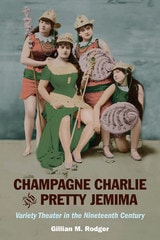
Champagne Charlie and Pretty Jemima
Variety Theater in the Nineteenth CenturyGillian Rodger
University of Illinois Press, 2010
In this rich, imaginative survey of variety musical theater, Gillian M. Rodger masterfully chronicles the social history and class dynamics of the robust, nineteenth-century American theatrical phenomenon that gave way to twentieth-century entertainment forms such as vaudeville and comedy on radio and television. Fresh, bawdy, and unabashedly aimed at the working class, variety honed in on its audience's fascinations, emerging in the 1840s as a vehicle to accentuate class divisions and stoke curiosity about gender and sexuality. Cross-dressing acts were a regular feature of these entertainments, and Rodger profiles key male impersonators Annie Hindle and Ella Wesner while examining how both gender and sexuality gave shape to variety. By the last two decades of the nineteenth century, variety theater developed into a platform for ideas about race and whiteness.
As some in the working class moved up into the middling classes, they took their affinity for variety with them, transforming and broadening middle-class values. Champagne Charlie and Pretty Jemima places the saloon keepers, managers, male impersonators, minstrels, acrobats, singers, and dancers of the variety era within economic and social contexts by examining the business models of variety shows and their primarily white, working-class urban audiences. Rodger traces the transformation of variety from sexualized entertainment to more family-friendly fare, a domestication that mirrored efforts to regulate the industry, as well as the adoption of aspects of middle-class culture and values by the shows' performers, managers, and consumers.
Change Mummified
Cinema, Historicity, TheoryPhilip Rosen
University of Minnesota Press, 2001
An innovative study of the intersections between history and film.
Exploring the modern category of history in relation to film theory, film textuality, and film history, Change Mummified makes a persuasive argument for the centrality of historicity to film as well as the special importance of film in historical culture. What do we make of the concern for recovering the past that is consistently manifested in so many influential modes of cinema, from Hollywood to documentary and postcolonial film? How is film related to the many modern practices that define themselves as configuring pastness in the present, such as architectural preservation, theme parks, and, above all, professional historical research? What is the relation of history in film to other media such as television and digital imaging? How does emphasizing the connection between film and modern historicity affect the theorization and historicization of film and modern media culture?
Pursuing the full implications of film as cultural production, Philip Rosen reconceptualizes modern historicity as a combination of characteristic epistemological structures on the one hand, and the social imperative to regulate or manage time on the other. Emphasizing a fundamental constellation of pursuit of the real, indexical signification and the need to control time, he interrogates a spectrum of film theory and film texts. His argument refocuses the category of temporality for film and cultural theory while rethinking the importance of historicity. An original and sustained meditation on the historiographic status of cinematic signs, Change Mummified is both an intervention in film and media studies and an argument for the continuing necessity of modern historical thinking in its contradictions.
Changing Channels
Television and the Struggle for Power in RussiaEllen Mickiewicz
Duke University Press, 1999
Revised and expanded
During the tumultuous 1990s, as Russia struggled to shed the trappings of the Soviet empire, television viewing emerged as an enormous influence on Russian life. The number of viewers who routinely watch the nightly news in Russia matches the number of Americans who tune in to the Super Bowl, thus making TV coverage the prized asset for which political leaders intensely—and sometimes violently—compete. In this revised and expanded edition of Changing Channels, Ellen Mickiewicz provides many fascinating insights, describing the knowing ways in which ordinary Russians watch the news, skeptically analyze information, and develop strategies for dealing with news bias.
Covering the period from the state-controlled television broadcasts at the end of the Soviet Union through the attempted coup against Gorbachev, the war in Chechnya, the presidential election of 1996, and the economic collapse of 1998, Mickiewicz draws on firsthand research, public opinion surveys, and many interviews with key players, including Gorbachev himself. By examining the role that television has played in the struggle to create political pluralism in Russia, she reveals how this struggle is both helped and hindered by the barrage of information, advertisements, and media-created personalities that populate the airwaves. Perhaps most significantly, she shows how television has emerged as the sole emblem of legitimate authority and has provided a rare and much-needed connection from one area of this huge, crisis-laden country to the next.
This new edition of Changing Channels will be valued by those interested in Russian studies, politics, media and communications, and cultural studies, as well as general readers who desire an up-to-date view of crucial developments in Russia at the end of the twentieth century.
Changing the Subject
Marvin Carlson and Theatre Studies 1959-2009Edited and with an Introduction by Joseph Roach
University of Michigan Press, 2009
Character and the Individual Personality in English Renaissance Drama
Tragedy, History, TragicomedyJohn E. Curran
University of Delaware Press, 2014
Published by University of Delaware Press. Distributed worldwide by Rutgers University Press.
Charles Ives in the Mirror
American Histories of an Iconic ComposerDavid C. Paul
University of Illinois Press, 2013
Paul explores both how Ives positioned his music amid changing philosophical and aesthetic currents and how others interpreted his contributions to American music. Although Ives's initial efforts to find a public in the early twenties attracted a few devotees, the resurgence of interest in the American literary past during the thirties made a concert staple of his "Concord" Sonata, a work dedicated to nineteenth-century transcendentalist writers. Paul shows how Ives was subsequently deployed as an icon of American freedom during the early Cold War period and how he came to be instigated at the head of a line of "American maverick" composers. Paul also examines why a recent cadre of scholars has beset the composer with Gilded Age social anxieties.
By embedding Ives' reception within the changing developments of a wide range of fields including intellectual history, American studies, literature, musicology, and American politics and society in general, Charles Ives in the Mirror: American Histories of an Iconic Composer greatly advances our understanding of Ives and his influence on nearly a century of American culture.
Charles Ives's Concord
Essays after a SonataKyle Gann
University of Illinois Press, 2021
Charlie Chaplin, Director
Donna Kornhaber
Northwestern University Press, 2014
Charlie Chaplin was one of the cinema’s consummate comic performers, yet he has long been criticized as a lackluster film director. In this groundbreaking work—the first to analyze Chaplin’s directorial style—Donna Kornhaber radically recasts his status as a filmmaker. Spanning Chaplin’s career, Kornhaber discovers a sophisticated "Chaplinesque" visual style that draws from early cinema and slapstick and stands markedly apart from later, "classical" stylistic conventions. His is a manner of filmmaking that values space over time and simultaneity over sequence, crafting narrative and meaning through careful arrangement within the frame rather than cuts between frames. Opening up aesthetic possibilities beyond the typical boundaries of the classical Hollywood film, Chaplin’s filmmaking would profoundly influence directors from Fellini to Truffaut. To view Chaplin seriously as a director is to re-understand him as an artist and to reconsider the nature and breadth of his legacy.
Chaucer on Screen
Absence, Presence, and Adapting the Canterbury TalesEdited by Kathleen Coyne Kelly and Tison Pugh
The Ohio State University Press, 2016
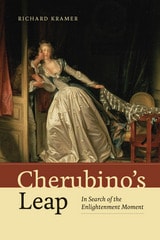
Cherubino's Leap
In Search of the Enlightenment MomentRichard Kramer
University of Chicago Press, 2016
In Cherubino’s Leap, Richard Kramer unmasks such prismatic moments in iconic music from the Enlightenment, from the “chromatic” moment—the single tone that disturbs the thrust of a diatonic musical discourse—and its deployment in seminal instrumental works by Emanuel Bach, Haydn, and Mozart; on to the poetic moment, taking the odes of Klopstock, in their finely wrought prosody, as a challenge to the problem of strophic song; and finally to the grand stage of opera, to the intense moment of recognition in Gluck’s Iphigénie en Tauride and the exquisitely introverted phrase that complicates Cherubino’s daring moment of escape in Mozart’s Figaro. Finally, the tears of the disconsolate Konstanze in Mozart’s Die Entführung aus dem Serail provoke a reflection on the tragic aspect of Mozart’s operatic women. Throughout, other players from literature and the arts—Diderot, Goethe, Lessing among them—enrich the landscape of this bold journey through the Enlightenment imagination.
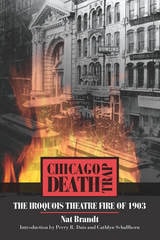
Chicago Death Trap
The Iroquois Theatre Fire of 1903Nat Brandt. Introduction by Perry R. Duis and Cathlyn Schallhorn
Southern Illinois University Press, 2006
On the afternoon of December 30, 1903, during a sold-out matinee performance, a fire broke out in Chicago’s Iroquois Theatre. In the short span of twenty minutes, more than six hundred people were asphyxiated, burned, or trampled to death in a panicked mob’s failed attempt to escape. In Chicago Death Trap: The Iroquois Theatre Fire of 1903, Nat Brandt provides a detailed chronicle of this horrific event to assess not only the titanic tragedy of the fire itself but also the municipal corruption and greed that kindled the flames beforehand and the political cover-ups hidden in the smoke and ash afterwards.
Advertised as “absolutely fireproof,” the Iroquois was Chicago’s most modern playhouse when it opened in the fall of 1903. With the approval of the city’s building department, theater developers Harry J. Powers and William J. Davis opened the theater prematurely to take full advantage of the holiday crowds, ignoring flagrant safety violations in the process.
The aftermath of the fire proved to be a study in the miscarriage of justice. Despite overwhelming evidence that the building had not been completed, that fire safety laws were ignored, and that management had deliberately sealed off exits during the performance, no one was ever convicted or otherwise held accountable for the enormous loss of life.
Lavishly illustrated and featuring an introduction by Chicago historians Perry R. Duis and Cathlyn Schallhorn, Chicago Death Trap: The Iroquois Theatre Fire of 1903 is rich with vivid details about this horrific disaster, captivatingly presented in human terms without losing sight of the broader historical context.
Chicago TV Horror Movie Shows
From Shock Theatre to SvengoolieTed Okuda and Mark Yurkiw
Southern Illinois University Press, 2007
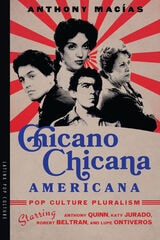
Chicano-Chicana Americana
Pop Culture Pluralism Starring Anthony Quinn, Katy Jurado, Robert Beltran, and Lupe OntiverosAnthony Macías
University of Arizona Press, 2023
Each biographical chapter analyzes an underappreciated actor, revealing their artistic contributions to U.S. common culture. Their long-shot careers tell a tale of players taking action with agency and fighting for screen time and equal opportunity despite disadvantages and differential treatment in Hollywood. These dynamic and complex individuals altered cinematic representations—and audience expectations—by surpassing stereotypes.
The book explores American national character by showing how ethnic Mexicans attained social and cultural status through fair, open competition without a radical realignment of political or economic structures. Their creative achievements demanded dignity and earned respect. Anthony Macías argues that these performances demonstrated a pop culture pluralism that subtly changed mainstream America, transforming it from the mythological past of the Wild West to the speculative future of science fiction.
Chicanos And Film
Representation and ResistanceChon A. Noriega
University of Minnesota Press, 1992
Childhood and Nineteenth-Century American Theatre
The Work of the Marsh Troupe of Juvenile ActorsShauna Vey
Southern Illinois University Press, 2015
Looking at the daily work lives of five members of the Marsh Troupe—the father and manager, Robert Marsh, and four child performers, Mary Marsh, Alfred Stewart, Louise Arnot, and Georgie Marsh—Vey reveals the realities of the antebellum theatre and American society: the rise of the nineteenth-century impresario; the emerging societal constructions of girlhood and goodness; the realities of child labor; the decline of the apprenticeship model of actor training; shifts in gender roles and the status of working women; and changes in the economic models of theatre production, including the development of the stock company system.
Both a microhistory of a professional theatre company and its juvenile players in the decade before the Civil War and a larger narrative of cultural change in the United States, Childhood and Nineteenth-Century American Theatre sheds light on how childhood was idealized both on and off the stage, how the role of the child in society shifted in the nineteenth century, and the ways economic value and sentiment contributed to how children were viewed.
Children of Cuarón
Speculative Futures Through Cinematic FictionMatt Garcia
Rutgers University Press, 2027
Alfonso Cuarón’s Children of Men thrusts readers into a gripping near-future world where environmental collapse and global infertility have fortified borders and torn apart the fabric of society. Its stark depictions of mass deportation, lawless border zones, and the desperate fight for survival echo powerfully through Octavia Butler’s prophetic novels Parable of the Sower and Parable of the Talents, where environmental breakdown, migration, childbirth, and the resilience of women’s bodies form the core of her visionary storytelling. Remarkably, the futures imagined in these works are no longer distant—Butler’s 2024 has arrived, and Cuarón’s 2027 is nearly here. Children of Cuarón: Speculative Futures Through Cinematic Fiction ignites bold, necessary conversations about borders, immigration, and the urgent political, environmental, and social challenges facing our world today. By examining how speculative fiction dares to imagine what comes next, this book invites readers to confront the realities of our present—and the possibilities of our future—with fresh eyes and uncompromising clarity.
Chimes at Midnight
Orson Welles, DirectorLyons, Bridget G
Rutgers University Press, 1988
This volume offers a complete continuity script of Chimes at Midnight, including its famous battle sequence. Each shot is described in detail and is keyed to the original Shakesperian sources, thus making the volume an invaluable guide to Welles as an adaptor and creator of texts. The first complete transcription of the continuity script of Chimes is accompanied by the editor's critical introduction on Welles's transformation of Shakespeare; a special interview with Keith Baxter, one of the film's principal actors, which discusses its production history; reviews and articles; and a biographical sketch of Welles, a filmography, and a bibliography.
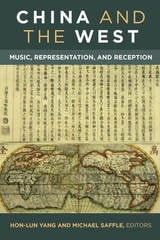
China and the West
Music, Representation, and ReceptionHon-Lun Yang and Michael Saffle, editors
University of Michigan Press, 2017
China and the West brings together essays on centuries of Sino-Western musical exchange by musicologists, ethnomusicologists, and music theorists from around the world. It opens with a look at theoretical approaches of prior studies of musical encounters and a comprehensive survey of the intercultural and cross-cultural theoretical frameworks—exoticism, orientalism, globalization, transculturation, and hybridization—that inform these essays. Part I focuses on the actual encounters between Chinese and European musicians, their instruments and institutions, and the compositions inspired by these encounters, while Part II examines theatricalized and mediated East-West cultural exchanges, which often drew on stereotypical tropes, resulting in performances more inventive than accurate. Part III looks at the musical language, sonority, and subject matters of “intercultural” compositions by Eastern and Western composers. Essays in Part IV address reception studies and consider the ways in which differences are articulated in musical discourse by actors serving different purposes, whether self-promotion, commercial marketing, or modes of nationalistic—even propagandistic—expression. The volume’s extensive bibliography of secondary sources will be invaluable to scholars of music, contemporary Chinese culture, and the globalization of culture.
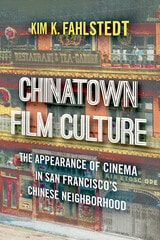
Chinatown Film Culture
The Appearance of Cinema in San Francisco’s Chinese NeighborhoodKim K. Fahlstedt
Rutgers University Press, 2020
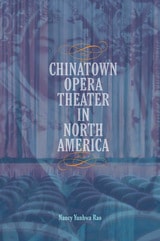
Chinatown Opera Theater in North America
Nancy Yunhwa Rao
University of Illinois Press, 2017
Irving Lowens Award, Society for American Music (SAM), 2019
Music in American Culture Award, American Musicological Society (AMS), 2018
Certificate of Merit for Best Historical Research in Recorded Country, Folk, Roots, or World Music, Association for Recorded Sound Collections (ARSC), 2018
Outstanding Achievement in Humanities and Cultural Studies: Media, Visual, and Performance Studies, Association for Asian American Studies (AAAS), 2019
The Chinatown opera house provided Chinese immigrants with an essential source of entertainment during the pre–World War II era. But its stories of loyalty, obligation, passion, and duty also attracted diverse patrons into Chinese American communities
Drawing on a wealth of new Chinese- and English-language research, Nancy Yunhwa Rao tells the story of iconic theater companies and the networks and migrations that made Chinese opera a part of North American cultures. Rao unmasks a backstage world of performers, performance, and repertoire and sets readers in the spellbound audiences beyond the footlights. But she also braids a captivating and complex history from elements outside the opera house walls: the impact of government immigration policy; how a theater influenced a Chinatown's sense of cultural self; the dissemination of Chinese opera music via recording and print materials; and the role of Chinese American business in sustaining theatrical institutions. The result is a work that strips the veneer of exoticism from Chinese opera, placing it firmly within the bounds of American music and a profoundly American experience.
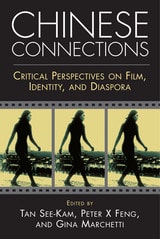
Chinese Connections
Critical Perspectives on Film, Identity, and DiasporaGina Marchetti
Temple University Press, 2009
Chinese Connections is a valuable new anthology that provides a prismatic look at the cross-fertilization between Chinese film and global popular culture. Leading film scholars consider the influence of world cinema on China-related and Chinese-related cinema over the last five decades. Highlighting the neglected connections between Chinese films and American and European cinema, the editors and contributors examine popular works such as Ang Lee’s The Hulk and Olivier Assayas’ Irma Vep to show the nexus of international film production and how national, political, social and sexual identities are represented in the Chinese diaspora.
With talent flowing back and forth between East and West, Chinese Connections explores how issues of immigration, class, race and economic displacement are viewed on a global level, ultimately providing a greater understanding of the impact of Chinese filmmaking at home and abroad.
Contributors include: Grace An, Aaron Anderson, Chris Berry, Evans Chan, Li-Mei Chang, Frances Gateward, Andrew Grossman, Peter Hitchcock, Chuck Kleinhans, Jenny Kwok Wah Lau, Helen Leung, Aaron Magnan-Park, Gayle Wald, Esther C.M. Yau, Emilie Yueh-yu Yeh, Xuelin Zhou and the editors.
Chinese Dreams
Pound, Brecht, Tel QuelEric Hayot
University of Michigan Press, 2011
China’s profound influence on the avant-garde in the 20th century was nowhere more apparent than in the work of Ezra Pound, Bertolt Brecht, and the writers associated with the Parisian literary journal Tel quel. Chinese Dreams explores the complex, intricate relationship between various “Chinas”—as texts—and the nation/culture known simply as “China”—their context—within the work of these writers. Eric Hayot calls into question the very means of representing otherness in the history of the West and ultimately asks if it might be possible to attend to the political meaning of imagining the other, while still enjoying the pleasures and possibilities of such dreaming. The latest edition of this critically acclaimed book includes a new preface by the author.
“Lucid and accessible . . . an important contribution to the field of East-West comparative studies, Asian studies, and modernism.”
—Comparative Literature Studies
“Instead of trying to decipher the indecipherable ‘China’ in Western literary texts and critical discourses, Hayot chose to show us why and how ‘China’ has remained, and will probably always be, an enchanting, ever-elusive dream. His approach is nuanced and refreshing, his analysis rigorous and illuminating.”
—Michelle Yeh, University of California, Davis
Chinese Film
Realism and Convention from the Silent Era to the Digital AgeJason McGrath
University of Minnesota Press, 2022
A tour de force chronicling the development of realism in Chinese cinema
The history of Chinese cinema is as long and complicated as the tumultuous history of China itself. Be it the silent, the Communist, or the contemporary, each Chinese cinematic era has necessitated its own form in conversation with broader trends in politics and culture.
In Chinese Film, Jason McGrath tells this fascinating story by tracing the varied claims to cinematic realism made by Chinese filmmakers, officials, critics, and scholars. Understanding realism as a historical dynamic that is both enabled and mitigated by aesthetic conventions of the day, he analyzes it across six different types of claims: ontological, perceptual, fictional, social, prescriptive, and apophatic.
Through this method, McGrath makes major claims not just about Chinese cinema but also about realism as an aesthetic form that negotiates between cultural conventions and the ever-evolving real. He comes to envision it as more than just a cinematic question, showing how the struggle for realism is central to the Chinese struggle for modernity itself.
Choreographing Mexico
Festive Performances and Dancing Histories of a NationManuel R. Cuellar
University of Texas Press, 2022
2023 de la Torre Bueno® First Book Award, Dance Studies Association
The impact of folkloric dance and performance on Mexican cultural politics and national identity.
The years between 1910 and 1940 were formative for Mexico, with the ouster of Porfirio Díaz, the subsequent revolution, and the creation of the new state. Amid the upheaval, Mexican dance emerged as a key arena of contestation regarding what it meant to be Mexican. Through an analysis of written, photographic, choreographic, and cinematographic renderings of a festive Mexico, Choreographing Mexico examines how bodies in motion both performed and critiqued the nation.
Manuel Cuellar details the integration of Indigenous and regional dance styles into centennial celebrations, civic festivals, and popular films. Much of the time, this was a top-down affair, with cultural elites seeking to legitimate a hegemonic national character by incorporating traces of indigeneity. Yet dancers also used their moving bodies to challenge the official image of a Mexico full of manly vigor and free from racial and ethnic divisions. At home and abroad, dancers made nuanced articulations of female, Indigenous, Black, and even queer renditions of the nation. Cuellar reminds us of the ongoing political significance of movement and embodied experience, as folklórico maintains an important and still-contested place in Mexican and Mexican American identity today.
Chris Marker
Nora M. Alter
University of Illinois Press, 2006
The maverick filmmaker's personal and political relationships with film
Best known in the United States for his visionary short film La Jetée, Chris Marker spearheaded the bourgeoning Nouvelle Vague scene in the late 1950s. His distinctive style and use of still images place him among the postwar era's most influential European filmmakers. His fearless political cinema, meanwhile, provided a bold model for other activist filmmakers.
Nora M. Alter investigates the core themes and motivations behind an unpredictable and transnational career that defies easy classification. A photographer, multimedia artist, writer, broadcaster, producer, and organizer, Marker cultivated an artistic dynamism and always-changing identity. ""I am an essayist,"" Marker once said, and his 1953 debut filmic essay The Statues Also Die (with Alain Resnais) exposed the European art market's complicity in atrocities in the former Belgian Congo. Ranging geographically as well as artistically, Marker's travels led to films like the classic Sans Soleil and Sunday in Peking. His decades-long struggle against global injustice involved him with Night and Fog, Le Joli Mai, Far from Vietnam, Le fond du l'air est Rouge, and Prime Time in the Camps.
Insightful and revealing, Chris Marker includes interviews with the notoriously private director.
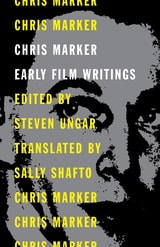
Chris Marker
Early Film WritingsChris Marker
University of Minnesota Press, 2024
Formative writings by French avant-garde filmmaker Chris Marker
It is hard to imagine French cinema without La Jetée (1962), the time-travel short feature by the reclusive French filmmaker Christian François Bouche-Villeneuve, better known as Chris Marker. He not only influenced artists ranging from David Bowie to J. G. Ballard but also inspired the cult film 12 Monkeys. Marker’s influence expanded beyond his own films through his writings for the French monthly Esprit as well as anthologies and newly founded film publications.
This first English translation of Marker’s early writings on film brings together reviews and essays, published between 1948 and 1955, that span the topics of film style, adaptation, and ideology, as well as animation and the debates surrounding 3-D and wide-screen technologies, ranging from late silent-era films to postwar Hollywood’s efforts to contend with the rise of television. Readers will find commentary on Laurence Olivier’s 1944 screen adaptation of Henry V, a scathing review of Robert Montgomery’s Lady in the Lake (1947), critiques of Walt Disney productions, a discussion of the pitfalls of prioritizing commercial success over aesthetic values, and more.
An indispensable resource for cinephiles and scholars alike, these texts document the emergence of Marker’s critical voice and situate him alongside such contemporaries as André Bazin and Eric Rohmer, as well as the future French New Wave figures Jean-Luc Godard and François Truffaut. They show how his remarks on individual films open onto his engagement with films as social and cultural phenomena.
Christina Rossetti and Illustration
A Publishing HistoryLorraine Janzen Kooistra
Ohio University Press, 2002
Readers do not always take into account how books that combine image and text make their meanings. But for the Pre-Raphaelite poet Christina Rossetti, such considerations were central.
Christina Rossetti and Illustration maps the production and reception of Rossetti’s illustrated poetry, devotional prose, and work for children, both in the author’s lifetime and in posthumous twentieth-century reprints.
Lorraine Janzen Kooistra’s reading of Rossetti’s illustrated works reveals for the first time the visual-verbal aesthetic that was fundamental to Rossetti’s poetics. Her exhaustive archival research brings to light new information on how Rossetti’s commitment to illustration and attitudes to copyright and control influenced her transactions with publishers and the books they produced. Janzen Kooistra also tracks the poet’s reception in the twentieth century through a complex web of illustrated books produced for a wide range of audiences.
Analyzing an impressive array of empirical data, Janzen Kooistra shows how Rossetti’s packaging for commodity consumption—by religious presses, publishers of academic editions and children’s picture books, and makers of erotica and collectibles—influenced the reception of her work and her place in literary history.

Cindy Sherman's Office Killer
Another Kind of MonsterDahlia Schweitzer
Intellect Books, 2014
The first book on this neglected piece of an esteemed artist’s oeuvre, Cindy Sherman’s “Office Killer” rescues the film from critical oblivion and situates it next to the artist’s other iconic works.
Cineaste on Film Criticism, Programming, and Preservation in the New Millennium
Edited by Cynthia Lucia and Rahul Hamid
University of Texas Press, 2017
Digital technology and the Internet have revolutionized film criticism, programming, and preservation in deeply paradoxical ways. The Internet allows almost everyone to participate in critical discourse, but many print publications and salaried positions for professional film critics have been eliminated. Digital technologies have broadened access to filmmaking capabilities, as well as making thousands of older films available on DVD and electronically. At the same time, however, fewer older films can be viewed in their original celluloid format, and newer, digitally produced films that have no “material” prototype are threatened by ever-changing servers that render them obsolete and inaccessible.
Cineaste, one of the oldest and most influential publications focusing on film, has investigated these trends through a series of symposia with the top film critics, programmers, and preservationists in the United States and beyond. This volume compiles several of these symposia: “Film Criticism in America Today” (2000), “International Film Criticism Today” (2005), “Film Criticism in the Age of the Internet” (2008), “Film Criticism: The Next Generation” (2013), “The Art of Repertory Film Exhibition and Digital Age Challenges” (2010), and “Film Preservation in the Digital Age” (2011). It also includes interviews with the late, celebrated New Yorker film critic Pauline Kael and the critic John Bloom (“Joe Bob Briggs”), as well as interviews with the programmers/curators Peter von Bagh and Mark Cousins and with the film preservationist George Feltenstein. This authoritative collection of primary-source documents will be essential reading for scholars, students, and film enthusiasts.
Cinema '62
The Greatest Year at the MoviesStephen Farber
Rutgers University Press, 2024
Lawrence of Arabia, The Miracle Worker, To Kill a Mockingbird, The Manchurian Candidate, Gypsy, Sweet Bird of Youth, The Longest Day, The Music Man, What Ever Happened to Baby Jane, and more.
Most conventional film histories dismiss the early 1960s as a pallid era, a downtime between the heights of the classic studio system and the rise of New Hollywood directors like Scorsese and Altman in the 1970s. It seemed to be a moment when the movie industry was floundering as the popularity of television caused a downturn in cinema attendance. Cinema ’62 challenges these assumptions by making the bold claim that 1962 was a peak year for film, with a high standard of quality that has not been equaled since.
Stephen Farber and Michael McClellan show how 1962 saw great late-period work by classic Hollywood directors like John Ford, Howard Hawks, and John Huston, as well as stars like Bette Davis, James Stewart, Katharine Hepburn, and Barbara Stanwyck. Yet it was also a seminal year for talented young directors like Sidney Lumet, Sam Peckinpah, and Stanley Kubrick, not to mention rising stars like Warren Beatty, Jane Fonda, Robert Redford, Peter O’Toole, and Omar Sharif. Above all, 1962—the year of To Kill a Mockingbird and The Manchurian Candidate—gave cinema attendees the kinds of adult, artistic, and uncompromising visions they would never see on television, including classics from Fellini, Bergman, and Kurosawa. Culminating in an analysis of the year’s Best Picture winner and top-grossing film, Lawrence of Arabia, and the factors that made that magnificent epic possible, Cinema ’62 makes a strong case that the movies peaked in the Kennedy era.
Cinema 1
The Movement-ImageGilles Deleuze
University of Minnesota Press, 1986
Cinema 2
The Time-ImageGilles Deleuze
University of Minnesota Press, 1989
Cinema 2: The Time-Image brings to completion Gilles Deleuze’s work on the theoretical implications of the cinematographic image. In Cinema 1: The Movement-Image, Deleuze proposed a new way to understand narrative cinema, based on Henri Bergson’s notion of the movement-image and C. S. Peirce’s classification of images and signs. In Cinema 2, he explains why, since World War II, time has come to dominate film: the fragment or solitary image, in supplanting narrative cinema’s rational development of events, illustrates this new significance of time.
Deleuze ascribes this shift to the condition of postwar Europe: the situations and spaces “we no longer know how to describe”—buildings deserted but inhabited, cities undergoing demolition or reconstruction—and the new race of characters who emerged from this rubble, mutants, who “saw rather than acted.” Deleuze discusses the films of Rossellini, De Sica, Fellini, Godard, Resnais, Antonioni, Pasolini, Rohmer, Ophuls, and many others, suggesting that contemporary cinema, far from being dead, is only beginning to find new ways to capture time in the image.