Results by title
51 books match the query 'Holocaust survivors' and 4 start with c
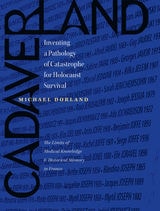
Cadaverland
Inventing a Pathology of Catastrophe for Holocaust Survival [The Limits of Medical Knowledge and Historical Memory in France]Michael Dorland
Brandeis University Press, 2009
In this extraordinary study, Michael Dorland explores sixty years of medical attempts by French doctors (mainly in the fields of neuropsychiatry and psychoanalysis) to describe the effects of concentration camp incarceration on Holocaust survivors. Dorland begins with a discussion of the liberation of concentration camp survivors, their stay in deportation camps, and eventual return to France, analyzing the circulation of mainly medical (neuropsychiatric) knowledge, its struggles to establish a symptomology of camp effects, and its broadening out into connected medical fields such as psychoanalysis. He then turns specifically to the French medical doctors who studied Holocaust survivors, and he investigates somatic, psychological, and holistic conceptions of survivors as patients and human beings. The final third of the book offers a comparative look at the “psy-science” approach to Holocaust survival beyond France, particularly in the United States and Israel. He illuminates the peculiar journey of a medical discourse that began in France but took on new forms elsewhere, eventually expanding into nonmedical fields to create the basis of the “traumato-culture” with which we are familiar today. Embedding his analysis of different medical discourses in the sociopolitical history of France in the twentieth century, he also looks at the French Jewish Question as it affected French medicine, the effects of five years of Nazi Occupation, France’s enthusiastic collaboration, and the problems this would pose for postwar collective memory.
[more]
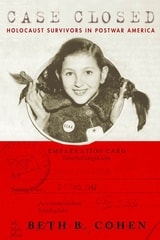
Case Closed
Holocaust Survivors in Postwar AmericaCohen, Beth B
Rutgers University Press, 2006
Following the end of World War II, it was widely reported by the media that Jewish refugees found lives filled with opportunity and happiness in America. However, for most of the 140,000 Jewish Displaced Persons (DPs) who immigrated to the United States from Europe in the years between 1946 and 1954, it was a much more complicated story.
Case Closed challenges the prevailing optimistic perception of the lives of Holocaust survivors in postwar America by scrutinizing their first years through the eyes of those who lived it. The facts brought forth in this book are supported by case files recorded by Jewish social service workers, letters and minutes from agency meetings, oral testimonies, and much more.
Cohen explores how the Truman Directive allowed the American Jewish community to handle the financial and legal responsibility for survivors, and shows what assistance the community offered the refugees and what help was not available. She investigates the particularly difficult issues that orphan children and Orthodox Jews faced, and examines the subtleties of the resettlement process in New York and other locales. Cohen uncovers the truth of survivors' early years in America and reveals the complexity of their lives as "New Americans."
[more]
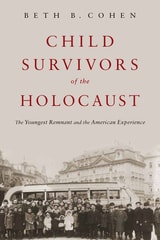
Child Survivors of the Holocaust
The Youngest Remnant and the American ExperienceCohen, Beth B
Rutgers University Press, 2018
2017 Wiener Library Ernst Fraenkel Prize (WLEFP) Finalist
The majority of European Jewish children alive in 1939 were murdered during the Holocaust. Of 1.5 million children, only an estimated 150,000 survived. In the aftermath of the Shoah, efforts by American Jews brought several thousand of these child survivors to the United States. In Child Survivors of the Holocaust, historian Beth B. Cohen weaves together survivor testimonies and archival documents to bring their story to light. She reveals that even as child survivors were resettled and “saved,” they struggled to adapt to new lives as members of adoptive families, previously unknown American Jewish kin networks, or their own survivor relatives. Nonetheless, the youngsters moved ahead. As Cohen demonstrates, the experiences both during and after the war shadowed their lives and relationships through adulthood, yet an identity as “survivors” eluded them for decades. Now, as the last living link to the Holocaust, the voices of Child Survivors are finally being heard.
The majority of European Jewish children alive in 1939 were murdered during the Holocaust. Of 1.5 million children, only an estimated 150,000 survived. In the aftermath of the Shoah, efforts by American Jews brought several thousand of these child survivors to the United States. In Child Survivors of the Holocaust, historian Beth B. Cohen weaves together survivor testimonies and archival documents to bring their story to light. She reveals that even as child survivors were resettled and “saved,” they struggled to adapt to new lives as members of adoptive families, previously unknown American Jewish kin networks, or their own survivor relatives. Nonetheless, the youngsters moved ahead. As Cohen demonstrates, the experiences both during and after the war shadowed their lives and relationships through adulthood, yet an identity as “survivors” eluded them for decades. Now, as the last living link to the Holocaust, the voices of Child Survivors are finally being heard.
[more]
Conversations with Primo Levi
Ferdinando Camon
Northwestern University Press, 1989
Beginning in 1982 and at intervals over the next four years Ferdinando Camon traveled to Turin for a series of meetings with Primo Levi. This book is the record of their dialogues. Levi spoke of the war, of anti-Semitism, of the camps, of German guilt, of Israel's emergence, and of his own extraordinary life and work. The give-and-take of the discussion, its tone, its lucidity, its intelligence, lift it well above the level and format of the usual journalistic interview with a celebrated author.
[more]