Results by title
69 books match the query 'Homosexuality and literature' and 5 start with c
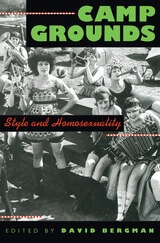
Camp Grounds
Style and HomosexualityEdited by David Bergman
University of Massachusetts Press, 1993
The concept of camp has never been easy to define. Derived from the French verb camper, “to pose,” it has been variously interpreted as a style that favors exaggeration, an ironic attitude toward the cultural mainstream, and a form of aestheticism that celebrates artifice over beauty. At the same time, camp has been long associated with homosexual culture, or at least with a self-conscious eroticism that questions traditional gender constructions.
The sixteen essays on camp included in this book explore further the relationship between style and homosexuality, showing how camp has made its way into every aspect of our cultural lives: theater, popular music, opera, film, and literature. Beginning with an overview of what camp is, where it came from, and how it operates, the chapter addresses topics ranging from the “high camp” of Whitman and Proust to the “low camp” of drag queen culture and gay fanzines. Together they carry forward a conversation that began more than twenty-five years ago, before Stonewall and AIDS, when Susan Sontag published her memorable “Notes on Camp.”
Chaucer’s Queer Nation
Glenn Burger
University of Minnesota Press, 2003
Draws parallels between questions of identity in Chaucer’s time and our own.
Bringing the concerns of queer theory and postcolonial studies to bear on Chaucer’s Canterbury Tales, this ambitious book compels a rethinking not only of this most canonical of works, but also of questions of sexuality and gender in pre- and postmodern contexts, of issues of modernity and nation in historiography, and even of the enterprise of historiography itself. Glenn Burger shows us Chaucer uneasily situated between the medieval and the modern, his work representing new forms of sexual and communal identity but also enacting the anxieties provoked by such departures from the past.
Burger argues that, under the pressure of producing a poetic vision for a new vernacular English audience in the Canterbury Tales, Chaucer reimagines late medieval relations between the body and the community. In close readings that are at once original, provocative, and convincing, Chaucer’s Queer Nation helps readers to see the author and audience constructed with and by the Tales as subjects-in-process caught up in a conflicted moment of "becoming." In turn, this historicization unsettles present-day assumptions about identity with the realization that social organizations of the body can be done differently.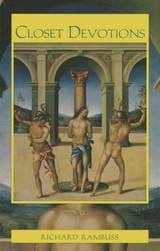
Closet Devotions
Richard Rambuss
Duke University Press, 1998
Through startling rereadings of works ranging from the devotional verse of the metaphysical poets (Donne, Herbert, Crashaw, and Traherne) to photographer Andres Serrano’s controversial “Piss Christ,” from Renaissance religious iconography to contemporary gay porn, Rambuss uncovers the highly charged erotic imagery that suffuses religious devotional art and literature. And he explores one of Christian culture’s most guarded (and literal) closets—the prayer closet itself, a privileged space where the vectors of same-sex desire can travel privately between the worshiper and his or her God.
Elegantly written and theoretically astute, Closet Devotions illuminates the ways in which sacred Christian devotion is homoeroticized, a phenomenon that until now has gone unexplored in current scholarship on religion, the body, and its passions. This book will attract readers across a wide array of disciplines, including gay and lesbian studies, literary theory and criticism, Renaissance studies, and religion.

Closet Writing/Gay Reading
The Case of Melville's PierreJames Creech
University of Chicago Press, 1994
In Closet Writing/Gay Reading, Creech shows how a literary critic can be receptive to implicit and closeted sexual content. Forcefully advocating a tactic of identification and projection in literary analysis, he lends renewed currency to the kind of "sentimental" response to literature that continental theory—particularly deconstruction—has sought to discredit.
In the second half of his book, Creech sets out to analyze what he considers the exemplary novel of the nineteenth-century closet, Melville's Pierre, or: The Ambiguities. By approaching Pierre as the gay man Melville longed to have as its reader, Creech is able to decipher the novel's "encrypted erotics" and to reveal that Melville's apparent tale of incest is actually a homosexual novel in disguise. The closeted "address" to queer-sensitive readers that Pierre disseminates finally receives a critical reading that strives to be explicit, shareable, and public.
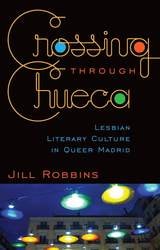
Crossing through Chueca
Lesbian Literary Culture in Queer MadridJill Robbins
University of Minnesota Press, 2010
Jill Robbins traverses the various literary spaces of the city associated with queer culture, in particular the gay barrio of Chueca, revealing how it is a product of interrelations—a site crisscrossed by a multiplicity of subjects who constitute it as a queer space through the negotiation of their sexual, racial, gender, and class identities. Robbins recognizes Chueca as a political space as well, a refuge from homophobia. She also shows how the spatial and literary practices of Chueca relate to economic issues.
In examining how women’s sexual identities have become visible in and through the Chueca phenomenon, this work is a revealing example of transnational queer studies within the broader Western discussion on gender and sexuality.