Results by title
85 books match the query 'Housing' and 4 start with c
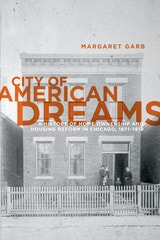
City of American Dreams
A History of Home Ownership and Housing Reform in Chicago, 1871-1919Margaret Garb
University of Chicago Press, 2005
In this vivid portrait of life in Chicago in the fifty years after the Civil War, Margaret Garb traces the history of the American celebration of home ownership. As the nation moved from an agrarian to an industrialized urban society, the competing visions of capitalists, reformers, and immigrants turned the urban landscape into a testing ground for American values. Neither a natural progression nor an inevitable outcome, the ideal of home ownership emerged from the struggles of industrializing cities. Garb skillfully narrates these struggles, showing how the American infatuation with home ownership left the nation's cities sharply divided along class and racial lines.
Based on research of real estate markets, housing and health reform, and ordinary homeowners—African American and white, affluent and working class—City of American Dreams provides a richly detailed picture of life in one of America's great urban centers. Garb shows that the pursuit of a single-family house set on a tidy yard, commonly seen as the very essence of the American dream, resulted from clashes of interests and decades of struggle.
Based on research of real estate markets, housing and health reform, and ordinary homeowners—African American and white, affluent and working class—City of American Dreams provides a richly detailed picture of life in one of America's great urban centers. Garb shows that the pursuit of a single-family house set on a tidy yard, commonly seen as the very essence of the American dream, resulted from clashes of interests and decades of struggle.
[more]
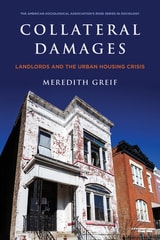
Collateral Damages
Landlords and the Urban Housing CrisisMeredith Greif
Russell Sage Foundation, 2022
Changes in federal housing policies over the past several decades shifted the primary responsibility for providing low-income renters with affordable housing from the government to private landlords. Federal, state, and local governments have passed laws to ensure that low-income renters are protected from illicit landlording practices. Yet we know little about how private landlords experience local housing regulations. In Collateral Damages, sociologist Meredith Greif examines how local laws affect private landlords and whether tenants are, in fact, being adequately protected.
For three years, Greif followed sixty private landlords serving low- and moderate-income residents in the Cleveland, Ohio, metropolitan area to better understand how local regulations, such as criminal activity nuisance ordinances (CANOs) and local water billing regulations, affect their landlording practices. CANOs are intended to protect communities by discouraging criminal activity on private properties. Property owners can face financial and criminal sanctions if they do not abate nuisance activities, which can include littering, noise, drug use, and calls for police assistance, including calls for domestic violence. Local water billing regulations hold landlords responsible for delinquent water bills, even in cases where the account is registered in the tenant’s name. Greif finds that such laws often increase landlords’ sense of “financial precarity” – the real or perceived uncertainty that their business is financially unsustainable – by holding them responsible for behavior they feel is out of their control. Feelings of financial uncertainty led some landlords to use illegitimate business practices against their tenants, including harassment, oversurveillance, poor property upkeep, and illegal evictions. And to avoid to financial penalties associated with CANOs and delinquent water bills, some landlords engage in discriminatory screening of vulnerable potential tenants who are unemployed or have histories of domestic violence or drug use. In this sense, by promoting a sense of financial insecurity among landlords, laws meant to protect renters ultimately had the opposite effect.
While some landlords, particularly those who rented a larger number of units, were able to operate their businesses both lawfully and profitably, the majority could not. Greif offers practical recommendations to address the concerns of small- and mid-sized landlords, such as regular meetings that bring landlords and local authorities together to engage in constructive dialogue about local housing policy, issues, and concerns. She also proposes policy recommendations to protect renters, such as establishing the right to counsel for lower-income tenants in eviction hearings and enacting a federal renter’s tax credit.
Collateral Damages is an enlightening investigation on how local laws and practices perpetuate disadvantage among marginalized populations and communities, in ways that are hidden and often unintended.
[more]
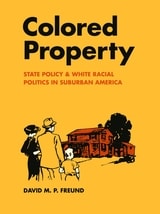
Colored Property
State Policy and White Racial Politics in Suburban AmericaDavid M. P. Freund
University of Chicago Press, 2007
Northern whites in the post–World War II era began to support the principle of civil rights, so why did many of them continue to oppose racial integration in their communities? Challenging conventional wisdom about the growth, prosperity, and racial exclusivity of American suburbs, David M. P. Freund argues that previous attempts to answer this question have overlooked a change in the racial thinking of whites and the role of suburban politics in effecting this change. In Colored Property, he shows how federal intervention spurred a dramatic shift in the language and logic of residential exclusion—away from invocations of a mythical racial hierarchy and toward talk of markets, property, and citizenship.
Freund begins his exploration by tracing the emergence of a powerful public-private alliance that facilitated postwar suburban growth across the nation with federal programs that significantly favored whites. Then, showing how this national story played out in metropolitan Detroit, he visits zoning board and city council meetings, details the efforts of neighborhood “property improvement” associations, and reconstructs battles over race and housing to demonstrate how whites learned to view discrimination not as an act of racism but as a legitimate response to the needs of the market. Illuminating government’s powerful yet still-hidden role in the segregation of U.S. cities, Colored Property presents a dramatic new vision of metropolitan growth, segregation, and white identity in modern America.
[more]
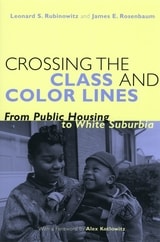
Crossing the Class and Color Lines
From Public Housing to White SuburbiaLeonard S. Rubinowitz and James E. Rosenbaum
University of Chicago Press, 2000
From 1976 to 1998, the Gautreaux Assisted Housing Program moved over 7,000 low-income black families from Chicago's inner city to middle-class white suburbs—the largest and longest-running residential, racial, and economic integration effort in American history. Crossing the Class and Color Lines is the story of that project, from the initial struggles and discomfort of the relocated families to their eventual successes in employment and education—cementing the sociological concept of the "neighborhood effect" and shattering the myth that inner-city blacks cannot escape a "culture of poverty."
"This book's history of Chicago public housing should be required reading for anyone interested in social policy in the United States."—Jens Ludwig, Social Service Review
"[The authors'] work is rightly cited as one of the important precedents in the field. . . . This is a remarkable, unassailable accomplishment and this book is an important record of their scholarly contribution."—John M. Goering, Ethnic and Racial Studies
[more]