Results by title
125 books match the query 'Human-animal relationships' and 6 start with c
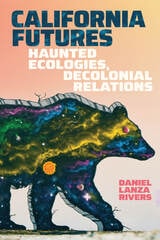
California Futures
Haunted Ecologies, Decolonial RelationsDaniel Lanza Rivers
Duke University Press, 2026
California Futures is a critical study of California as a site of liberatory dreaming—one that takes up the history, politics, and afterlives of the region’s colonial imaginings as well as archives of resistance and world-making which strive toward Indigenous, decolonial, Black, queer, feminist, and anti-white supremacist futures. Attending carefully to the colonial, commercial, and environmental entanglements of the region, Daniel Lanza Rivers offers an account of the processes of speculation that worlded California into being. Rivers examines case studies such as the colonial cultures of grizzly bear eradication and reintroduction; the convergence of drought, industrial agriculture, and environmental toxicity in California's Central Valley; utopianism in the Klamath Mountains, from the Black Bear Ranch commune to Octavia Butler’s Parable series; dam removal and Native climate adaptation on the Klamath watershed; and the policing of unhoused people around Oakland's Lake Merritt. Through these case studies, Rivers interrogates the long histories of settler conquest, extractive and racial capitalism, and heteropatriarchy that have shaped California. They chart strategies for thinking beyond the colonial Anthropocene and toward the post-extractive and liberatory futures that emerge from and with decolonial land relations.
[more]
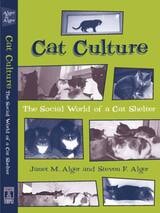
Cat Culture
The Social World Of A Cat ShelterJanet M. Alger and Steven F. Alger
Temple University Press, 2002
Even people who live with cats and have good reason to know better insist that cats are aloof and uninterested in relating to humans. Janet and Steven Alger contend that the anti-social cat is a myth; cats form close bonds with humans and with each other. In the potentially chaotic environment of a shelter that houses dozens of uncaged cats, they reveal a sense of self and build a culture—a shared set of rules, roles, and expectations that organizes their world and assimilates newcomers.As volunteers in a local cat shelter for eleven years, the Algers came to realize that despite the frequency of new arrivals and adoptions, the social world of the shelter remained quite stable and pacific. They saw even feral cats adapt to interaction with humans and develop friendships with other cats. They saw established residents take roles as welcomers and rules enforcers. That is, they saw cats taking an active interest in maintaining a community in which they could live together and satisfy their individual needs. Cat Culture's intimate portrait of life in the shelter, its engaging stories, and its interpretations of behavior, will appeal to general readers as well as academics interested in human and animal interaction.
[more]
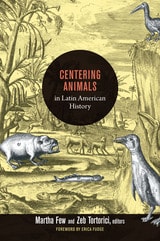
Centering Animals in Latin American History
Martha Few and Zeb Tortorici, eds.
Duke University Press, 2013
Centering Animals in Latin American History writes animals back into the history of colonial and postcolonial Latin America. This collection reveals how interactions between humans and other animals have significantly shaped narratives of Latin American histories and cultures. The contributors work through the methodological implications of centering animals within historical narratives, seeking to include nonhuman animals as social actors in the histories of Mexico, Guatemala, the Dominican Republic, Puerto Rico, Cuba, Chile, Brazil, Peru, and Argentina. The essays discuss topics ranging from canine baptisms, weddings, and funerals in Bourbon Mexico to imported monkeys used in medical experimentation in Puerto Rico. Some contributors examine the role of animals in colonization efforts. Others explore the relationship between animals, medicine, and health. Finally, essays on the postcolonial period focus on the politics of hunting, the commodification of animals and animal parts, the protection of animals and the environment, and political symbolism.
Contributors. Neel Ahuja, Lauren Derby, Regina Horta Duarte, Martha Few, Erica Fudge, León García Garagarza, Reinaldo Funes Monzote, Heather L. McCrea, John Soluri, Zeb Tortorici, Adam Warren, Neil L. Whitehead
[more]
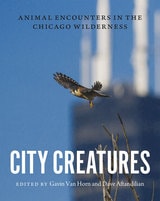
City Creatures
Animal Encounters in the Chicago WildernessEdited by Gavin Van Horn and Dave Aftandilian
University of Chicago Press, 2015
Read about Ten Years of City Creatures at the Center for Humans and Nature
We usually think of cities as the domain of humans—but we are just one of thousands of species that call the urban landscape home. Chicago residents knowingly move among familiar creatures like squirrels, pigeons, and dogs, but might be surprised to learn about all the leafhoppers and water bears, black-crowned night herons and bison, beavers and massasauga rattlesnakes that are living alongside them. City Creatures introduces readers to an astonishing diversity of urban wildlife with a unique and accessible mix of essays, poetry, paintings, and photographs.
We usually think of cities as the domain of humans—but we are just one of thousands of species that call the urban landscape home. Chicago residents knowingly move among familiar creatures like squirrels, pigeons, and dogs, but might be surprised to learn about all the leafhoppers and water bears, black-crowned night herons and bison, beavers and massasauga rattlesnakes that are living alongside them. City Creatures introduces readers to an astonishing diversity of urban wildlife with a unique and accessible mix of essays, poetry, paintings, and photographs.
The contributors bring a story-based approach to this urban safari, taking readers on birding expeditions to the Magic Hedge at Montrose Harbor on the North Side, canoe trips down the South Fork of the Chicago River (better known as Bubbly Creek), and insect-collecting forays or restoration work days in the suburban forest preserves.
The book is organized into six sections, each highlighting one type of place in which people might encounter animals in the city and suburbs. For example, schoolyard chickens and warrior wasps populate “Backyard Diversity,” live giraffes loom at the zoo and taxidermy-in-progress pheasants fascinate museum-goers in “Animals on Display,” and a chorus of deep-freeze frogs awaits in “Water Worlds.” Although the book is rooted in Chicago’s landscape, nature lovers from cities around the globe will find a wealth of urban animal encounters that will open their senses to a new world that has been there all along. Its powerful combination of insightful narratives, numinous poetry, and full-color art throughout will help readers see the city—and the creatures who share it with us—in an entirely new light.
[more]
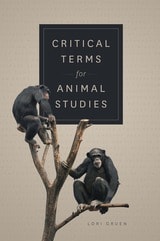
Critical Terms for Animal Studies
Edited by Lori Gruen
University of Chicago Press, 2018
An essential primer and handbook for students and scholars in Animal Studies
Animal Studies is a rapidly growing interdisciplinary field devoted to examining, understanding, and critically evaluating the complex relationships between humans and
other animals. Scholarship in Animal Studies draws on a variety of methodologies to explore these multi-faceted relationships in order to help us understand the ways in which other animals figure in our lives and we in theirs.
Bringing together the work of a group of internationally distinguished scholars, the contribution in Critical Terms for Animal Studies offers distinct voices and diverse perspectives, exploring significant concepts and asking important questions. How do we take non-human animals seriously, not simply as metaphors for human endeavors, but as subjects themselves? What do we mean by anthropocentrism, captivity, empathy, sanctuary, and vulnerability, and what work do these and other critical terms do in Animal Studies?
An indispensable reference for the field, Critical Terms for Animal Studies not only provides a framework for thinking about animals as subjects of their own experiences, but also serves as a touchstone to help us think differently about our conceptions of what it means to be human, and the impact human activities have on the more than human world.
[more]
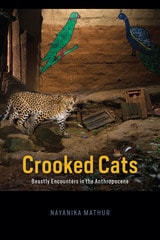
Crooked Cats
Beastly Encounters in the AnthropoceneNayanika Mathur
University of Chicago Press, 2021
Big cats—tigers, leopards, and lions—that make prey of humans are commonly known as “man-eaters.” Anthropologist Nayanika Mathur reconceptualizes them as cats that have gone off the straight path to become “crooked.” Building upon fifteen years of research in India, this groundbreaking work moves beyond both colonial and conservationist accounts to place crooked cats at the center of the question of how we are to comprehend a planet in crisis.
There are many theories on why and how a big cat comes to prey on humans, with the ecological collapse emerging as a central explanatory factor. Yet, uncertainty over the precise cause of crookedness persists. Crooked Cats explores in vivid detail the many lived complexities that arise from this absence of certain knowledge to offer startling new insights into both the governance of nonhuman animals and their intimate entanglements with humans. Through creative ethnographic storytelling, Crooked Cats illuminates the Anthropocene in three critical ways: as method, as a way of reframing human-nonhuman relations on the planet, and as a political tool indicating the urgency of academic engagement. Weaving together “beastly tales” spun from encounters with big cats, Mathur deepens our understanding of the causes, consequences, and conceptualization of the climate crisis.
There are many theories on why and how a big cat comes to prey on humans, with the ecological collapse emerging as a central explanatory factor. Yet, uncertainty over the precise cause of crookedness persists. Crooked Cats explores in vivid detail the many lived complexities that arise from this absence of certain knowledge to offer startling new insights into both the governance of nonhuman animals and their intimate entanglements with humans. Through creative ethnographic storytelling, Crooked Cats illuminates the Anthropocene in three critical ways: as method, as a way of reframing human-nonhuman relations on the planet, and as a political tool indicating the urgency of academic engagement. Weaving together “beastly tales” spun from encounters with big cats, Mathur deepens our understanding of the causes, consequences, and conceptualization of the climate crisis.
[more]