Results by title
85 books match the query 'Humanities' and 4 start with c
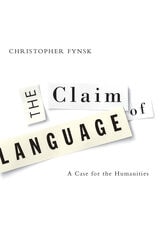
Claim Of Language
A Case For The HumanitiesChristopher Fynsk
University of Minnesota Press, 2004
Argues for the importance of humanities research in an era of globalization and technical reason
The humanities—in their conceptual and intellectual specificity, disciplinary rigor, and ethical, social, and political potential—are very much in need of defense and rearticulation in our time, particularly from a perspective that moves beyond the political and philosophical reductions of identity politics. In The Claim of Language, Christopher Fynsk clearly and eloquently does just that. Leaving aside polemics, Fynsk asserts that discourses in the humanities will find real ethical-political purchase when they engage with the material events in art, literature, and social life that call for humanistic reflection.
Fynsk describes the collapse of the traditional terms of defense in the contemporary academy, and then sets out to establish that the humanities are more than a loose affiliation of academic disciplines and research projects. Showing how events in language raise questions fundamental to the humanities—questions about the nature of human experience in the modern era and the nature of the human itself—The Claim of Language proposes a renewed relationship to language as a way to rethink humanistic research. Fynsk extends his philosophical meditation with two essays on the university and the politics of philosophy. The first, devoted to the work of Gérard Granel, explores the political implications of a quite radical project of fundamental critique. The second focuses on Jacques Derrida’s propositions for a reconception of the nature and task of critical thought in the new Collège International de Philosophie.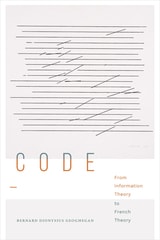
Code
From Information Theory to French TheoryBernard Dionysius Geoghegan
Duke University Press, 2022
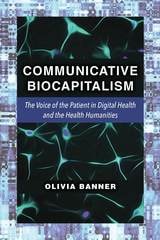
Communicative Biocapitalism
The Voice of the Patient in Digital Health and the Health HumanitiesOlivia Banner
University of Michigan Press, 2017
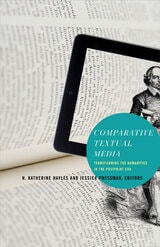
Comparative Textual Media
Transforming the Humanities in the Postprint EraN. Katherine Hayles
University of Minnesota Press, 2013
For the past few hundred years, Western cultures have relied on print. When writing was accomplished by a quill pen, inkpot, and paper, it was easy to imagine that writing was nothing more than a means by which writers could transfer their thoughts to readers. The proliferation of technical media in the latter half of the twentieth century has revealed that the relationship between writer and reader is not so simple. From telegraphs and typewriters to wire recorders and a sweeping array of digital computing devices, the complexities of communications technology have made mediality a central concern of the twenty-first century.
Despite the attention given to the development of the media landscape, relatively little is being done in our academic institutions to adjust. In Comparative Textual Media, editors N. Katherine Hayles and Jessica Pressman bring together an impressive range of essays from leading scholars to address the issue, among them Matthew Kirschenbaum on archiving in the digital era, Patricia Crain on the connection between a child’s formation of self and the possession of a book, and Mark Marino exploring how to read a digital text not for content but for traces of its underlying code.
Primarily arguing for seeing print as a medium along with the scroll, electronic literature, and computer games, this volume examines the potential transformations if academic departments embraced a media framework. Ultimately, Comparative Textual Media offers new insights that allow us to understand more deeply the implications of the choices we, and our institutions, are making.
Contributors: Stephanie Boluk, Vassar College; Jessica Brantley, Yale U; Patricia Crain, NYU; Adriana de Souza e Silva, North Carolina State U; Johanna Drucker, UCLA; Thomas Fulton, Rutgers U; Lisa Gitelman, New York U; William A. Johnson, Duke U; Matthew G. Kirschenbaum, U of Maryland; Patrick LeMieux; Mark C. Marino, U of Southern California; Rita Raley, U of California, Santa Barbara; John David Zuern, U of Hawai‘i at Mānoa.