115 books match the query 'Hungary' and 8 start with c

cover of Carrying a Secret in My Heart: Children of the Victims of the Reprisals after the Hungarian Revolution in 1956 - An Oral History

Carrying a Secret in My Heart

Children of the Victims of the Reprisals after the Hungarian Revolution in 1956 - An Oral History

Zsuzsanna Korösi

Central European University Press, 2003
For a decade now, the authors have been conducting interviews for Hungary's Oral History Archives, with the children of those Hungarians - national heroes, as they are generally seen today - who were imprisoned or executed for their involvement in the 1956 revolution. The vast body of material that has been collected, and is now at the disposal of sociologists, psychologists and others in the academic community, forms the basis of this volume. This is a documentation of memories of the revolt and, more particularly, its aftermath. The virtually spontaneous twelve-day uprising exerted a lasting effect on the fates of the families of the more than 20,000 who were imprisoned and 229 executed by the régime in the harsh reprisals that followed the crushing of the revolution (the last of them as late as the early 1960s), with active police surveillance extended to tens of thousands more. This intimidation, and the attendant social and economic devastation that it wrought, bore especially hard on the psyches, upbringing and education, and hence the subsequent opportunities and life courses of the children who grew up within those families. The material is grouped by theme: e.g. the effects on communication within families, changes in social status, how relatives and friends reacted, and what sorts of problems these children encountered in pursuing their studies, in trying to assimilate into society as adults, and in relating to those fathers who did return. In an appendix, the editors present detailed biographies of the people most directly affected, offering an unparalleled glimpse into the fates of those they interviewed. The documentation includes letters that the children wrote to their imprisoned fathers and the farewell letters of the executed to their families.
[more]
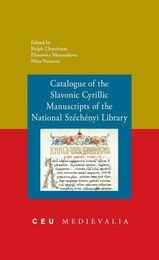
cover of Catalogue of the Slavonic Cyrillic Manuscripts of the National Szechenyi Library

Catalogue of the Slavonic Cyrillic Manuscripts of the National Szechenyi Library

Ralph Cleminson

Central European University Press, 2007
This volume provides a thorough introduction to the Cyrillic collection, and contains the detailed descriptions of the fifty-six Slavonic Cyrillic codices or fragments thereof held by the National Széchényi Library in Budapest, the vast majority of which are here described for the first time. The analysis of the codices has been done using the resources of modern technology. Written from the thirteenth to early nineteenth century, the codices were mostly produced within the confines of the historical Kingdom of Hungary. The catalogue is extensively illustrated with pictures of the most characteristic and decorative pages and a few covers of the codices.This publication is a further step towards the complete documentation of the Cyrillic manuscript heritage of Central Europe.
[more]
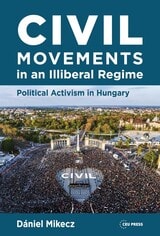
cover of Civil Movements in an Illiberal Regime: Political Activism in Hungary

Civil Movements in an Illiberal Regime

Political Activism in Hungary

Dániel Mikecz

Central European University Press, 2023

Dániel Mikecz addresses in this study the tensions between oppositional civil society and party-political actors. As successive elections demonstrate the increasing confidence of the illiberal regime of Viktor Orbán, left and liberal parties of the opposition have faced a prolonged crisis in credibility. At the same time, the civil society has not been immobile, and bottom-up initiatives, social and political movements, and non-governmental organizations have gained momentum in the public sphere. The ruling power is also active in the extra-parliamentary political arena. Through national consultations, Peace Marches, and other means, Orbán’s governing Fidesz party has mobilized voters outside of election campaigns and has implemented a so-called movement governance. The study offers a vivid examination of this top-down or astroturf mobilization of the regime.

Mikecz identifies the different patterns of activism and creates a coherent typology. He describes in detail each kind of activism based on opinion surveys, protest surveys and content analysis. The categorization and comprehensive exploration of civil movements provide a deep understanding of the mechanisms of illiberal postcommunist regimes.
[more]
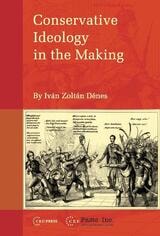
cover of Conservative Ideology in the Making

Conservative Ideology in the Making

Ivan Zoltan Denes

Central European University Press, 2009
The fifty years or so preceding the watershed of 1848–49 witnessed the emergence of liberal nationalism in Hungary, along with a transmutation of conservatism which appeared then as a party and an ideological system in the political arena. The specific features of the conservatism, combining the protection of the status quo with some reform measures, its strategic vision, conceptual system, argumentation, assessment criteria and values require an in depth exploration and analysis. Different conservative groups were in the background or in opposition from 1848 to 1918, while in the period between the two World Wars, they constituted the overwhelming majority of ruling parties. During the one-party system, from 1949 to 1989, the liberals and conservatives—like all other political groups—were illegal, a status from which they could later emerge upon the change of the political system. The inheritance of the autocratic system frozen up and undigested by the one-party state was thawed after the peaceful regime change, the constitutional revolution and its discrete components began to be reactivated, including the enemy images of earlier discourses. "Liberal" and "conservative" had become state-party stigmas in line with fascist, reactionary, rightist, and bourgeois. In reaction to that, at first conservative then liberal, intellectual fashions and renascences unfolded in the 1980s. The attempts by liberal and conservative advocates to find predecessors did not favor an objective approach.The first step toward objectivity is establishing distance from the different kinds of enemy images and their political idioms. This is a pressing need because, although several pioneering works have appeared on different variants of the Hungarian liberalisms and conservatisms, there are no serious unbiased syntheses. This work is urgent because the political poles of the constitutional revolution and the ensuing period have up till now been described in terms of different conspiracy theories.
[more]
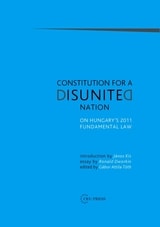
cover of Constitution for a Disunited Nation: On Hungary's 2011 Fundamental Law

Constitution for a Disunited Nation

On Hungary's 2011 Fundamental Law

Gábor Attila Tóth

Central European University Press, 2013
This collection is the most comprehensive account of the Fundamental Law and its underlying principles. The objective is to analyze this constitutional transition from the perspectives of comparative constitutional law, legal theory and political philosophy. The authors outline and analyze how the current constitutional changes are altering the basic structure of the Hungarian State. The key concepts of the theoretical inquiry are sociological and normative legitimacy, majoritarian and partnership approach to democracy, procedural and substantive elements of constitutionalism. Changes are also examined in the field of human rights, focusing on the principles of equality, dignity, and civil liberties.
[more]
cover of Constitutional Democracy

Constitutional Democracy

János Kis

Central European University Press, 2003
Constitutional democracy addresses the widely held belief that liberal democracy embodies an uneasy compromise of incompatible values: those of liberal rights on the one hand, and democratic equality on the other. Liberalism is said to compromise democracy, while democracy is said to endanger the values of liberalism. It is these theses that János Kis examines and tries to refute. Making the assumption that the alleged conflict is to be resolved at the level of institutions, he outlines a new theory of constitutional democracy. A wide range of problems encountered in constitutional democracy are discussed, such as the popular vote, popular sovereignty, and non-elected justices. The volume is composed of three parts. Part One, "Public Good and Civic Virtue", revisits the debate between liberals and democrats on how to interpret the democratic vote. In Part Two, "Liberal Democracy", the author proves that on the level of principles there is no incompatibility between liberalism and democracy and that liberal theory can demonstrate that democratic values follow from fundamental liberal values. In Part Three, "Constitutional Adjudication in a Democracy", the compatibility of democracy and judicial or constitutional review is analyzed and a theory of constitutionalism is outlined. This volume appeals to scholars in political philosophy, political science, and constitutional law, but is also recommended to all those interested in liberal and democratic theory, and the transition to democracy in Central and Eastern Europe.
[more]
cover of Constitutional Judiciary in a New Democracy: The Hungarian Constitutional Court

Constitutional Judiciary in a New Democracy

The Hungarian Constitutional Court

Laszlo Solyom and Georg Brunner, Editors

University of Michigan Press, 2000

Two in-depth essays and a selection of twenty-seven of the most important decisions present the Hungarian Constitutional Court as one of the most important actors of the transition into democracy in a post-communist country.
How was it possible that a new Court established in 1990, in a country just released from forty years of Communist rule, was able to enforce a Constitution, maintain the rule of law, and protect the freedom of its citizens in a way comparable to the U.S. Supreme Court? This new Court has issued decisions on topics ranging from the establishment of democracy and a market economy--privatization, compensation for the nationalization of property, and retroactive criminal legislation--as well as such issues as the constitutionality of capital punishment, abortion, freedom of speech and the media, and the separation of powers.
U.S. Supreme Court Justice Stephen Breyer provides the foreword and introduces the two essays that begin the book. In the first essay, Georg Brunner explains how the Court was set up and what its procedures are. In the second, Lázszló Sólyom describes systematically the emergence of the case-law of the Court and its jurisprudence on constitutional rights and on the powers and procedures of the other branches of government. The models followed by the Court are outlined, and its contribution to global constitutionalism explored.
Lázszló Sólyom is President of the Constitutional Court of Hungary and Professor of Law, ELTE University of Budapest. Georg Brunner is Professor of Law, University of Cologne, Germany.
[more]
cover of Constructing Identities over Time: “Bad Gypsies” and “Good Roma” in Russia and Hungary

Constructing Identities over Time

“Bad Gypsies” and “Good Roma” in Russia and Hungary

Jekatyerina Dunajeva

Central European University Press, 2022

Jekatyerina Dunajeva explores how two dominant stereotypes—“bad Gypsies” and “good Roma”—took hold in formal and informal educational institutions in Russia and Hungary. She shows that over centuries “Gypsies” came to be associated with criminality, lack of education, and backwardness. The second notion, of proud, empowered, and educated “Roma,” is a more recent development.

By identifying five historical phases—pre-modern, early-modern, early and “ripe” communism, and neomodern nation-building—the book captures crucial legacies that deepen social divisions and normalize the constructed group images. The analysis of the state-managed Roma identity project in the brief korenizatsija program for the integration of non-Russian nationalities into the Soviet civil service in the 1920s is particularly revealing, while the critique of contemporary endeavors is a valuable resource for policy makers and civic activists alike.

The top-down view is complemented with the bottom-up attention to everyday Roma voices. Personal stories reveal how identities operate in daily life, as Dunajeva brings out hidden narratives and subaltern discourse. Her handling of fieldwork and self-reflexivity is a model of sensitive research with vulnerable groups.

[more]