Results by title
101 books match the query 'Identity (Psychology)' and 4 start with c
Choosing an Identity
A General Model of Preference and Belief FormationSun-Ki Chai
University of Michigan Press, 2001
Social science research is fragmented by the widely differing and seemingly contradictory approaches used by the different disciplines of the social sciences to explain human action. Attempts at integrating different social science approaches to explain action have often been frustrated by the difficulty of incorporating cultural assumptions into rational choice theories without robbing them of their generality or making them too vague for predictions. Another problem has been the major disagreements among cultural theorists regarding the ways in which culture affects preferences and beliefs.
This book provides a general model of preference and belief formation, addressing the largest unresolved issue in rational choice theories of action. It attempts to play a bridging role between these approaches by augmenting and modifying the main ideas of the "rational choice" model to make it more compatible with empirical findings in other fields. The resulting model is used to analyze three major unresolved issues in the developing world: the sources of a government's economic ideology, the origins of ethnic group boundaries, and the relationship between modernization and violence.
Addressing theoretical problems that cut across numerous disciplines, this work will be of interest to a diversity of theoretically-minded scholars.
Sun-Ki Chai is Assistant Professor of Sociology, University of Arizona.
[more]
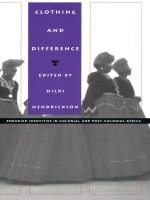
Clothing and Difference
Embodied Identities in Colonial and Post-Colonial AfricaHildi Hendrickson, ed.
Duke University Press, 1996
This volume examines the dynamic relationship between the body, clothing, and identity in sub-Saharan Africa and raises questions that have previously been directed almost exclusively to a Western and urban context. Unusual in its treatment of the body surface as a critical frontier in the production and authentification of identity, Clothing and Difference shows how the body and its adornment have been used to construct and contest social and individual identities in Nigeria, Zimbabwe, Tanzania, Kenya, and other African societies during both colonial and post-colonial times.
Grounded in the insights of anthropology and history and influenced by developments in cultural studies, these essays investigate the relations between the personal and the public, and between ideas about the self and those about the family, gender, and national groups. They explore the bodily and material creation of the changing identities of women, spirits, youths, ancestors, and entrepreneurs through a consideration of topics such as fashion, spirit possession, commodity exchange, hygiene, and mourning.
By taking African societies as its focus, Clothing and Difference demonstrates that factors considered integral to Western social development—heterogeneity, migration, urbanization, transnational exchange, and media representation—have existed elsewhere in different configurations and with different outcomes. With significance for a wide range of fields, including gender studies, cultural studies, art history, performance studies, political science, semiotics, economics, folklore, and fashion and textile analysis/design, this work provides alternative views of the structures underpinning Western systems of commodification, postmodernism, and cultural differentiation.
Contributors. Misty Bastian, Timothy Burke, Hildi Hendrickson, Deborah James, Adeline Masquelier, Elisha Renne, Johanna Schoss, Brad Weiss
[more]

Codependent Forevermore
The Invention of Self in a Twelve Step GroupLeslie Irvine
University of Chicago Press, 1999
In the same week that his father died, Alex came home to find his live-in fiancée in bed with another man. Paul is a divorced single parent who was recently forced to go on disability. Liz left an abusive husband and then found herself involved with yet another controlling man. These three, along with many others, have found a kind of salvation in Codependents Anonymous. Is this self-indulgent psychobabble or legitimate therapy? Are Twelve Step groups helpful communities or disguised addictions? And what exactly is codependency, the psychological condition that has apparently swept the United States? Leslie Irvine went inside "CoDA" to find out.
Codependent Forevermore is thus an insider's look at the world of people "in recovery" and the society that produced them. Through extensive interviews with CoDA members, case studies, and the meetings she attended regularly, Irvine develops a galvanizing perspective on contemporary Americans' sense of self. She explores the idea that selfhood is a narrative accomplishment, achieved by people telling stories to themselves and about themselves. She shows how Alex, Paul, Liz, and many others create a sense of self by combining elements of autobiography, culture, and social structure all within the adopted language of psycho-spirituality.
By following the progress and tribulations of CoDA members, Irvine gets to the heart of widespread American conceptions of relationships, selfhood, and community. Amidst the increasingly shrill criticism of the Twelve Step ethos, her reasoned and considered analysis of these groups reveals the sources of both their power and their popularity.
[more]
Cosmopolitan English and Transliteracy
Xiaoye You
Southern Illinois University Press, 2016
Winner, CCCC Research Impact Award, 2018
Despite the vast number of multilingual speakers in the United States and the pervasive influence of globalization, writing studies in this country is still inextricably linked to a nationalistic, monolingual English ideology. In Cosmopolitan English and Transliteracy, Xiaoye You addresses this issue by proposing that writing studies programs adopt a cosmopolitan perspective. Emphasizing local and global forms of citizenship and identification, You merges a humanistic vision with the rigor of social science, arguing that linguistic and cultural differences can be explored to recover human connections normally severed by geographical and semiotic borders.
You examines several areas of writing affected by globalization. He then turns to the composition classroom, highlighting the challenges and possibilities of crossing cultural boundaries in academic discourse before introducing a pedagogy aimed at fostering American students’ translingual and transcultural sensibilities. Included is a model for training writing teachers in the context of globalization, which aims to help instructors gain practical knowledge about the needs and resources of multilingual writers through communication technologies and cross-cultural partnerships.
By introducing cosmopolitan perspectives into the composition classroom, You challenges traditional assumptions about language, identity, and literacy as they relate to writing studies. Innovative and provocative, Cosmopolitan English and Transliteracy charts a new way forward for writing programs, with a call to focus on global rather than national identity.
[more]