Results by title
67 books match the query 'Imagination' and 3 start with c
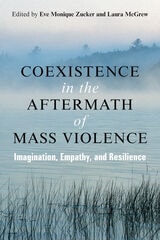
Coexistence in the Aftermath of Mass Violence
Imagination, Empathy, and ResilienceEdited by Eve Monique Zucker and Laura McGrew
University of Michigan Press, 2020
Coexistence in the Aftermath of Mass Violence demonstrates how imagination, empathy, and resilience contribute to the processes of social repair after ethnic and political violence. Adding to the literature on transitional justice, peacebuilding, and the anthropology of violence and social repair, the authors show how these conceptual pathways--imagination, empathy and resilience--enhance recovery, coexistence and sustainable peace. Coexistence (or reconciliation) is the underlying goal or condition desired after mass violence, enabling survivors to move forward with their lives. Imagination allows these survivors--victims, perpetrators, bystanders--to draw guidance and inspiration from their social and cultural imaginaries, to develop empathy, and to envision a future of peace and coexistence. Resilience emerges through periods of violence and its aftermaths through acts of survival, compassion, modes of rebuilding social worlds, and the establishment of a peaceful society.
Focusing on society at the grass roots level, the authors discuss the myriad and little understood processes of social repair that allow ruptured societies and communities to move toward a peaceful and stable future. The volume also illustrates some of the ways in which imagination, empathy, and resilience may contribute to the prevention of future violence and the authors conclude with a number of practical and policy recommendations. The cases include Cambodia, Rwanda, Sierra Leone, Somaliland, Columbia, the Southern Cone, Iraq, and Bosnia.

Control of the Imaginary
Reason and Imagination in Modern TimesLuiz Costa LimaTranslated by Ronald W. SousaIntroduction by Ronald W. SousaAfterword by Jochen Schulte-Sasse
University of Minnesota Press, 1989
Control of the Imaginary was first published in 1989. Minnesota Archive Editions uses digital technology to make long-unavailable books once again accessible, and are published unaltered from the original University of Minnesota Press editions.
In Control of the Imaginary Luiz Costa Lima explains how the distinction between truth and fiction emerged at the beginning of modern times and why, upon its emergence, fiction fell under suspicion. Costa Lima not only describes the continuous relationship between Western notions of reason and subjectivity over a broad time-frame—the Renaissance to the first decade of the twentieth century—but he uses this occasion to reexamine the literary traditions of France, Italy, Spain, Portugal, England, and Germany. The book reconstructs the dominant frames in the European tradition between the Middle Ages and the nineteenth century from the perspective of a Latin American who sees the culture of his native Brazil haunted by unresolved questions from the Northern Hemisphere. Costa Lima manages to synthesize positions from philosophy, anthropology, sociology, psychology, linguistics, and history without separating the theoretical discussion from his historical reconstructions.
The first chapter situates the problem and grounds the emergent distinction between truth and fiction in a very close analysis of one of the first European historians, Fernao Lopes, who sets the tone for the condemnation of fiction in the name of the truth of history and the potential for individual interpretation. Costa Lima pursues these notions through the aesthetic debates of the seventeenth and eighteenth centuries to the writings of the French historian Michelet. He also devotes an illuminating chapter to the invention of the strictures imposed on fiction.

Crossroads of Imagination
Czech Fantastic Literature 1831–1945Edited by Carleton Bulkin
Karolinum Press, 2026
The first anthology of early Czech fantastic writing in translation.
Crossroads of Imagination is a rare English-language study of modern science fiction’s precursors beyond the U.S. and Britain. Many translated for the first time, these thirty texts reflect a rich Euro-Atlantic tradition from the Romantic age to World War II. Authors include Jakub Arbes, Karel Čapek, Jiří Karásek ze Lvovic, Ladislav Klíma, Jiří Mordechai Langer, Jan Neruda, Emilie Procházková, Jan Weiss, and Julius Zeyer. The anthology highlights women’s, Jewish, and queer voices.
Prefaces to each selection uncover how new ideas and technologies shaped the European fantastic—positivism, mistrust of elites, pacifism, spiritism, and xenophobia, alongside expansions in communications, transportation, electrification, and technical education. Comparative essays and annotations look beyond “major” literatures and emphasize those of East-Central Europe. Archival images enliven this collection. General and genre readers alike will discover new stories and authors, as well as a fantastic tradition shared across Europe and North America before the advent of modern science fiction.