65 books match the query 'Imperialism in literature' and 7 start with c
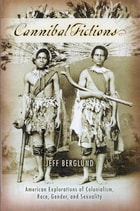
cover of Cannibal Fictions: American Explorations of Colonialism, Race, Gender, and Sexuality

Cannibal Fictions

American Explorations of Colonialism, Race, Gender, and Sexuality

Jeff Berglund

University of Wisconsin Press, 2006

    Objects of fear and fascination, cannibals have long signified an elemental "otherness," an existence outside the bounds of normalcy. In the American imagination, the figure of the cannibal has evolved tellingly over time, as Jeff Berglund shows in this study encompassing a strikingly eclectic collection of cultural, literary, and cinematic texts.
    Cannibal Fictions brings together two discrete periods in U.S. history: the years between the Civil War and World War I, the high-water mark in America's imperial presence, and the post-Vietnam era, when the nation was beginning to seriously question its own global agenda. Berglund shows how P. T. Barnum, in a traveling exhibit featuring so-called "Fiji cannibals," served up an alien "other" for popular consumption, while Edgar Rice Burroughs in his Tarzan of the Apes series tapped into similar anxieties about the eruption of foreign elements into a homogeneous culture. Turning to the last decades of the twentieth century, Berglund considers how treatments of cannibalism variously perpetuated or subverted racist, sexist, and homophobic ideologies rooted in earlier times. Fannie Flagg's novel Fried Green Tomatoes invokes cannibalism to new effect, offering an explicit critique of racial, gender, and sexual politics (an element to a large extent suppressed in the movie adaptation). Recurring motifs in contemporary Native American writing suggest how Western expansion has, cannibalistically, laid the seeds of its own destruction. And James Dobson's recent efforts to link the pro-life agenda to allegations of cannibalism in China testify still further to the currency and pervasiveness of this powerful trope.
    By highlighting practices that preclude the many from becoming one, these representations of cannibalism, Berglund argues, call into question the comforting national narrative of e pluribus unum.

[more]
cover of Captivity and Sentiment: Cultural Exchange in American Literature, 1682–1861

Captivity and Sentiment

Cultural Exchange in American Literature, 1682–1861

Michelle Burnham

Dartmouth College Press, 2000
In a radically new interpretation and synthesis of highly popular 18th- and 19th-century genres, Michelle Burnham examines the literature of captivity, and, using Homi Bhabha's concept of interstitiality as a base, provides a valuable redescription of the ambivalent origins of the US national narrative. Stories of colonial captives, sentimental heroines, or fugitive slaves embody a "binary division between captive and captor that is based on cultural, national, or racial difference," but they also transcend these pre-existing antagonistic dichotomies by creating a new social space, and herein lies their emotional power. Beginning from a simple question on why captivity, particularly that of women, so often inspires a sentimental response, Burnham examines how these narratives elicit both sympathy and pleasure. The texts carry such great emotional impact precisely because they "traverse those very cultural, national, and racial boundaries that they seem so indelibly to inscribe. Captivity literature, like its heroines, constantly negotiates zones of contact," and crossing those borders reveals new cultural paradigms to the captive and, ultimately, the reader.
[more]
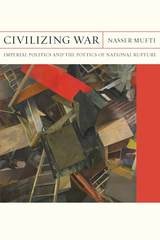
cover of Civilizing War: Imperial Politics and the Poetics of National Rupture

Civilizing War

Imperial Politics and the Poetics of National Rupture

Nasser Mufti

Northwestern University Press, 2018

Winner of the Gustave O. Arlt Award in the Humanities, awarded by the Council of Graduate Schools
Honorable Mention for the 2019 Sonya Rudikoff Prize, awarded by the Northeast Victorian Studies Association


Civilizing War
traces the historical transformation of civil war from a civil affair into an uncivil crisis. Civil war is today synonymous with the global refugee crisis, often serving as grounds for liberal-humanitarian intervention and nationalist protectionism.

In Civilizing War, Nasser Mufti situates this contemporary conjuncture in the long history of British imperialism, demonstrating how civil war has been and continues to be integral to the politics of empire. Through comparative readings of literature, criticism, historiography, and social analysis, Civilizing War shows how writers and intellectuals of Britain’s Anglophone empire articulated a “poetics of national rupture” that defined the metropolitan nation and its colonial others.

Mufti’s tour de force marshals a wealth of examples as diverse as Thomas Carlyle, Benjamin Disraeli, Friedrich Engels, Arthur Conan Doyle, Rudyard Kipling, Joseph Conrad, V. S. Naipaul, Nadine Gordimer, and Michael Ondaatje to examine the variety of forms this poetics takes—metaphors, figures, tropes, puns, and plot—all of which have played a central role in Britain’s civilizing mission and its afterlife. In doing so, Civilizing War shifts the terms of Edward Said’s influential Orientalism to suggest that imperialism was not only organized around the norms of civility but also around narratives of civil war.
[more]
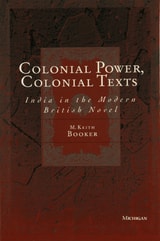
cover of Colonial Power, Colonial Texts: India in the Modern British Novel

Colonial Power, Colonial Texts

India in the Modern British Novel

M. Keith Booker

University of Michigan Press, 1997
Half a century after the Raj, India retains a major place in the British imagination. In Colonial Power, Colonial Texts, M. Keith Booker examines a number of British novels that deal with colonial rule in India in the first half of the twentieth century. The works discussed -- by authors such as Rudyard Kipling, E. M. Forster, George Orwell, Paul Scott, and J. G. Farrell -- date from both the colonial and postcolonial periods, and Booker pays attention as well to representations of India in both British and American popular culture, especially film. These various cultural texts open multiple viewpoints on the role of literature in the British vision of India and the role of India in the British conception of literature. Drawing particularly on the work of Georg Lukács and Fredric Jameson, Booker focuses on the treatment of British colonial power in these fictions as that treatment indicates how colonialism and decolonization participate in a larger historical process of modernization. The author uses a Marxist model of bourgeois cultural revolution to illustrate the ways these texts engage in productive exchanges with their historical context. Colonial Power, Colonial Texts will be of particular value to those who study the role of culture in colonialism and anticolonial resistance, as well as to students and scholars of modern British literature and culture.
[more]
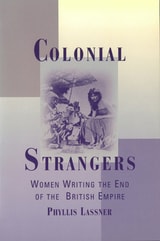
cover of Colonial Strangers: Women Writing the End of the British Empire

Colonial Strangers

Women Writing the End of the British Empire

Lassner, Phyllis

Rutgers University Press, 2004

Colonial Strangers revolutionizes modern British literary studies by showing how our interpretations of the postcolonial must confront World War II and the Holocaust. Phyllis Lassner’s analysis reveals how writers such as Muriel Spark, Olivia Manning, Rumer Godden, Phyllis Bottome, Elspeth Huxley, and Zadie Smith insist that World War II is critical to understanding how and why the British Empire had to end.

Drawing on memoirs, fiction, reportage, and film adaptations, Colonial Strangers explores the critical perspectives of writers who correct prevailing stereotypes of British women as agents of imperialism. They also question their own participation in British claims of moral righteousness and British politics of cultural exploitation. These authors take center stage in debates about connections between the racist ideologies of the Third Reich and the British Empire.

Colonial Strangers reveals how the literary responses of key artists represent not only compelling reading, but also a necessary intervention in colonial and postcolonial debates and the canons of modern British fiction.

[more]
cover of Conrad and Empire

Conrad and Empire

Stephen Ross

University of Missouri Press, 2004
In Conrad and Empire, Stephen Ross challenges the orthodoxy of the last thirty years of Conrad criticism by arguing that to focus on issues of race and imperialism in Conrad’s work is to miss the larger and more important engagement with developing globalization undertaken there. Drawing on the conceptual model provided by Arjun Appadurai and by Michael Hardt and Antonio Negri, Ross maintains that Conrad’s major novels confront an emergent new world order that replaces nation-state-based models of geopolitics with the global rule of capitalism, and shows how Conrad supplements this conceptualization by tracing the concrete effects of such a change on the psyches of individual subjects. Borrowing from Slavoj Žižek and Jacques Lacan, Ross contends that Conrad’s major novels present us with an astute vision of a truly global world order.
Devoting a chapter to each novel, the author analyzes Heart of Darkness,Lord Jim, Nostromo, and The Secret Agent to expose their social vision, their concern with individual experience, and their philosophical synthesis of the two. After showing how Conrad sets the stage, Ross considers selected characters’ personal histories and the family romances by which Conrad sheds light on individual characters’ motives, exposing the penetration of ideological forces into personal lives. He then shows how the drama of slave morality in each of the novels synthesizes their critique of social organization and their attention to personal history by revealing how each novel follows an individual character’s doomed attempt to transcend the totalizing dimensions of Empire.
Ross claims that though postcolonial criticisms of Conrad’s work have produced excellent insights, they remain inadequate to understanding its complexity. Instead, he argues, Conrad’s novels should be read for their compellingly prescient vision of a postnational world under the sway of global capitalism. Although Conrad’s vision of that world is undeniably bleak, Ross believes, his almost willful reaffirmation of the very values he has shown to be bankrupt constitutes a “weak idealism.” Consequently, Ross argues, Conrad’s fiction is profoundly ethical and pertinent to the pressing project of how to live in a bewilderingly variable world.
[more]
cover of Culture of Empire: American Writers, Mexico, and Mexican Immigrants, 1880–1930

Culture of Empire

American Writers, Mexico, and Mexican Immigrants, 1880–1930

By Gilbert G. González

University of Texas Press, 2003

A history of the Chicano community cannot be complete without taking into account the United States' domination of the Mexican economy beginning in the late nineteenth and early twentieth centuries, writes Gilbert G. González. For that economic conquest inspired U.S. writers to create a "culture of empire" that legitimated American dominance by portraying Mexicans and Mexican immigrants as childlike "peons" in need of foreign tutelage, incapable of modernizing without Americanizing, that is, submitting to the control of U.S. capital. So powerful was and is the culture of empire that its messages about Mexicans shaped U.S. public policy, particularly in education, throughout the twentieth century and even into the twenty-first.

In this stimulating history, Gilbert G. González traces the development of the culture of empire and its effects on U.S. attitudes and policies toward Mexican immigrants. Following a discussion of the United States' economic conquest of the Mexican economy, González examines several hundred pieces of writing by American missionaries, diplomats, business people, journalists, academics, travelers, and others who together created the stereotype of the Mexican peon and the perception of a "Mexican problem." He then fully and insightfully discusses how this misinformation has shaped decades of U.S. public policy toward Mexican immigrants and the Chicano (now Latino) community, especially in terms of the way university training of school superintendents, teachers, and counselors drew on this literature in forming the educational practices that have long been applied to the Mexican immigrant community.

[more]