Results by title
54 books match the query 'Indians in literature' and 3 start with c
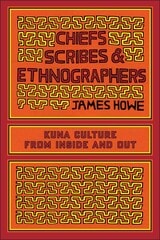
Chiefs, Scribes, and Ethnographers
Kuna Culture from Inside and OutBy James Howe
University of Texas Press, 2009
The Kuna of Panama, today one of the best known indigenous peoples of Latin America, moved over the course of the twentieth century from orality and isolation towards literacy and an active engagement with the nation and the world. Recognizing the fascination their culture has held for many outsiders, Kuna intellectuals and villagers have collaborated actively with foreign anthropologists to counter anti-Indian prejudice with positive accounts of their people, thus becoming the agents as well as subjects of ethnography. One team of chiefs and secretaries, in particular, independently produced a series of historical and cultural texts, later published in Sweden, that today still constitute the foundation of Kuna ethnography. As a study of the political uses of literacy, of western representation and indigenous counter-representation, and of the ambivalent inter-cultural dialogue at the heart of ethnography, Chiefs, Scribes, and Ethnographers addresses key issues in contemporary anthropology. It is the story of an extended ethnographic encounter, one involving hundreds of active participants on both sides and continuing today.
[more]
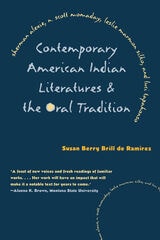
Contemporary American Indian Literatures and the Oral Tradition
Susan Berry Brill de Ramírez
University of Arizona Press, 1999
Because American Indian literatures are largely informed by their respective oral storytelling traditions, they may be more difficult to understand or interpret than the more text-based literatures with which most readers are familiar. In this insightful new book, Susan Berry Brill de Ramírez addresses the limitations of contemporary criticism and theory in opening up the worlds of story within American Indian literatures, proposing instead a conversive approach for reading and understanding these works. In order to fully understand American Indian literatures, Brill de Ramírez explains that the reader must become a listener-reader, an active participant in the written stories
. To demonstrate this point, she explores literary works both by established Native writers such as Sherman Alexie, N. Scott Momaday, Leslie Marmon Silko, and Luci Tapahonso and by less-well-known writers such as Anna Lee Walters, Della Frank, Lee Maracle, and Louis Owens. Through her literary engagements with many poems, novels, and short stories, she demonstrates a new way to read and understand the diverse body of American Indian literatures. Brill de Ramírez's conversive approach interweaves two interconnected processes: co-creating the stories by participating in them as listener-readers and recognizing orally informed elements in the stories such as verbal minimalism and episodic narrative structures.
Because this methodology is rooted in American Indian oral storytelling traditions, Native voices from these literary works are able to more directly inform the scholarly process than is the case in more textually based critical strategies. Through this innovative approach, Brill de Ramírez shows that literature is not a static text but an interactive and potentially transforming conversation between listener-readers, storyteller-writers, and the story characters as well. Her book furthers the discussion of how to read American Indian and other orally informed literatures with greater sensitivity to their respective cultural traditions and shows that the immediacy of the relationship between teller, story, and listener can also be experienced in the relationships between writers, literary works, and their listener-readers.
[more]
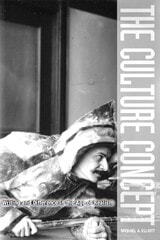
Culture Concept
Writing and Difference in the Age of RealismMichael A. Elliott
University of Minnesota Press, 2002
Examines the prehistory of the American struggle to address cultural difference.
"Culture" is a term we commonly use to explain the differences in our ways of living. In this book Michael A. Elliott returns to the moment this usage was first articulated, tracing the concept of culture to the writings-folktales, dialect literature, local color sketches, and ethnographies-that provided its intellectual underpinnings in turn-of-the-century America.
The Culture Concept explains how this now-familiar definition of "culture" emerged during the late nineteenth century through the intersection of two separate endeavors that shared a commitment to recording group-based difference-American literary realism and scientific ethnography. Elliott looks at early works of cultural studies as diverse as the conjure tales of Charles Chesnutt, the Ghost Dance ethnography of James Mooney, and the prose narrative of the Omaha anthropologist-turned-author Francis La Flesche. His reading of these works-which struggle to find appropriate theoretical and textual tools for articulating a less chauvinistic understanding of human difference-is at once a recovery of a lost connection between American literary realism and ethnography and a productive inquiry into the usefulness of the culture concept as a critical tool in our time and times to come.[more]