50 books match the query 'Industrial Management' and 9 start with c
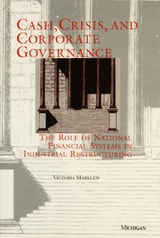
cover of Cash, Crisis, and Corporate Governance: The Role of National Financial Systems in Industrial Restructuring

Cash, Crisis, and Corporate Governance

The Role of National Financial Systems in Industrial Restructuring

Victoria Marklew

University of Michigan Press, 1995

This study chronicles four large manufacturers during a period of crisis and restructuring when they needed vast sums of money just to survive -- let alone adapt to remain competitive. By focusing on how these firms found financing, Victoria Marklew shows that the way national financial systems channel money to industry is the key issue in industrial competitiveness. The author challenges the traditional approach in comparative political economy by starting her analysis of government-industry relations at the level of the firm. By so doing, the author is able to chart in a unique way the role governments play in setting the boundaries of financial systems and to show how these boundaries fundamentally determine the kinds of financing to which a firm has access. The case studies (comparing the British Steel Corporation's passage from state to private ownership, the French steel industry's evolution into the nationalized Usinor Sacilor, British Leyland's transition from a nationalized company to two privately-owned firms, and Peugeot SA's rise to a dominant firm in the French private sector) dramatically prove that whether ownership is public or private has little to do with a firm's ability to survive a crisis. By extending her arguments to the United States, Germany, and Japan, the author shows how apparently very different governments in fact behave remarkably similarly, highlighting more accurately where the key differences among them lie and what the consequences of these differences are.
[more]
cover of Changing Corporate America from Inside Out: Lesbian and Gay Workplace Rights

Changing Corporate America from Inside Out

Lesbian and Gay Workplace Rights

Nicole C. Raeburn

University of Minnesota Press, 2004

Investigates how gays, lesbians, and bisexuals have succeeded in securing equitable benefits

Despite the backlash against lesbian and gay rights occurring in cities and states across the country, a growing number of corporations are actually expanding protections and benefits for their gay and lesbian employees. Why this should be, and why some corporations are increasingly open to inclusive policies while others are determinedly not, is what Nicole C. Raeburn seeks to explain in Changing Corporate America from Inside Out.

A long-overdue study of the workplace movement, Raeburn’s analysis focuses on the mobilization of lesbian, gay, and bisexual employee networks over the past fifteen years to win domestic partner benefits in Fortune 1000 companies. Drawing on surveys of nearly one hundred corporations with and without gay networks, intensive interviews with human resources executives and gay employee activists, as well as a number of case studies, Raeburn reveals the impact of the larger social and political environment on corporations’s openness to gay-inclusive policies, the effects of industry and corporate characteristics on companies’s willingness to adopt such policies, and what strategies have been most effective in transforming corporate policies and practices to support equitable benefits for all workers.

[more]
cover of Changing Forever: The Well-Kept Secrets of America's Leading Companies

Changing Forever

The Well-Kept Secrets of America's Leading Companies

Carl F. Frost

Michigan State University Press, 1996

Do Motorola, Herman Miller, and the Donelly corporations all share a secret of business? Without a doubt, it is the ability to continually change—their "only hope for survival and success"—change based on a participatory management style, often referred to as the Scanlon Plan—identity, participation, equity, and managerial competence—these corporations have succeeded where others have failed.  
      Changing Forever builds on the forty years of research, experience, and development that have gone into the Scanlon Plan. Documenting fully the principles and processes of the Scanlon Plan, Carl Frost gives the reader a clear view of how the plan works and how it can be adapted to suit the needs of businesses large and small. The conclusions of his research are not surprising: with implementation of the four basic principles of the Scanlon Plan comes an optimal synergistic relationship between all employees and management.
[more]
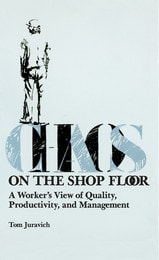
cover of Chaos On The Shop Floor

Chaos On The Shop Floor

Tom Juravich

Temple University Press, 1988
"Juravich argues that problems in declining American productivity and competitiveness-often and conveniently blamed on workers-can be placed principally in the laps of management." --Socialist Review "[Juravich] provides valuable insights into the operations of a small manufacturing firm, emphasizing the role of worker ‘tradecraft' practiced on the job.... Of greatest interest to institutions with strong sociology/industrial psychology holdings serving upper-division and graduate students, but also relevant for libraries serving vocational and technical students." --Choice From his well-placed vantage point, Juravich has produced an interesting and valuable ethnography of factory life in the industrial periphery.... I recommend this book to those interested in the sociology of work. It is written clearly and straightforwardly, and it is well suited for undergraduate or graduate courses. --Contemporary Sociology
[more]
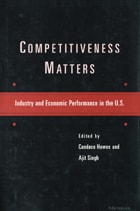
cover of Competitiveness Matters: Industry and Economic Performance in the U.S.

Competitiveness Matters

Industry and Economic Performance in the U.S.

Candace Howes and Ajit Singh, Editors

University of Michigan Press, 2000
This book argues, against the current view, that competitiveness--that is, the competitiveness of the manufacturing sector--matters to the long-term health of the U.S. economy and particularly to its long-term capacity to raise the standard of living of its citizens. The book challenges the arguments popularized most recently by Paul Krugman that
competitiveness is a dangerous obsession that distracts us from the question most central to solving the problem of stagnant real income growth, namely, what causes productivity growth, especially in the service sector.
The central argument is that, if the U.S. economy is to achieve full employment with rising real wages, it is necessary to enhance the competitiveness of its tradable goods sector. The book shows that current account deficits cannot be explained by macroeconomic mismanagement but are rather the consequence of an uncompetitive manufacturing sector. It finds that the long-term health of the manufacturing sector requires not only across-the-board policies to remedy problems of low or inefficient investment, but also sectoral policies to address problems that are strategic to resolving the balance of payments problems. Lessons are drawn from the experience of some European and Asian countries.
This book will be of interest to economists, political scientists, and business researchers concerned with the place of the manufacturing sector in overall health of the U.S. economy, with issues of industrial policy and industrial restructuring, and with the conditions for rising standards of living.
Candace Howes is Associate Professor, Barbara Hogate Ferrin Chair, Connecticut College. Ajit Singh is Professor of Economics, Queens College, Cambridge.
[more]
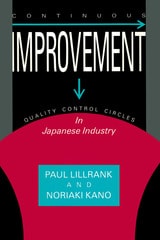
cover of Continuous Improvement: Quality Control Circles in Japanese Industry

Continuous Improvement

Quality Control Circles in Japanese Industry

Paul Lillrank; Noriaki Kano

University of Michigan Press, 1989

Quality Control Circles (QCCs) are small groups of workers from the same workshop, which meet, often on their own time, to discuss ways to improve the quality of their work. They are supported by management; the circles and the support structure together are called Quality Control Circle (QCC) activity. The phenomenon is widespread in Japan: as of December 1987, 264,899 circles had been registered with more than two million members. QCC activities have spread to more than fifty countries worldwide and can be considered the most famous Japanese organizational innovation to date. The Japanese QCC, in its contribution to business application and theory, may rival the discovery of the informal organization of Hawthorne Studies frame.
The Japanese QCC movement has achieved quite impressive results, which are well described in the Japanese-language literature. Of concern, however, is what sustains and causes the phenomenon. The existing literature is quite thin on these mechanisms and forces.
Our aim in this research is to develop a systematic model of the organizational nature and management of Japanese QCC activities. Quality engineering and group dynamics are not part of this study; the focus is on the supporting arrangements, not on what happens within a circle. [1]
[more]
cover of Coordination and Information: Historical Perspectives on the Organization of Enterprise

Coordination and Information

Historical Perspectives on the Organization of Enterprise

Edited by Naomi R. Lamoreaux and Daniel M. G. Raff

University of Chicago Press, 1995

Case studies that examine how firms coordinate economic activity in the face of asymmetric information—information not equally available to all parties—are the focus of this volume.

In an ideal world, the market would be the optimal provider of coordination, but in the real world of incomplete information, some activities are better coordinated in other ways. Divided into three parts, this book addresses coordination within firms, at the borders of firms, and outside firms, providing a picture of the overall incidence and logic of economic coordination. The case studies—drawn from the late nineteenth and early twentieth century, when the modern business enterprise was evolving, address such issues as the relationship between coordination mechanisms and production techniques, the logic of coordination in industrial districts, and the consequences of regulation for coordination.

Continuing the work on information and organization presented in the influential Inside the Business Enterprise, this book provides material for business historians and economists who want to study the development of the dissemination of information and the coordination of economic activity within and between firms.

[more]
cover of Corporate Futures: The Diffusion of the Culturally Sensitive Corporate Form

Corporate Futures

The Diffusion of the Culturally Sensitive Corporate Form

Edited by George E. Marcus

University of Chicago Press, 1998

As we approach the end of the century, cultural, institutional, and even geopolitical change becomes the norm rather than the exception. Late Editions, edited by George E. Marcus, is a series of annuals designed to probe these changes not through the familiar academic conventions of analysis but instead through in-depth, informed conversations and interviews with individuals at the sites of these transformations. The casts of other volumes in the series include artists, oncologists, Siberian medical leaders, warhead designers, and computer junkies, all of whom take the opportunity presented by Late Editions to reflect upon the great and often puzzling shifts occurring in the cultural landscape.

Late Editions 5, Corporate Futures, questions this idea of a "cultural landscape" by focusing on the the marked investment of corporations in the concept of culture, long the purview of anthropologists and, more recently, those involved in the humanistic disciplines. Emerging in the discourse of the workplace—and traveling beyond it to traditionally alternative associations—is the idea of a "corporate culture" with its own organization, management policies and practices, and ethos. How can we understand this culture of corporations, and to what extent does it reflect self-contained communities or fragmented human existence in groups under conditions of postmodernity? Corporate Futures tackles these issues and questions through conversations with managers, financial and risk analysts, and other participants in national and international organizations.

The results—engaging, intriguing, speculative, current—continue the work begun in earlier volumes to map the terrain of the present and navigate the uncertain future.

Praise for Late Editions: "If the succeeding volumes are as compassionate and informed as the first, this series could become an essential postmodern guidebook to the world's changing cultural terrain. I plan on letting it ease me into the next century."—Catherine Gysin, Utne Reader

[more]
cover of Creativity on Demand: The Dilemmas of Innovation in an Accelerated Age

Creativity on Demand

The Dilemmas of Innovation in an Accelerated Age

Eitan Y. Wilf

University of Chicago Press, 2019

Business consultants everywhere preach the benefits of innovation—and promise to help businesses reap them. A trendy industry, this type of consulting generates courses, workshops, books, and conferences that all claim to hold the secrets of success. But what promises does the notion of innovation entail? What is it about the ideology and practice of business innovation that has made these firms so successful at selling their services to everyone from small start-ups to Fortune 500 companies? And most important, what does business innovation actually mean for work and our economy today?
 
In Creativity on Demand, cultural anthropologist Eitan Wilf seeks to answer these questions by returning to the fundamental and pervasive expectation of continual innovation. Wilf focuses a keen eye on how our obsession with ceaseless innovation stems from the long-standing value of acceleration in capitalist society. Based on ethnographic work with innovation consultants in the United States, he reveals, among other surprises, how routine the culture of innovation actually is. Procedures and strategies are repeated in a formulaic way, and imagination is harnessed as a new professional ethos, not always to generate genuinely new thinking, but to produce predictable signs of continual change. A masterful look at the contradictions of our capitalist age, Creativity on Demand is a model for the anthropological study of our cultures of work.
 
[more]