Results by title
54 books match the query 'Inside' and 2 start with c

Campesinos
Inside the Soul of CubaChip Cooper and Julio Larramendi
University of Alabama Press, 2017
Deep inside the soul of Cuba are the campesinos—the men and women who have always worked the countryside across the length and breadth of Cuba, away from cities, towns, and often villages. Resilient, resourceful, and proud, campesinos are the heart and soul of Cuba. The fruit of years of travel among Cuba’s less-known and little-explored rural communities, Campesinos: Inside the Soul of Cuba is a collection of loving and intimate photographs by world-renowned photographers Chip Cooper and Julio Larramendi documenting people and places from every corner of the island nation, many never seen by Cubans themselves let alone visitors from abroad.
Into the center of this world traveled two photographers to document these extraordinary people. One, Julio Larramendi, was born in Cuba and has spent his whole life there. The other, Chip Cooper, came to visit for the first time from his native Alabama more than a decade ago. Together, Cooper and Larramendi have captured the light, sounds, and spirit of the campesino landscape and the humble and determined people who inhabit it, ways of living that have not changed, in many instances, for a century or more. From green tobacco fields and winding roads to the faces, both stern and smiling, of children and their close-knit families, Cooper and Larramendi have captured in this landmark volume the rhythms and traditions of contemporary rural Cuban life in ways never before documented.
Into the center of this world traveled two photographers to document these extraordinary people. One, Julio Larramendi, was born in Cuba and has spent his whole life there. The other, Chip Cooper, came to visit for the first time from his native Alabama more than a decade ago. Together, Cooper and Larramendi have captured the light, sounds, and spirit of the campesino landscape and the humble and determined people who inhabit it, ways of living that have not changed, in many instances, for a century or more. From green tobacco fields and winding roads to the faces, both stern and smiling, of children and their close-knit families, Cooper and Larramendi have captured in this landmark volume the rhythms and traditions of contemporary rural Cuban life in ways never before documented.
[more]
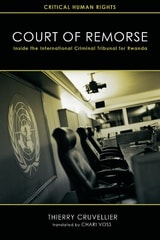
Court of Remorse
Inside the International Criminal Tribunal for RwandaThierry Cruvellier
University of Wisconsin Press, 2010
When genocidal violence gripped Rwanda in 1994, the international community recoiled, hastily withdrawing its peacekeepers. Late that year, in an effort to redeem itself, the United Nations Security Council created the International Criminal Tribunal for Rwanda to seek accountability for some of the worst atrocities since World War II: the genocide suffered by the Tutsi and crimes against humanity suffered by the Hutu. But faced with competing claims, the prosecution focused exclusively on the crimes of Hutu extremists. No charges would be brought against the Tutsi-led Rwandan Patriotic Front, which ultimately won control of the country. The UN, as if racked by guilt for its past inaction, gave in to pressure by Rwanda’s new leadership. With the Hutu effectively silenced, and the RPF constantly reminding the international community of its failure to protect the Tutsi during the war, the Tribunal pursued an unusual form of one-sided justice, born out of contrition.
Fascinated by the Tribunal’s rich complexities, journalist Thierry Cruvellier came back day after day to watch the proceedings, spending more time there than any other outside observer. Gradually he gained the confidence of the victims, defendants, lawyers, and judges. Drawing on interviews with these protagonists and his close observations of their interactions, Cruvellier takes readers inside the courtroom to witness the motivations, mechanisms, and manipulations of justice as it unfolded on the stage of high-stakes, global politics. It is this ground-level view that makes his account so valuable—and so absorbing. A must-read for those who want to understand the dynamics of international criminal tribunals, Court of Remorse reveals both the possibilities and the challenges of prosecuting human rights violations.
Fascinated by the Tribunal’s rich complexities, journalist Thierry Cruvellier came back day after day to watch the proceedings, spending more time there than any other outside observer. Gradually he gained the confidence of the victims, defendants, lawyers, and judges. Drawing on interviews with these protagonists and his close observations of their interactions, Cruvellier takes readers inside the courtroom to witness the motivations, mechanisms, and manipulations of justice as it unfolded on the stage of high-stakes, global politics. It is this ground-level view that makes his account so valuable—and so absorbing. A must-read for those who want to understand the dynamics of international criminal tribunals, Court of Remorse reveals both the possibilities and the challenges of prosecuting human rights violations.
Best Books for General Audiences, selected by the American Association for School Libraries and the Public Library Association
Best Books for High Schools, selected by the American Association for School Libraries
[more]