Results by title
58 books match the query 'Intellectual property' and 8 start with c
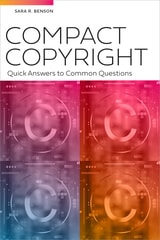
Compact Copyright
Quick Answers to Common QuestionsSara R. Benson
American Library Association, 2021
Included in Choice's Top 75 Titles and Resources for Community College Libraries
Faculty, students, and colleagues come to you with copyright questions, both simple and complex. And they all want reliable answers—as fast as you can get them. With this guide, designed for ready access, you’ll be prepared to deliver. Lawyer, copyright librarian, and iSchool instructor Benson presents succinct explanations ideal for both on-the-fly reference and staff training. Copyright specialists will appreciate excerpts from the law itself alongside tools and resources for digging deeper. Practical discussions of key legal concepts, illustrated using 52 scenarios, will lead you to fast, accurate answers on a range of topics, such as
- barriers to using the TEACH Act provisions in content for online teaching;
- showing a full-length movie in a university class;
- public domain and the 1998 Sonny Bono Copyright Term Extension Act;
- your legal options when receiving a DMCA take-down notice;
- court interpretations of fair use in three key recent cases;
- Creative Commons licenses, complete with a quick reference chart;
- library rights to license photographs in a digital collection;
- using letters under copyright in a special collections display case;
- a grad student’s right to use in a thesis writing published in their professor’s journal article;
- applying the implied license option to post historical student dissertations in institutional repositories;
- the Marrakesh Treaty provision supporting transfer of accessible works internationally; and
- limiting factors for interlibrary loan.
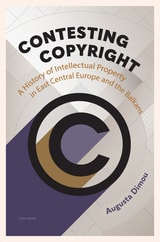
Contesting Copyright
A History of Intellectual Property in East Central Europe and the BalkansAugusta Dimou
Central European University Press, 2026
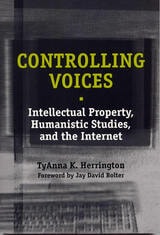
Controlling Voices
Intellectual Property, Humanistic Studies, and the InternetTyAnna K. Herrington. Foreword by Jay David Bolter
Southern Illinois University Press, 2001
TyAnna K. Herrington explains current intellectual property law and examines the effect of the Internet and ideological power on its interpretation. Promoting a balanced development of our national culture, she advocates educators’ informed participation in ensuring egalitarian public access to information. She discusses the control of information and the creation of knowledge in terms of the way control functions under current property law.
Copyright in Historical Perspective
L. Ray Patterson
Vanderbilt University Press, 1968
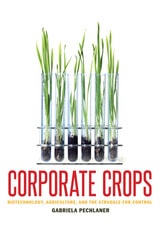
Corporate Crops
Biotechnology, Agriculture, and the Struggle for ControlBy Gabriela Pechlaner
University of Texas Press, 2012
Biotechnology crop production area increased from 1.7 million hectares to 148 million hectares worldwide between 1996 to 2010. While genetically modified food is a contentious issue, the debates are usually limited to health and environmental concerns, ignoring the broader questions of social control that arise when food production methods become corporate-owned intellectual property. Drawing on legal documents and dozens of interviews with farmers and other stakeholders, Corporate Crops covers four case studies based around litigation between biotechnology corporations and farmers. Pechlaner investigates the extent to which the proprietary aspects of biotechnologies—from patents on seeds to a plethora of new rules and contractual obligations associated with the technologies—are reorganizing crop production.
The lawsuits include patent infringement litigation launched by Monsanto against a Saskatchewan canola farmer who, in turn, claimed his crops had been involuntarily contaminated by the company’s GM technology; a class action application by two Saskatchewan organic canola farmers launched against Monsanto and Aventis (later Bayer) for the loss of their organic market due to contamination with GMOs; and two cases in Mississippi in which Monsanto sued farmers for saving seeds containing its patented GM technology. Pechlaner argues that well-funded corporate lawyers have a decided advantage over independent farmers in the courts and in creating new forms of power and control in agricultural production. Corporate Crops demonstrates the effects of this intersection between the courts and the fields where profits, not just a food supply, are reaped.
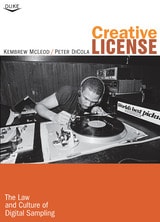
Creative License
The Law and Culture of Digital SamplingKembrew McLeod and Peter DiCola
Duke University Press, 2011
Interviewees include David Byrne, Cee Lo Green, George Clinton, De La Soul, DJ Premier, DJ Qbert, Eclectic Method, El-P, Girl Talk, Matmos, Mix Master Mike, Negativland, Public Enemy, RZA, Clyde Stubblefield, T.S. Monk.
Creativity and Its Discontents
China's Creative Industries and Intellectual Property Rights OffensesLaikwan Pang
Duke University Press, 2012
Cutting Across Media
Appropriation Art, Interventionist Collage, and Copyright LawKembrew McLeod and Rudolf Kuenzli, eds.
Duke University Press, 2011
Contributors. Craig Baldwin, David Banash, Marcus Boon, Jeff Chang, Joshua Clover, Lorraine Morales Cox, Lloyd Dunn, Philo T. Farnsworth, Pierre Joris, Douglas Kahn, Rudolf Kuenzli, Rob Latham, Jonathan Lethem, Carrie McLaren, Kembrew McLeod, Negativland, Davis Schneiderman, David Tetzlaff, Gábor Vályi, Warner Special Products, Eva Hemmungs Wirtén