Results by title
101 books match the query 'Intellectuals' and 3 start with c
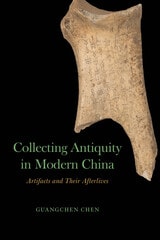
Collecting Antiquity in Modern China
Artifacts and Their AfterlivesGuangchen Chen
University of Chicago Press, 2026
A look at twentieth-century Chinese writers and intellectuals who used the material remains of the past to unsettle the present.
In this book, Guangchen Chen argues that discerning collectors used antiquities to upend dominant discourses on history and cultural memory in twentieth-century China. Examining four categories of ancient artifacts—“carving” (oracle bones), “rubbing” (imprints of inscriptions and books), “brushing” (calligraphy), and “weaving” (textiles and costumes)—Chen explains how their modern (re)emergences changed our understanding of the relationship between tradition and modernity, textuality and materiality, and the very meaning of “Chineseness.”
Chen considers intellectuals such as Wang Yirong, Liu E, Luo Zhenyu, Wang Guowei, and Chen Mengjia, who played a pivotal role in the oracle bones’ modern reception. He also looks to major literary figures including Lu Xun, whose engagements with textual remnants of the past inspired his critique of Chinese culture; Guo Moruo, whose work on the calligraphic masterpiece Lantingxu contributed to the cultural-political climate that sparked the Cultural Revolution; Shi Zhecun, whose interest in inscriptions on ancient stelae helped him to hold fast to intellectual integrity in the face of political pressure; and Shen Congwen, whose obsession with ancient textiles saved him from committing suicide after his writing fell out of favor. These antiquarians used their collections as a strategy to synchronize historical time and to challenge two dominant yet contrasting ideologies in modern China: a regressive idealization of antiquity and an unquestioning trust in linear progress. During this turbulent period, long-lost artifacts came to function as omens, warnings, and revelations from another time, generating new meanings that were uniquely relevant to the present.
[more]
Community and Solitude
New Essays on Johnson’s CircleLee, Anthony W
Bucknell University Press, 2019
Samuel Johnson’s life was situated within a rich social and intellectual community of friendships—and antagonisms. Community and Solitude is a collection of ten essays that explore relationships between Johnson and several of his main contemporaries—including James Boswell, Edmund Burke, Frances Burney, Robert Chambers, Oliver Goldsmith, Bennet Langton, Arthur Murphy, Richard Savage, Anna Seward, and Thomas Warton—and analyzes some of the literary productions emanating from the pressures within those relationships. In their detailed and careful examination of particular works situated within complex social and personal contexts, the essays in this volume offer a “thick” and illuminating description of Johnson’s world that also engages with larger cultural and aesthetic issues, such as intertextuality, literary celebrity, narrative, the nature of criticism, race, slavery, and sensibility.
Contributors: Christopher Catanese, James Caudle, Marilyn Francus, Christine Jackson-Holzberg, Claudia Thomas Kairoff, Elizabeth Lambert, Anthony W. Lee, James E. May, John Radner, and Lance Wilcox.
Published by Bucknell University Press. Distributed worldwide by Rutgers University Press.
Contributors: Christopher Catanese, James Caudle, Marilyn Francus, Christine Jackson-Holzberg, Claudia Thomas Kairoff, Elizabeth Lambert, Anthony W. Lee, James E. May, John Radner, and Lance Wilcox.
Published by Bucknell University Press. Distributed worldwide by Rutgers University Press.
[more]
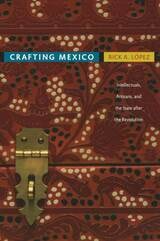
Crafting Mexico
Intellectuals, Artisans, and the State after the RevolutionRick A. López
Duke University Press, 2010
After Mexico’s revolution of 1910–1920, intellectuals sought to forge a unified cultural nation out of the country’s diverse populace. Their efforts resulted in an “ethnicized” interpretation of Mexicanness that intentionally incorporated elements of folk and indigenous culture. In this rich history, Rick A. López explains how thinkers and artists, including the anthropologist Manuel Gamio, the composer Carlos Chávez, the educator Moisés Sáenz, the painter Diego Rivera, and many less-known figures, formulated and promoted a notion of nationhood in which previously denigrated vernacular arts—dance, music, and handicrafts such as textiles, basketry, ceramics, wooden toys, and ritual masks—came to be seen as symbolic of Mexico’s modernity and national distinctiveness. López examines how the nationalist project intersected with transnational intellectual and artistic currents, as well as how it was adapted in rural communities. He provides an in-depth account of artisanal practices in the village of Olinalá, located in the mountainous southern state of Guerrero. Since the 1920s, Olinalá has been renowned for its lacquered boxes and gourds, which have been considered to be among the “most Mexican” of the nation’s arts. Crafting Mexico illuminates the role of cultural politics and visual production in Mexico’s transformation from a regionally and culturally fragmented country into a modern nation-state with an inclusive and compelling national identity.
[more]