Results by title
89 books match the query 'Invention' and 5 start with c

Celluloid Pueblo
Western Ways Films and the Invention of the Postwar SouthwestJennifer L. Jenkins
University of Arizona Press, 2016
Celluloid Pueblo tells the story of Western Ways Features and its role in the invention of the Southwest of the imagination. Active during a thirty-year period of profound growth and transformation, the Herberts created a dynamic visual record of the region, and their archival films now serve as a time capsule of the Sunbelt in the mid-twentieth century. Drawing upon a ten-year career with Fox, Western Ways owner-operator Charles Herbert brought a newshound’s sensibility and acute skill at in-camera editing to his southwestern subjects. The Western Ways films provided counternarratives to Hollywood representations of the West and established the regional identity of Tucson and the borderlands.
Jennifer L. Jenkins’s broad-sweeping book examines the Herberts’ work on some of the first sound films in the Arizona borderlands and their ongoing promotion of the Southwest. The book covers the filmic representation of Native and Mexican lifeways, Anglo ranching and leisure, Mexican missions and tourism, and postwar borderlands prosperity and progressivism. The story of Western Ways closely follows the boom-and-bust arc of the midcentury Southwest and the constantly evolving representations of an exotic—but safe and domesticated—frontier.

Chaucer, Gower, and the Affect of Invention
Steele Nowlin
The Ohio State University Press, 2016
Chaucer, Gower, and the Affect of Invention thus formulates a definition of affect that differs from most work in the recent “turn to affect” in medieval studies, focusing not on the representation of emotion or desire, or efforts to engage medieval alterity, but on the movement and emergence that precede emotional experience. It likewise argues for a broader understanding of invention in late medieval literature beyond analyses of rhetorical poetics and authorial politics by recuperating the dynamism and sense of potential that characterize inventional activity. Finally, its close readings of Chaucer’s and Gower’s poetry provide new insights into how these poets represent invention in order to engage the pervasive social and cultural discourses their poetry addresses.
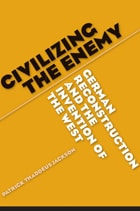
Civilizing the Enemy
German Reconstruction and the Invention of the WestPatrick Thaddeus Jackson
University of Michigan Press, 2006
By examining German reconstruction under the Marshall Plan, author Patrick Jackson shows how the rhetorical invention of a West that included Germany was critical to the emergence of the postwar world order. Civilizing the Enemy convincingly describes how concepts are strategically shaped and given weight in modern international relations, by expertly dissecting the history of "the West" and demonstrating its puzzling persistence in the face of contradictory realities.
"By revisiting the early Cold War by means of some carefully conducted intellectual history, Patrick Jackson expertly dissects the post-1945 meanings of "the West" for Europe's emergent political imaginary. West German reconstruction, the foundation of NATO, and the idealizing of 'Western civilization' all appear in fascinating new light."
--Geoff Eley, University of Michigan
"Western civilization is not given but politically made. In this theoretically sophisticated and politically nuanced book, Patrick Jackson argues that Germany's reintegration into a Western community of nations was greatly facilitated by civilizational discourse. It established a compelling political logic that guided the victorious Allies in their occupation policy. This book is very topical as it engages critically very different, and less successful, contemporary theoretical constructions and political deployments of civilizational discourse."
--Peter J. Katzenstein, Cornell University
"What sets Patrick Jackson's book apart is his attention, on the one hand, to philosophical issues behind the kinds of theoretical claims he makes and, on the other hand, to the methodological implications that follow from those claims. Few scholars are willing and able to do both, and even fewer are as successful as he is in carrying it off. Patrick Jackson is a systematic thinker in a field where theory is all the rage but systematic thinking is in short supply."
--Nicholas Onuf, Florida International University
Patrick Thaddeus Jackson is Assistant Professor of International Relations in American University's School of International Service.

Codependent Forevermore
The Invention of Self in a Twelve Step GroupLeslie Irvine
University of Chicago Press, 1999
Codependent Forevermore is thus an insider's look at the world of people "in recovery" and the society that produced them. Through extensive interviews with CoDA members, case studies, and the meetings she attended regularly, Irvine develops a galvanizing perspective on contemporary Americans' sense of self. She explores the idea that selfhood is a narrative accomplishment, achieved by people telling stories to themselves and about themselves. She shows how Alex, Paul, Liz, and many others create a sense of self by combining elements of autobiography, culture, and social structure all within the adopted language of psycho-spirituality.
By following the progress and tribulations of CoDA members, Irvine gets to the heart of widespread American conceptions of relationships, selfhood, and community. Amidst the increasingly shrill criticism of the Twelve Step ethos, her reasoned and considered analysis of these groups reveals the sources of both their power and their popularity.
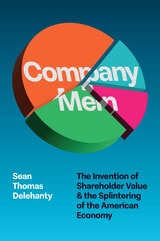
Company Men
The Invention of Shareholder Value and the Splintering of the American EconomySean Delehanty
University of Chicago Press, 2025
How an esoteric economic theory—and its most devout believers—changed the world forever.
In the modern economy, stock price is king. The value of a corporation is measured in how it enriches its shareholders, even when doing so subtracts from long-term growth or social good. Greed, in the last half-century of corporate practice, has become very good. Company Men is a sweeping intellectual history of how shareholder value rose from the lesser-known edges of academic theory to the vanguard of corporate practice.
Historian Sean Delehanty marshals archival resources to reveal how a group of motivated consultants, activist investors, and academic economists successfully branded shareholder value as the antidote to problems of management and economic stagnation in the 1970s. In their success, they created a class of well-heeled managers who executed shareholder-value theory as an everyday practice—and at the expense of most everything else. Delehanty’s history of the modern American corporation is a sobering account of the business regime that would rule the world and produce no shortage of regrets—even amongst those who championed it. Company Men is intellectual history at its most vital, offering a surprising origin story of our economy’s discontents.