Results by title
167 books match the query 'Iowa' and 3 start with c
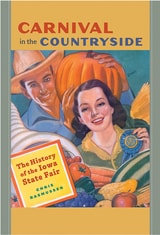
Carnival in the Countryside
The History of the Iowa State FairChris Rasmussen
University of Iowa Press, 2015
More than a century and a half after its founding, the Iowa State Fair is the state’s central institution, event, and symbol. New Jersey has the Shore; Kentucky has the Derby; Iowa has the Fair. The humble Iowa State Fairground ranks alongside the Great Pyramids at Giza and the Taj Mahal in the best-selling travel guide 1,000 Places to See Before You Die. During its annual run each August, the fair attracts hundreds of thousands of visitors who make the pilgrimage to the fairground to see the iconic butter cow, to ride the Old Mill, to walk through the livestock barns, and to people-watch. At the same time that they enjoy fried candy bars and roller coasters, Iowans also compete to raise the best corn and zucchinis, to make the best jams and jellies, to rear the finest sheep and goats, the largest cattle and hogs, and the handsomest horses.
This tension between entertainment and agriculture goes back all the way to the fair’s founding in the mid-1800s, as historian Chris Rasmussen shows in this thought-provoking history. The fair’s founders had lofty aims: they sought to improve agriculture and foster a distinctively democratic American civilization. But from the start these noble intentions jostled up against people’s desire to have fun and make money, honestly or otherwise—not least because the fair had to pay for itself. In their effort to uplift rural life without going broke, the organizers of the Iowa State Fair debated the respectability of horse racing and gambling and struggled to find qualified livestock judges. Worried about the economic forces undermining rural families, they ran competitions to select the best babies and the “ideal” rural girl and boy while luring spectators with massive panoramas of earthquakes and fires, not to mention staged trainwrecks. In short, the Iowa State Fair has as much to tell us about human nature and American history as it does about growing corn.
This tension between entertainment and agriculture goes back all the way to the fair’s founding in the mid-1800s, as historian Chris Rasmussen shows in this thought-provoking history. The fair’s founders had lofty aims: they sought to improve agriculture and foster a distinctively democratic American civilization. But from the start these noble intentions jostled up against people’s desire to have fun and make money, honestly or otherwise—not least because the fair had to pay for itself. In their effort to uplift rural life without going broke, the organizers of the Iowa State Fair debated the respectability of horse racing and gambling and struggled to find qualified livestock judges. Worried about the economic forces undermining rural families, they ran competitions to select the best babies and the “ideal” rural girl and boy while luring spectators with massive panoramas of earthquakes and fires, not to mention staged trainwrecks. In short, the Iowa State Fair has as much to tell us about human nature and American history as it does about growing corn.
[more]

Complete in All Its Parts
Nursing Education at the University of Iowa, 1898-1998Lee Anderson and Kathy Penningroth
University of Michigan Press, 1998
This narrative history of nursing education is a case study of a single institution set within the context of trends in the nursing profession, nursing education, and health care practices in the Midwest and the United States. The detailed research and analysis in this work make a fundamental contribution not only to the history of nursing but also to the broader history of women's work, the history of women in higher education, and the history of the health care professions. The Midwestern focus of Complete in All Its Parts and its emphasis on the post-World War II emergence of the University of Iowa College of Nursing provide a fresh perspective on the education of nurses, especially the education of nurses within a major teaching-research university. In doing so, this book pushes nursing historiography beyond the profession's early development, details the struggles involved in establishing nursing as a legitimate academic endeavor in the university environment, and provides groundwork for a comparison with other such institutions across the nation. Its core audience includes health care professionals and educators as well as institutional historians, perhaps especially those involved in the history of American health care institutions.
[more]
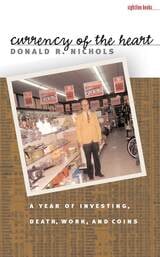
Currency of the Heart
A Year of Investing, Death, Work, and CoinsDonald Nichols
University of Iowa Press, 2002
In 1998, Don Nichols returned regularly to Iowa from his life and job in Washington, D.C., to be with his dying father and to oversee his parents’ investments. A veteran investor and investment author, Nichols found that managing the portfolio entrusted to him brought a larger understanding of mortality, family, love, work, and the choices he had made as “an agri-kid who took the road out of town and kept going.” In this insightful and money-wise book that grew out of that experience, he merges the emotions of a dutiful son with the actions of a knowledgeable investor.
Nichols uses money in myriad forms—a grandfather‘s silver dollar, stocks and bonds, salaries, pallets of coins at the U.S. Mint, on-the-job dealings with coin collectors—as touchstones for reflections on relationships, motives, and a career "like one of those moving walkways in airports." His father's health is measured, tested, and evaluated in part by the health of his finances; at the same time, the turmoil and mystery surrounding both money and relationships are reflected in this memorable story.
Nichols uses money in myriad forms—a grandfather‘s silver dollar, stocks and bonds, salaries, pallets of coins at the U.S. Mint, on-the-job dealings with coin collectors—as touchstones for reflections on relationships, motives, and a career "like one of those moving walkways in airports." His father's health is measured, tested, and evaluated in part by the health of his finances; at the same time, the turmoil and mystery surrounding both money and relationships are reflected in this memorable story.
Wry, unsentimental, and financially savvy, Currency of the Heart is about rediscovering family, managing a portfolio, honoring promises, grieving, and healing; it is about a father and a son who once “fought like medieval villagers in a Thirty Years‘ War” and the deepening bond between a middle-age son and his aging mother. It is a multilayered story for everyone who will manage, financially and emotionally, a parent's death.
[more]