Results by title
104 books match the query 'Japanese' and 5 start with c
CROSS-CULTURAL VISIONS IN AFRICAN AMERICAN MODERNISM
FROM SPATIAL NARRATIVE TO JAZZ HAIKUYOSHINOBU HAKUTANI
The Ohio State University Press, 2006
Yoshinobu Hakutani traces the development of African American modernism, which initially gathered momentum with Richard Wright’s literary manifesto “Blueprint for Negro Writing” in 1937. Hakutani dissects and discusses the cross-cultural influences on the then-burgeoning discipline in three stages: American dialogues, European and African cultural visions, and Asian and African American cross-cultural visions.
In writing Black Boy, the centerpiece of the Chicago Renaissance, Wright was inspired by Theodore Dreiser. Because the European and African cultural visions that Wright, Ralph Ellison, Alice Walker, and Toni Morrison acquired were buttressed by the universal humanism that is common to all cultures, this ideology is shown to transcend the problems of society. Fascinated by Eastern thought and art, Wright, Walker, Sonia Sanchez, and James Emanuel wrote highly accomplished poetry and prose. Like Ezra Pound, Wright was drawn to classic haiku, as reflected in the 4,000 haiku he wrote at the end of his life. As W. B. Yeats’s symbolism was influenced by his cross-cultural visions of noh theatre and Irish folklore, so is James Emanuel’s jazz haiku energized by his cross-cultural rhythms of Japanese poetry and African American music.
The book demonstrates some of the most visible cultural exchanges in modern and postmodern African American literature. Such a study can be extended to other contemporary African American writers whose works also thrive on their cross-cultural visions, such as Amiri Baraka, Ishmael Reed, Charles Johnson, and haiku poet Lenard Moore.
[more]
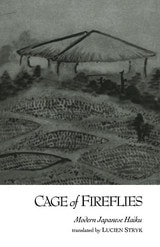
Cage Of Fireflies
Modern Japanese HaikuLucien Stryk
Ohio University Press, 1993
Haiku at its best is an art in which the poet takes a natural, most ordinary event, and without fuss, ornament or inflated words makes of it a rare moment — sparely rendered, crystallized into a microcosm which reveals transcendent unity. Small wonder haiku has a growing audience throughout the world.
In all arts — music, painting, dance, theatre — change has come with that startling moment of dissatisfaction when the artist upends complacency, shocks the old to its foundations, and emerges with clear vision. He has had the courage to rescue his art from dullness. Two of Japan’s “Great Four” of haiku, Basho (1644-94) and Shiki (1862-1902), were such revolutionaries, albeit two hundred years apart. Before Basho, haiku was but a pleasant occupation for the idle. He set about transforming it with such success that experts to this day agree that his were the first true haiku.
Shiki, who lived into the 20th century, was passionate in his attempt to salvage haiku from its past, sending out shock waves by dismissing virtually all earlier work, including most of Basho’s. He saw it as his mission to make a difference — to let nothing, not even the most revered, stand in the way. He proclaimed, “A poem has no meaning. It is feeling alone.” And he practiced what he preached.
Autumn wind:
gods, Buddha—
lies, lies, lies.
These modern Japanese poets, many of whom are translated here into English for the first time, learned as much from Basho as from Shiki, and from Buson (1715-83) and Issa (1763-1827), the “Great Four.” Yet in a sense they are followers of Shiki, in spite of the harshness of his views and the impossibly high standards he demanded. They were forced to reckon with him, became willing participants in a heated dialogue with him. They had to: his spirit dominated the age. Stryk captures that spirit here, in this Cage of Fireflies.
[more]
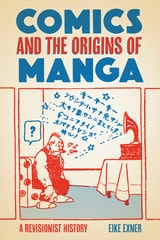
Comics and the Origins of Manga
A Revisionist HistoryEike Exner
Rutgers University Press, 2022
2022 Eisner Award Winner for Best Academic/Scholarly Work
Japanese comics, commonly known as manga, are a global sensation. Critics, scholars, and everyday readers have often viewed this artform through an Orientalist framework, treating manga as the exotic antithesis to American and European comics. In reality, the history of manga is deeply intertwined with Japan’s avid importation of Western technology and popular culture in the early twentieth century.
Comics and the Origins of Manga reveals how popular U.S. comics characters like Jiggs and Maggie, the Katzenjammer Kids, Felix the Cat, and Popeye achieved immense fame in Japan during the 1920s and 1930s. Modern comics had earlier developed in the United States in response to new technologies like motion pictures and sound recording, which revolutionized visual storytelling by prompting the invention of devices like speed lines and speech balloons. As audiovisual entertainment like movies and record players spread through Japan, comics followed suit. Their immediate popularity quickly encouraged Japanese editors and cartoonists to enthusiastically embrace the foreign medium and make it their own, paving the way for manga as we know it today.
By challenging the conventional wisdom that manga evolved from centuries of prior Japanese art and explaining why manga and other comics around the world share the same origin story, Comics and the Origins of Manga offers a new understanding of this increasingly influential artform.
[more]
Complex Predicates in Japanese
A Syntactic and Semantic Study of the Notion 'Word'Yo Matsumoto
CSLI, 1996
In this thoroughly revised version of 1992 Stanford dissertation, the author presents an extensive discussion of Japanese complex predicates. A broad range of constructions and predicates are discussed, which include predicative complement constructions, light verbs, causative predicates, desiderative predicates, syntactic and lexical compound verbs, and complex motion predicates. A number of new interesting facts are uncovered, and a detailed syntactic and semantic analyses are presented. On the basis of the analyses, the author argues that the notion 'word' must be relativized to at least three different senses: morphological, grammatical (functional), and semantic; and that this observation can be insightfully captured in the theory of Lexical-Functional Grammar. Previous proposals for each type of predicate that involve such mechanisms as argument transfer, incorporation, restructuring, etc. are thoroughly reviewed. Concrete proposals on the constraints on semantic wordhood are also made (an issue rarely discussed in the literature), drawing insights from cognitive linguistics.
[more]
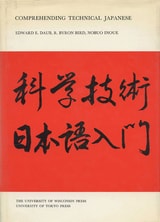
Comprehending Technical Japanese
Edward E. Daub
University of Wisconsin Press, 1975
Used for self-study or in the classroom, this text shows the reader how to read and translate technical Japanese texts by providing graded readings, explanatory notes, and translation aids.
[more]