Results by title
82 books match the query 'Japanese Americans' and 10 start with c
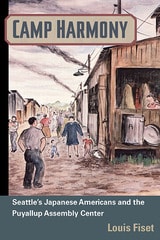
Camp Harmony
Japanese American Internment and the Puyallup Assembly CenterLouis Fiset
University of Illinois Press, 2009
This book is the first full portrait of a single assembly center--located at the Western Washington fairgrounds at Puyallup, outside Seattle--that held Japanese Americans for four months prior to their transfer to a relocation center during World War II. Gathering archival evidence and eyewitness accounts, Louis Fiset reconstructs the events leading up to the incarceration as they unfolded on a local level: arrests of Issei leaders, Nikkei response to the war dynamics, debates within the white community, and the forced evacuation of the Nikkei community from Bainbridge Island. The book explores the daily lives of the more than seven thousand inmates at "Camp Harmony," detailing how they worked, played, ate, and occasionally fought with each other and with their captors. Fiset also examines the inmates' community life, health care, and religious activities. He includes details on how army surveyors selected the center's site, oversaw its construction, and managed the transfer of inmates to the more permanent Minidoka Relocation Center in Idaho.
Camp Nine
A NovelVivienne Schiffer
University of Arkansas Press, 2011
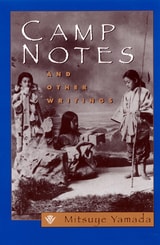
Camp Notes and Other Writings
Yamada, Mitsuye
Rutgers University Press, 1998
Honorable Mention of the 1999 Gustavus Myers Outstanding Book Awards
Two collections by an important Asian American writer -- Camp Notes and Other Poeems and Desert Run: Poems and Stories -- return to print in one volume.
Mitsuye Yamada was born in Kyushu, Japan, and raised in Seattle, Washington, until the outbreak of World War II when her family was removed to a concentration camp in Idaho. Camp Notes and Other Writings recounts this experience.
Yamada's poetry yields a terse blend of emotions and imagery. Her twist of words creates a twist of vision that make her poetry come alive. The weight of her cultural experience-the pain of being perceived as an outsider all of her life-permeates her work.
Yamada's strength as a poet stems from the fact that she has managed to integrate both individual and collective aspects of her background, giving her poems a double impact. Her strong portrayal of individual and collective life experience stands out as a distinct thread in the fabric of contemporary literature by women.
"The core poems of Camp Notes and the title come from the notes I had taken when I was in camp, and it wasn’t published until thirty years after most of it was written. I was simply describing what was happening to me, and my thoughts. But, in retrospect, the collection takes on a kind of expanded meaning about that period in our history. As invariably happens, because Japanese American internment became such an issue in American history, I suppose I will be forever identified as the author of Camp Notes. Of course, I try to show that it’s not the only thing I ever did in my whole life; I did other things besides go to an internment camp during World War II. So, in some ways I keep producing to counteract that one image that gets set in the public mind. At the time that I was writing it, I wasn’t necessarily a political person. Now, when I reread it, even to myself, I think it probably has a greater warning about the dangers of being not aware, not aware of one’s own rights, not aware of helping other people who may be in trouble. I think that it does speak to our present age very acutely." -- Mitsuye Yamada, "You should not be invisible”: An Interview with Mitsuye Yamada, Contemporary Women's Writing, March 2014, Vol. 8 Issue 1
Read the whole interview at: https://academic.oup.com/cww/article/8/1/1/414906/You-should-not-be-invisible-An-Interview-with
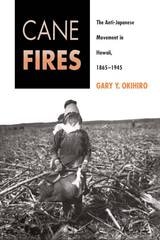
Cane Fires
The Anti-Japanese Movement in Hawaii, 1865-1945Gary Y. Okihiro
Temple University Press, 1992
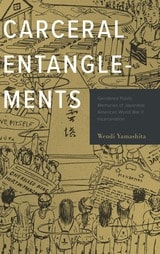
Carceral Entanglements
Gendered Public Memories of Japanese American World War II IncarcerationWendi Yamashita
Temple University Press, 2024
Carceral Entanglements features interviews, archival research, and texts to explore racial violence and patriotic masculinity and explain how Japanese American history and identity are publicly memorialized. Yamashita examines museums, digital archives, pilgrimages, and student-run and performed plays to understand how Japanese Americans occupy a “contradictory location” produced by the state. She also addresses historical erasure, race relations and the struggle for redress and reparations.
Carceral Entanglements is about the interlocking relationship Japanese American incarceration memories have to the prison industrial complex and the settler colonial logics that at times unknowingly sustain it.

Claiming the Oriental Gateway
Prewar Seattle and Japanese AmericaAuthored by Shelley S. Lee
Temple University Press, 2012
In Claiming the Oriental Gateway, Shelley Sang-Hee Lee explores the various intersections of urbanization, ethnic identity, and internationalism in the experience of Japanese Americans in early twentieth-century Seattle. She examines the development and self-image of the city by documenting how U.S. expansion, Asian trans-Pacific migration, and internationalism were manifested locally—and how these forces affected residents’ relationships with one another and their surroundings.
Lee details the significant role Japanese Americans—both immigrants and U.S. born citizens—played in the social and civic life of the city as a means of becoming American. Seattle embraced the idea of cosmopolitanism and boosted its role as a cultural and commercial "Gateway to the Orient" at the same time as it limited the ways in which Asian Americans could participate in the public schools, local art production, civic celebrations, and sports. She also looks at how Japan encouraged the notion of the "gateway" in its participation in the Alaska-Yukon-Pacific Exposition and International Potlach.
Claiming the Oriental Gateway thus offers an illuminating study of the "Pacific Era" and trans-Pacific relations in the first four decades of the twentieth century.
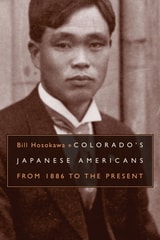
Colorado's Japanese American
B Hosokawa
University Press of Colorado, 2005
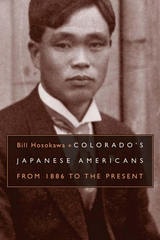
Colorado's Japanese Americans
From 1886 to the PresentBill Hosokawa
University Press of Colorado, 2005
Hosokawa traces personal histories, such as Bob Sakata's journey from internment in a relocation camp to his founding of a prosperous truck farm; the conviction of three sisters for assisting the escape of German POWs; and the years of initiative and determination behind Toshihiro Kizaki's ownership of Sushi Den, a beloved Denver eatery. In addition to personal stories, the author also relates the larger history of the interweave of cultures in Colorado, from the founding of the Navy's Japanese language school at the University of Colorado to the merging of predominantly white and Japanese American congregations at Arvada's Simpson United Methodist Church.
With the author's long view and sharp eye, Colorado's Japanese Americans creates a storied document of lasting legacy about the Issei and Nisei in Colorado.
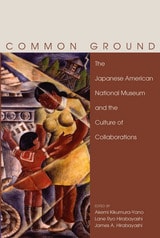
Common Ground
The Japanese American National Museum and the Culture of CollaborationsAkemi Kikumura-Yano
University Press of Colorado, 2005
Current scholarship in museum studies is generally limited to interpretations by scholars and curators. Common Ground brings descriptive data to the intellectual canon and illustrates how museum institutions must be transformed and recreated to suit the needs of the twenty-first century.
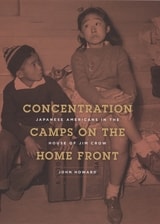
Concentration Camps on the Home Front
Japanese Americans in the House of Jim CrowJohn Howard
University of Chicago Press, 2008
While the basic facts of Japanese-American incarceration are well known, John Howard’s extensive research gives voice to those whose stories have been forgotten or ignored. He highlights the roles of women, first-generation immigrants, and those who forcefully resisted their incarceration by speaking out against dangerous working conditions and white racism. In addition to this overlooked history of dissent, Howard also exposes the government’s aggressive campaign to Americanize the inmates and even convert them to Christianity. After the war ended, this movement culminated in the dispersal of the prisoners across the nation in a calculated effort to break up ethnic enclaves.
Howard’s re-creation of life in the camps is powerful, provocative, and disturbing. Concentration Camps on the Home Front rewrites a notorious chapter in American history—a shameful story that nonetheless speaks to the strength of human resilience in the face of even the most grievous injustices.