Results by title
185 books match the query 'Jazz' and 9 start with c
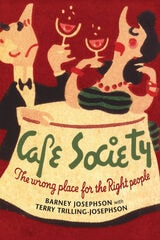
Cafe Society
The wrong place for the Right peopleBarney Josephson with Terry Trilling-Josephson. Foreword by Dan Morgenstern.
University of Illinois Press, 2009
Set against the drama of the Great Depression, the conflict of American race relations, and the inquisitions of the House Un-American Activities Committee, Cafe Society tells the personal history of Barney Josephson, proprietor of the legendary interracial New York City night clubs Cafe Society Downtown and Cafe Society Uptown and their successor, The Cookery. Famously known as "the wrong place for the Right people," Cafe Society featured the cream of jazz and blues performers--among whom were Billie Holiday, boogie-woogie pianists, Big Joe Turner, Lester Young, Buck Clayton, Big Sid Catlett, and Mary Lou Williams--as well as comedy stars Imogene Coca, Zero Mostel, and Jack Gilford, and also gospel and folk singers. A trailblazer in many ways, Josephson welcomed black and white artists alike to perform for mixed audiences in a venue whose walls were festooned with artistic and satiric murals lampooning what was then called "high society."
Featuring scores of photographs that illustrate the vibrant cast of characters in Josephson's life, this exceptional book speaks richly about Cafe Society's revolutionary innovations and creativity, inspired by the vision of one remarkable man.
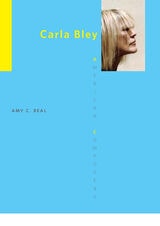
Carla Bley
Amy C. Beal
University of Illinois Press, 2011
This is the first comprehensive treatment of the remarkable music and influence of Carla Bley, a highly innovative American jazz composer, pianist, organist, band leader, and activist. With fastidious attention to Bley's diverse compositions over the last fifty years spanning critical moments in jazz and experimental music history, Amy C. Beal tenders a long-overdue representation of a major figure in American music.
Best known for her jazz opera "Escalator over the Hill," her role in the Free Jazz movement of the 1960s, and her collaborations with artists such as Jack Bruce, Don Cherry, Robert Wyatt, and Pink Floyd drummer Nick Mason, Bley has successfully maneuvered the field of jazz from highly accessible, tradition-based contexts to commercially unviable, avant-garde works. Beal details the staggering variety in Bley's work as well as her use of parody, quotations, and contradictions, examining the vocabulary Bley has developed throughout her career and highlighting the compositional and cultural significance of her experimentalism.
Beal also points to Bley's professional and managerial work as a pioneer in the development of artist-owned record labels, the cofounder and manager of WATT Records, and the cofounder of New Music Distribution Service. Showing her to be not just an artist but an activist who has maintained musical independence and professional control amid the profit-driven, corporation-dominated world of commercial jazz, Beal's straightforward discussion of Bley's life and career will stimulate deeper examinations of her work.
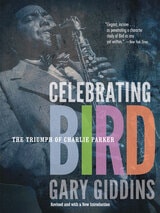
Celebrating Bird
The Triumph of Charlie ParkerGary Giddins
University of Minnesota Press, 2013
Within days of Charlie “Bird” Parker’s death at the age of thirty-four, a scrawled legend began appearing on walls around New York City: Bird Lives. Gone was one of the most outstanding jazz musicians of any era, the troubled genius who brought modernism to jazz and became a defining cultural force for musicians, writers, and artists of every stripe. Arguably the most significant musician in the country at the time of his death, Parker set the standard many musicians strove to reach—though he never enjoyed the same popular success that greeted many of his imitators. Today, the power of Parker’s inventions resonates undiminished; and his influence continues to expand.
Celebrating Bird is the groundbreaking and award-winning account of the life and legend of Charlie Parker from renowned biographer and critic Gary Giddins, whom Esquire called “the best jazz writer in America today.” Richly illustrated and drawing primarily from original sources, Giddins overturns many of the myths that have grown up around Parker. He cuts a fascinating portrait of the period, from Parker’s apprentice days in the 1930s in his hometown of Kansas City to the often difficult years playing clubs in New York and Los Angeles, and reveals how Parker came to embody not only musical innovation and brilliance but the rage and exhilaration of an entire generation.
Fully revised and with a new introduction by the author, Celebrating Bird is a classic of jazz writing that the Village Voice heralded as “a celebration of the highest order”—a portrayal of a jazz virtuoso whose gargantuan talent was haunted by his excesses and a view into the ravishing art of one of jazz’s most commanding and remarkable figures.
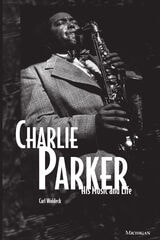
Charlie Parker
His Music and LifeCarl Woideck
University of Michigan Press, 1998
As one of the architects of modern jazz (often called "bebop"), Charlie Parker (1920-55) had a profound effect on American music that continues to this day.
This book opens with a chapter of biography and then progresses to four chapters focusing on Charlie Parker's music by tracing his artistic evolution and major achievements as a jazz improviser. Much like a guided tour through an artist's retrospective, the book introduces readers to a sampling of Charlie Parker's most illustrative works. The musical discussions and transcribed musical examples are keyed to compact disc timings for easy location--a feature unique to this book.
"The musical analysis is brilliant, particularly the pre-1945 fragments." --DownBeat
". . . debunks the stereotype that jazz musicians are unschooled and unsophisticated when it comes to music as art rather than entertainment. . . . [An] insightful and informative addition to the literature of jazz." --Calvin Wilson, Kansas City Star
Carl Woideck is Instructor of Jazz History, University of Oregon.
Charlie Parker
His Music and LifeCarl Woideck
University of Michigan Press, 2020
Circular Breathing
The Cultural Politics of Jazz in BritainGeorge McKay
Duke University Press, 2005
McKay explores the music in relation to issues of whiteness, blackness, and masculinity—all against a backdrop of shifting imperial identities, postcolonialism, and the Cold War. He considers objections to the music’s spread by the “anti-jazzers” alongside the ambivalence felt by many leftist musicians about playing an “all-American” musical form. At the same time, McKay highlights the extraordinary cultural mixing that has defined British jazz since the 1950s, as musicians from Britain’s former colonies—particularly from the Caribbean and South Africa—have transformed the genre. Circular Breathing is enriched by McKay’s original interviews with activists, musicians, and fans and by fascinating images, including works by the renowned English jazz photographer Val Wilmer. It is an invaluable look at not only the history of jazz but also the Left and race relations in Great Britain.
Civic Jazz
American Music and Kenneth Burke on the Art of Getting AlongGregory Clark
University of Chicago Press, 2015
Jazz music, Clark argues, demonstrates how this aesthetic rhetoric of identification can bind people together through their shared experience in a common project. While such shared experience does not demand agreement—indeed, it often has an air of competition—it does align people in practical effort and purpose. Similarly, Clark shows, Burke considered Americans inhabitants of a persistently rhetorical situation, in which each must choose constantly to identify with some and separate from others. Thought-provoking and path-breaking, Clark’s harmonic mashup of music and rhetoric will appeal to scholars across disciplines as diverse as political science, performance studies, musicology, and literary criticism.
Come In and Hear the Truth
Jazz and Race on 52nd StreetPatrick Burke
University of Chicago Press, 2008
Come In and Hear the Truth uses a range of materials, from classic photographs to original interviews with musicians, to bring the street’s vibrant history to life and to shed new light on the interracial contacts and collaborations it generated.
Composing for the Jazz Orchestra
William Russo
University of Chicago Press, 1961