Results by title
92 books match the query 'Judges' and 7 start with c

Call Him Mac
Ernest W. McFarland, the Arizona YearsGary L. Stuart; Foreword by Michael Daly Hawkins
University of Arizona Press, 2018
In Call Him Mac, Gary L. Stuart renders a nuanced portrait of a young, ambitious, restless, and smiling man on the verge of becoming a political force headed for the highest levels of governance in Arizona and America. Stuart reveals how Mac became an expert on water law and a visionary in Arizona’s agricultural future. Using interviews with friends and family and extensive primary source research, Stuart spotlights Mac’s unerring focus as a loving husband, father, and grandfather, even in times of great personal tragedy. Mac’s commitments to his family mirrored his sense of fiduciary duty in public life. His enormous political successes were answers to how he dealt with threats to his own life in 1919, the loss of his first wife and three children in the 1930s, and a political loss in 1952 that no one saw coming.
Stuart writes the little-known story of how Arizona’s culture and citizens shaped this energetic, determined, likable lawyer. The fame Mac created was not for himself but for those he served in Arizona and beyond. Mac’s unparalleled political success was fermented during his early Arizona years, the bridge that brought him to his future as an approachable and likable elder statesman of Arizona politics.

Cardozo
A Study in ReputationRichard A. Posner
University of Chicago Press, 1993
"The present compact and unflaggingly interesting volume . . . is a full-bodied scholarly biography. . . .It is illuminating in itself, and will serve as a significant contribution."—Paul A. Freund, New York Times Book Review
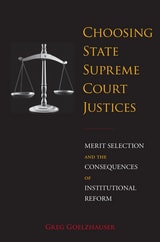
Choosing State Supreme Court Justices
Merit Selection and the Consequences of Institutional ReformGreg Goelzhauser
Temple University Press, 2016
Since 1940, more than half of all states have switched at least in part from popular election or elite appointment to experiment with merit selection in choosing some or all of their state supreme court justices. Under merit selection, a commission—often comprising some combination of judges, attorneys, and the general public—is tasked with considering applications from candidates vying to fill a judicial vacancy. Ostensibly, the commission forwards the best candidates to the governor, who ultimately appoints them. Presently, numerous states are debating whether to adopt or abolish merit selection.
In his short, sharp book, Choosing State Supreme Court Justices, Greg Goelzhauser utilizes new data on more than 1,500 state supreme court justices seated from 1960 through 2014 to answer the question, Does merit selection produce better types of judges? He traces the rise of merit selection and explores whether certain judicial selection institutions favor candidates who have better qualifications, are more diverse, and have different types of professional experience.
Goelzhauser’s results ultimately contribute to the broader debate concerning comparative institutional performance with respect to state judicial selection.
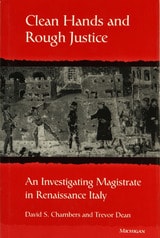
Clean Hands and Rough Justice
An Investigating Magistrate in Renaissance ItalyDavid S. Chambers and Trevor Dean
University of Michigan Press, 1997
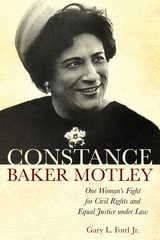
Constance Baker Motley
One Woman's Fight for Civil Rights and Equal Justice under LawGary L. Ford Jr.
University of Alabama Press, 2017
The story of NAACP’s sole female attorney. She shaped civil rights history as lead strategist and litigator from 1946–1964, arguing landmark desegregation cases and defending Martin Luther King Jr. and countless freedom fighters.
Constance Baker Motley was an African American woman; the daughter of immigrants from Nevis, British West Indies; a wife; and a mother who became a pioneer and trailblazer in the legal profession. She broke down barriers, overcame gender constraints, and operated outside the boundaries placed on black women by society and the civil rights movement. In Constance Baker Motley: One Woman’s Fight for Civil Rights and Equal Justice under Law, Gary L. Ford Jr. explores the key role Motley played in the legal fight to desegregate public schools as well as colleges, universities, housing, transportation, lunch counters, museums, libraries, parks, and other public accommodations.
The only female attorney at the NAACP Legal Defense and Educational Fund, Inc., Motley was also the only woman who argued desegregation cases in court during much of the civil rights movement. From 1946 through 1964, she was a key litigator and legal strategist for landmark civil rights cases including the Montgomery Bus Boycott and represented Martin Luther King Jr. as well as other protesters arrested and jailed as a result of their participation in sit-ins, marches, and freedom rides.
Motley was a leader who exhibited a leadership style that reflected her personality traits, skills, and strengths. She was a visionary who formed alliances and inspired local counsel to work with her to achieve the goals of the civil rights movement. As a leader and agent of change, she was committed to the cause of justice and she performed important work in the trenches in the South and behind the scene in courts that helped make the civil rights movement successful.
"Highly recommended."
—CHOICE
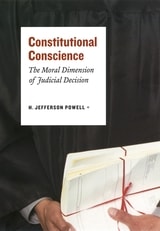
Constitutional Conscience
The Moral Dimension of Judicial DecisionH. Jefferson Powell
University of Chicago Press, 2008
Powell argues that almost every controversial decision has more than one constitutionally defensible resolution. In such cases, he goes on to contend, the language and ideals of the Constitution require judges to decide in good faith, exercising what Powell calls the constitutional virtues: candor, intellectual honesty, humility about the limits of constitutional adjudication, and willingness to admit that they do not have all the answers. Constitutional Conscience concludes that the need for these qualities in judges—as well as lawyers and citizens—is implicit in our constitutional practices, and that without them judicial review would forfeit both its own integrity and the credibility of the courts themselves.
Continuity and Change on the United States Courts of Appeals
Donald R. Songer, Reginald S. Sheehan, and Susan B. Haire
University of Michigan Press, 2000
The authors present the first comprehensive examination of the shifting role of the Courts of Appeals, investigating changes over time and presenting the first systematic analyses of those changes. Their work is the first book to utilize the database of the U.S. Courts of Appeals, analyzing over 15,000 cases to examine trends between 1925 and 1988. The book answers questions such as who are the judges? What are their decisional tendencies? What has been the role of region and partisan politics? Who are the litigants? And who has won and who has lost throughout the twentieth century? It is the only current, up-to-date book on the Courts of Appeals and an essential read for all scholars and students interested in American politics and judicial behavior.
Donald R. Songer is Professor of Political Science, University of South Carolina. Reginald S. Sheehan is Associate Professor of Political Science and Director of the Program for Law and Juridical Politics, Michigan State University. Susan B. Haire is Assistant Professor of Political Science, University of Georgia