Results by title
50 books match the query 'Justice, Administration of' and 7 start with c
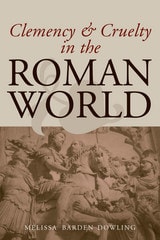
Clemency and Cruelty in the Roman World
Melissa Barden Dowling
University of Michigan Press, 2006
In this first thorough study of the origins of clemency, Dowling provides a vivid look at the ideology of clemency and new philosophies of mercy and cruelty in Western society, through an examination of ancient art, literature, historical documents, and archaeological artifacts. By illuminating the emergence of mercy and forgiveness as social concepts, and the mechanisms by which peoples are transformed in response to changes in power structures, Dowling makes an important contribution to the study of the ancient Roman world, as well as to modern Western culture.
Constitutional Conscience
The Moral Dimension of Judicial DecisionH. Jefferson Powell
University of Chicago Press, 2008
Powell argues that almost every controversial decision has more than one constitutionally defensible resolution. In such cases, he goes on to contend, the language and ideals of the Constitution require judges to decide in good faith, exercising what Powell calls the constitutional virtues: candor, intellectual honesty, humility about the limits of constitutional adjudication, and willingness to admit that they do not have all the answers. Constitutional Conscience concludes that the need for these qualities in judges—as well as lawyers and citizens—is implicit in our constitutional practices, and that without them judicial review would forfeit both its own integrity and the credibility of the courts themselves.
Continuity and Change on the United States Courts of Appeals
Donald R. Songer, Reginald S. Sheehan, and Susan B. Haire
University of Michigan Press, 2000
The authors present the first comprehensive examination of the shifting role of the Courts of Appeals, investigating changes over time and presenting the first systematic analyses of those changes. Their work is the first book to utilize the database of the U.S. Courts of Appeals, analyzing over 15,000 cases to examine trends between 1925 and 1988. The book answers questions such as who are the judges? What are their decisional tendencies? What has been the role of region and partisan politics? Who are the litigants? And who has won and who has lost throughout the twentieth century? It is the only current, up-to-date book on the Courts of Appeals and an essential read for all scholars and students interested in American politics and judicial behavior.
Donald R. Songer is Professor of Political Science, University of South Carolina. Reginald S. Sheehan is Associate Professor of Political Science and Director of the Program for Law and Juridical Politics, Michigan State University. Susan B. Haire is Assistant Professor of Political Science, University of Georgia
Courting the Community
Legitimacy and Punishment in a Community CourtChristine Zozula
Temple University Press, 2019
Community Courts are designed to handle a city’s low-level offenses and quality-of-life crimes, such as littering, loitering, or public drunkenness. Court advocates maintain that these largely victimless crimes jeopardize the well-being of residents, businesses, and visitors. Whereas traditional courts might dismiss such cases or administer a small fine, community courts aim to meaningfully punish offenders to avoid disorder escalating to apocalyptic decline.
Courting the Community is a fascinating ethnography that goes behind the scenes to explore how quality-of-life discourses are translated into court practices that marry therapeutic and rehabilitative ideas. Christine Zozula shows how residents and businesses participate in meting out justice—such as through community service, treatment, or other sanctions—making it more emotional, less detached, and more legitimate in the eyes of stakeholders. She also examines both “impact panels,” in which offenders, residents, and business owners meet to discuss how quality-of-life crimes negatively impact the neighborhood, as well as strategic neighborhood outreach efforts to update residents on cases and gauge their concerns.
Zozula’s nuanced investigation of community courts can lead us to a deeper understanding of punishment and rehabilitation and, by extension, the current state of the American court system.
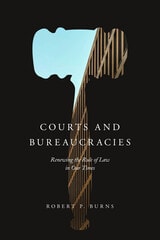
Courts and Bureaucracies
Renewing the Rule of Law in Our TimesRobert P. Burns
University of Chicago Press, 2027
A novel meditation on how courts and bureaucracies function today and how they can be made better.
We live in a highly bureaucratic society, so much so that we often don’t even see it. Although we think of bureaucracies and courtrooms as different kinds of institutions, as Robert P. Burns argues in Courts and Bureaucracies, their functions and everyday operations often blur together. Today, courts are being used to address numerous social problems that the government is unable or unwilling to tackle, and consequently, the courts frequently emphasize bureaucratic goals—such as efficiency and social control—over the adjudicatory functions that they are supposed to embody.
Drawing on social theory, philosophy, public administration, and law, Burns clarifies the role of courts in today’s bureaucratic society and considers the distinctive contributions that specifically legal procedures can bring. After exploring the competing first principles of adjudication, Burns then examines our current administrative, civil, and criminal processes and describes new and looming changes to rules and practices that should affect our thinking about the rule of law and the role of the courts.
A broad reassessment—both philosophical and practical—of how criminal, civil, and administrative practices differ from one another and what benefits each bestows, Courts and Bureaucracies offers concrete suggestions for how we can better achieve the ideals already implicit in our judicial traditions and practices.
Crime and Justice, Volume 41
Prosecutors and Politics: A Comparative PerspectiveEdited by Michael Tonry
University of Chicago Press Journals, 2012
Prosecutors are powerful figures in any criminal justice system. They decide what crimes to prosecute, whom to pursue, what charges to file, whether to plea bargain, how aggressively to seek a conviction, and what sentence to demand. In the United States, citizens can challenge decisions by police, judges, and corrections officials, but courts keep their hands off the prosecutor. Curiously, in the United States and elsewhere, very little research is available that examines this powerful public role. And there is almost no work that critically compares how prosecutors function in different legal systems, from state to state or across countries. Prosecutors and Politics begins to fill that void.
Police, courts, and prisons are much the same in all developed countries, but prosecutors differ radically. The consequences of these differences are enormous: the United States suffers from low levels of public confidence in the criminal justice system and high levels of incarceration; in much of Western Europe, people report high confidence and support moderate crime control policies; in much of Eastern Europe, people’s perceptions of the law are marked by cynicism and despair. Prosecutors and Politics unpacks these national differences and provides insight into this key area of social control.
Since 1979 the Crime and Justice series has presented a review of the latest international research, providing expertise to enhance the work of sociologists, psychologists, criminal lawyers, justice scholars, and political scientists. The series explores a full range of issues concerning crime, its causes, and its cure.
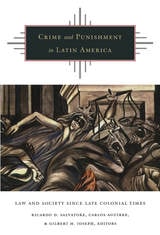
Crime and Punishment in Latin America
Law and Society Since Late Colonial TimesRicardo D. Salvatore, Carlos Aguirre, and Gilbert M. Joseph, eds.
Duke University Press, 2001
While disassociating law from a strictly legalist approach, the volume showcases a number of highly original studies on topics such as the role of law in processes of state formation and social and political conflict, the resonance between legal and cultural phenomena, and the contested nature of law-enforcing discourses and practices. Treating law as an ambiguous and malleable arena of struggle, the contributors to this volume—scholars from North and Latin America who represent the new wave in legal history that has emerged in recent years-- demonstrate that law not only produces and reformulates culture, but also shapes and is shaped by larger processes of political, social, economic, and cultural change. In addition, they offer valuable insights about the ways in which legal systems and cultures in Latin America compare to those in England, Western Europe, and the United States.
This volume will appeal to scholars in Latin American studies and to those interested in the social, cultural, and comparative history of law and legal phenomena.
Contributors. Carlos Aguirre, Dain Borges, Lila Caimari, Arlene J. Díaz, Luis A. Gonzalez, Donna J. Guy, Douglas Hay, Gilbert M. Joseph, Juan Manuel Palacio, Diana Paton, Pablo Piccato, Cristina Rivera Garza, Kristin Ruggiero, Ricardo D. Salvatore, Charles F. Walker