Results by title
100 books match the query 'Kings and rulers' and 4 start with c
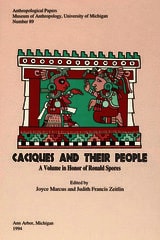
Caciques and Their People
A Volume in Honor of Ronald SporesEdited by Joyce Marcus and Judith Francis Zeitlin
University of Michigan Press, 1994
A volume of essays by Mesoamerican scholars on topics ranging from Zapotec archaeology to Cuicatec irrigation and Mixtec codices to Aztec ethnohistory. Authors use a direct historical approach, the comparative method, or develop models that contribute to ethnological and archaeological theory. Contributors: J. Chance, G. Feinman, K.V. Flannery, F. Hicks, R. Hunt, M. Lind, J. Marcus, J. Monaghan, J. Paddock, E. Redmond, M. Romero Frizzi, M.E. Smith, C. Spencer, and J. Zeitlin.
[more]
Can a Liberal be a Chief? Can a Chief be a Liberal?
Some Thoughts on an Unfinished Business of ColonialismOlúfémi Táíwò
Prickly Paradigm Press, 2021
An argument against the idea of the indigenous chief as a liberal political figure.
Across Africa, it is not unusual for proponents of liberal democracy and modernization to make room for some aspects of indigenous culture, such as the use of a chief as a political figure. Yet for Olúfẹ́mi Táíwò, no such accommodation should be made. Chiefs, he argues, in this thought-provoking and wide-ranging pamphlet, cannot be liberals—and liberals cannot be chiefs. If we fail to recognize this, we fail to acknowledge the metaphysical underpinnings of modern understandings of freedom and equality, as well as the ways in which African intellectuals can offer a distinctive take on the unfinished business of colonialism.
Across Africa, it is not unusual for proponents of liberal democracy and modernization to make room for some aspects of indigenous culture, such as the use of a chief as a political figure. Yet for Olúfẹ́mi Táíwò, no such accommodation should be made. Chiefs, he argues, in this thought-provoking and wide-ranging pamphlet, cannot be liberals—and liberals cannot be chiefs. If we fail to recognize this, we fail to acknowledge the metaphysical underpinnings of modern understandings of freedom and equality, as well as the ways in which African intellectuals can offer a distinctive take on the unfinished business of colonialism.
[more]
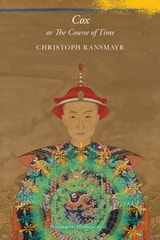
Cox
or, The Course of TimeChristoph Ransmayr
Seagull Books, 2020
Richly imagined and recounted in vivid prose of extraordinary beauty, this book is a stunning illustration of Ransmayr’s talent for imbuing a captivating tale with intense metaphorical, indeed metaphysical force.
The world’s most powerful man, Qiánlóng, emperor of China, invites the famous eighteenth-century clockmaker Alister Cox to his court in Beijing. There, in the heart of the Forbidden City, the Englishman and his assistants are to build machines that mark the passing of time as a child or a condemned man might experience it and that capture the many shades of happiness, suffering, love, and loss that come with that passing.
Mystified by the rituals of a rigidly hierarchical society dominated by an unimaginably wealthy, god-like ruler, Cox musters all his expertise and ingenuity to satisfy the emperor’s desires. Finally, Qiánlóng, also known by the moniker Lord of Time, requests the construction of a clock capable of measuring eternity—a perpetuum mobile. Seizing this chance to realize a long-held dream and honor the memory of his late beloved daughter, yet conscious of the impossibility of his task, Cox sets to work. As the court is suspended in a never-ending summer, festering with evil gossip about the monster these foreigners are creating, the Englishmen wonder if they will ever escape from their gilded cage. More than a meeting of two men, one isolated by power, the other by grief, this is an exploration of mortality and a virtuoso demonstration that storytelling alone can truly conquer time.
[more]
Cymbeline
William Shakespeare
Arizona Center for Medieval and Renaissance Studies, 2023
One of Shakespeare’s late plays rewritten in contemporary language.
In her modern translation of Cymbeline, Andrea Thome takes up one of Shakespeare’s most complex plays. Thome’s update brings the play’s language into the present, highlighting new resonances and providing a more accessible version of Shakespeare’s play for today’s audiences. One of Shakespeare’s final plays, Cymbeline tells the story of the British king Cymbeline and his daughter, Imogen. It is a tale of deceit and jealousy, with accusations of infidelity that often draw comparisons to Othello and The Winter’s Tale.
This translation of Cymbeline was written as part of the Oregon Shakespeare Festival’s Play On! project, which commissioned new translations of thirty-nine Shakespeare plays. These translations present the work of “The Bard” in language accessible to modern audiences while never losing the beauty of Shakespeare’s verse. Enlisting the talents of a diverse group of contemporary playwrights, screenwriters, and dramaturges from diverse backgrounds, this project reenvisions Shakespeare for the twenty-first century. These volumes make these works available for the first time in print—a new First Folio for a new era.
[more]