Results by title
118 books match the query 'Land tenure' and 10 start with c
Cartographic Mexico
A History of State Fixations and Fugitive LandscapesRaymond B. Craib
Duke University Press, 2004
Cattle Bring Us to Our Enemies
Turkana Ecology, Politics, and Raiding in a Disequilibrium SystemJ. Terrence McCabe
University of Michigan Press, 2004
Based on sixteen years of fieldwork among the pastoral Turkana people, McCabe examines how individuals use the land and make decisions about mobility, livestock, and the use of natural resources in an environment characterized by aridity, unpredictability, insecurity, and violence. The Turkana are one of the world's most mobile peoples, but understanding why and how they move is a complex task influenced by politics, violence, historical relations among ethnic groups, and the government, as well as by the arid land they call home.
As one of the original members of the South Turkana Ecosystem Project, McCabe draws on a wealth of ecological data in his analysis. His long-standing relationship with four Turkana families personalize his insights and conclusions, inviting readers into the lives of these individuals, their families, and the way they cope with their environment and political events in daily life.
J. Terrence McCabe is Associate Professor of Anthropology, University of Colorado at Boulder.
Colonial Lives of Property
Law, Land, and Racial Regimes of OwnershipBrenna Bhandar
Duke University Press, 2018
Competing Norms
State Regulations and Local Praxis in sub-Saharan AfricaEdited by Mamadou Diawara and Ute Röschenthaler
Campus Verlag, 2016
Conflicts over Coca Fields in Sixteenth-Century Perú
María Rostworowski de Diez Canseco
University of Michigan Press, 1988
Constellations of Inequality
Space, Race, and Utopia in BrazilSean T. Mitchell
University of Chicago Press, 2017
In 1982, the Brazilian Air Force arrived on the Alcântara peninsula to build a state-of-the-art satellite launch facility. They displaced some 1,500 Afro-Brazilians from coastal land to inadequate inland villages, leaving many more threatened with displacement. Completed in 1990, this vast undertaking in one of Brazil’s poorest regions has provoked decades of conflict and controversy.
Constellations of Inequality tells this story of technological aspiration and the stark dynamics of inequality it laid bare. Sean T. Mitchell analyzes conflicts over land, ethnoracial identity, mobilization among descendants of escaped slaves, military-civilian competition in the launch program, and international intrigue. Throughout, he illuminates Brazil’s changing politics of inequality and examines how such inequality is made, reproduced, and challenged. How people conceptualize and act on the unequal conditions in which they find themselves, he shows, is as much a cultural and historical matter as a material one. Deftly broadening our understanding of race, technology, development, and political consciousness on local, national, and global levels, Constellations of Inequality paints a portrait of contemporary Brazil that will interest a broad spectrum of readers.
Contested Territories
Native Americans and Non-Natives in the Lower Great Lakes, 1700-1850Charles Beatty-Medina
Michigan State University Press, 2012
A remarkable multifaceted history, Contested Territories examines a region that played an essential role in America's post-revolutionary expansion—the Lower Great Lakes region, once known as the Northwest Territory. As French, English, and finally American settlers moved westward and intersected with Native American communities, the ethnogeography of the region changed drastically, necessitating interactions that were not always peaceful. Using ethnohistorical methodologies, the seven essays presented here explore rapidly changing cultural dynamics in the region and reconstruct in engaging detail the political organization, economy, diplomacy, subsistence methods, religion, and kinship practices in play. With a focus on resistance, changing worldviews, and early forms of self-determination among Native Americans, Contested Territories demonstrates the continuous interplay between actor and agency during an important era in American history.
Courage Tastes of Blood
The Mapuche Community of Nicolás Ailío and the Chilean State, 1906-2001Florencia E. Mallon
Duke University Press, 2005
Mallon recounts the land usurpation Nicolás Ailío endured in the first decades of the twentieth century and the community’s ongoing struggle for restitution. Facing extreme poverty and inspired by the agrarian mobilizations of the 1960s, some community members participated in the agrarian reform under the government of socialist president Salvador Allende. With the military coup of 1973, they suffered repression and desperate impoverishment. Out of this turbulent period the Mapuche revitalization movement was born. What began as an effort to protest the privatization of community lands under the military dictatorship evolved into a broad movement for cultural and political recognition that continues to the present day. By providing the historical and local context for the emergence of the Mapuche revitalization movement, Courage Tastes of Blood offers a distinctive perspective on the evolution of Chilean democracy and its rupture with the military coup of 1973.
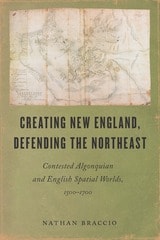
Creating New England, Defending the Northeast
Contested Algonquian and English Spatial Worlds, 1500–1700Nathan Braccio
University of Massachusetts Press, 2026
Between 1500 and 1700, Indigenous and English mapmakers across the North Atlantic depicted present-day New England in markedly distinct ways, highlighting how differently their communities understood the landscape. While English cartographers relied on new mathematics and other developing scientific knowledge from Europe, as well as an overhead perspective of the world, Algonquian mapmakers drew on deep knowledge of the landscape, derived from their communities’ long history upon it. Nathan Braccio refers to this phenomenon as “parallel landscapes.”
Creating New England, Defending the Northeast asserts that Algonquian knowledge of the landscape represented a powerful and persistent alternative to English surveying and mapmaking in the Northeast. When English colonists and explorers recognized the unsuitability of their techniques for understanding New England’s unfamiliar landscape, they attempted to appropriate Indigenous knowledge and maps. Algonquian sachems used this as an opportunity to control and benefit from their new English neighbors. Later, as the English became insecure in their dependence on Indigenous people, they began to remake and mark the landscape. Algonquians adapted, maintaining control of important spatial knowledge, even in a place no longer entirely of their making. This story complicates narratives of conquest and highlights the Indigenous spatial knowledge too often overlooked.
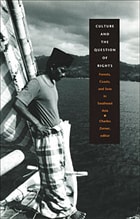
Culture and the Question of Rights
Forests, Coasts, and Seas in Southeast AsiaCharles Zerner, ed.
Duke University Press, 2003
Calling for radical redefinitions of development and ownership and for new understandings of the translation of culture and rights in politically dangerous contexts—natural resource frontiers—this volume links social injustice and the degradation of Southeast Asian environments. Charles Zerner and his colleagues show how geographical areas once viewed as wild and undeveloped are actually cultural artifacts shaped by complex interactions with human societies. Drawing on richly varied sources of evidence and interpretation—from trance dances, court proceedings, tree planting patterns, marine and forest rituals, erotic poems, and codifications of customary law, Culture and the Question of Rights reveals the ironies, complexities, and histories of contemporary communities’ struggles to retain their gardens, forests, fishing territories, and graveyards. The contributors examine how these cultural activities work to both construct and to lay claim to nature. These essays open up new avenues for negotiating indigenous rights against a background of violence, proliferating markets, and global ideas of biodiversity and threatened habitat.
Contributors. Jane Atkinson, Don Brenneis, Stephanie Fried, Nancy Peluso, Marina Roseman, Anna Tsing, Charles Zerner