Results by title
1917 books match the query 'Law' and 180 start with c
CEO Leadership
Navigating the New Era in Corporate GovernanceThomas A. Cole
University of Chicago Press, 2019
Drawing on four decades of experience advising boards and CEOs on how to do just that, Thomas A. Cole offers in CEO Leadership a straightforward and accessible guide to navigating corporate governance today. He explores the recurring question of whose benefit a corporation should be governed for, along with related matters of corporate social responsibility, and he explains the role of laws, market forces, and politics and their influence on the governance of public companies. For corporate directors, he provides a comprehensive examination of the roles, responsibilities, and accountability the role entails, while also offering guidance on how to be as effective as possible in addressing both routine corporate matters and special situations such as mergers and acquisitions, succession, and corporate crises. In addition, he offers practical suggestions for CEOs on leadership and their interactions with boards and shareholders. Cole also mounts a compelling case that a corporate culture that celebrates diversity and inclusion and has zero tolerance for sexual misconduct is critical to long-term business success.
Filled with vignettes from Cole’s many years of experience in the board room and C-suite, CEO Leadership is an invaluable resource for current and prospective directors, CEOs, and other senior officers of public companies as well as the next generation of corporate leaders and their business and financial advisors.
COURTS AND COMMERCE
GENDER, LAW, AND THE MARKET ECONOMY IN COLONIAL NEW YORKDeborah A. Rosen
The Ohio State University Press, 1997
Illuminates the legal engine behind colonial America’s market economy, revealing how law and commerce intertwined to sideline women's participation and lay the groundwork for industrial capitalism.
In Courts and Commerce, Deborah A. Rosen offers a fresh, incisive look at the economic and legal foundations of colonial New York. Drawing on a wide array of 18th-century sources—probate inventories, court records, petitions, and more—Rosen uncovers how law and commerce intertwined to shape a market economy long before the rise of industrial capitalism.
Rosen challenges the romanticized view of colonial America as a bastion of communal values. Instead, she reveals a society already driven by arm’s-length transactions and legal mechanisms that empowered men to expand their economic reach while systematically limiting women’s participation. Her analysis spans both urban and rural settings, highlighting regional contrasts and the gendered impact of legal structures.
This book pushes back against the idea that the nineteenth century marked a sudden economic transformation. Rosen shows that many of the legal and economic patterns associated with industrialization were already in motion a century earlier. Engaging and deeply researched, Courts and Commerce is essential reading for scholars of colonial history, legal and economic development, and gender studies. It reframes our understanding of early American life—and the roots of inequality in the modern economy.
Called by Stories
Biblical Sagas and Their Challenge for LawMilner S. Ball
Duke University Press, 2000
He begins with the story of Moses, who is obliged both to speak for God to the Hebrews and to advocate for the Hebrews before God. What, asks Ball, does Moses’s predicament say to lawyers professionally bound to zealous representation of only one client? In the story of Rachel, Ball finds insights that comprehend the role of tears and emotion in the judicial process. He relates these insights to specific contemporary situations, such as a plant closing and the subsequent movement of jobs to Mexico and legal disputes over the sovereignty of native Hawaiians. In a discussion of “The Gospel According to John,” Ball points out that the writer of this gospel is free simultaneously to be critical of law and to rely extensively on it. Ball uses this narrative to explore the boundaries of free will and independence in lawyering. By venturing into the world of powerful events and biblical characters, Ball enables readers to contest their own expectations and fundamental assumptions.
Employing legal theory, theology, and literary criticism, Called by Stories distills a wisdom in biblical texts that speaks specifically to the working life of legal professionals. As such, it will enrich lovers of narrative and poetry, ethicists, literary and biblical scholars, theologians, lawyers, law students, judges, and others who seek to discern deeper meanings in the texts that have shaped their lives.
Calling State Power to Account
Reparations in Morality, Law, and PoliticsJennifer M. Page
University of Chicago Press, 2027
An incisive philosophical examination of reparations claims within today’s political and legal landscapes.
For generations, Black Americans have demanded reparations, and, for generations, the US government has ignored or denied these claims. In Calling State Power to Account, Jennifer M. Page puts forward a novel case for reparations owed to Black Americans for slavery, Jim Crow, and subsequent injustices.
Navigating conflicting insights that reparations are owed for blameworthy wrongdoing and that present iniquities to Black Americans are structural rather than the result of intentional offenses by a clearly identifiable party, Page theorizes how unredressed state-sponsored injustices can be the basis of present reparative duties. Split into two parts, the book first makes a philosophical case for reparations before then examining reparations from both legal and political perspectives. This analysis includes considering practical challenges to reparations, such as the limits of legal accountability in a system with formal barriers designed to shield the government from liability. Despite formidable obstacles, Page argues that there is deep moral and democratic significance to the pursuits of reparations claimants. The aim of reparations is not only monetary compensation but also a moral reckoning and assertion of equality against the backdrop of social and political inequalities.
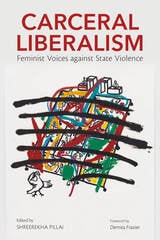
Carceral Liberalism
Feminist Voices against State ViolenceEdited by Shreerekha Pillai. Foreword by Demita Frazier
University of Illinois Press, 2023
One of Ms. Magazine's Most Anticipated Books of 2023
Carceral liberalism emerges from the confluence of neoliberalism, carcerality, and patriarchy to construct a powerful ruse disguised as freedom. It waves the feminist flag while keeping most women still at the margins. It speaks of a post-race society while one in three Black men remain incarcerated. It sings the praises of capital while the dispossessed remain mired in debt.
Shreerekha Pillai edits essays on carceral liberalism that continue the trajectory of the Combahee River Collective and the many people inspired by its vision of feminist solidarity and radical liberation. Academics, activists, writers, and a formerly incarcerated social worker look at feminist resurgence and resistance within, at the threshold of, and outside state violence; observe and record direct and indirect forms of carcerality sponsored by the state and shaped by state structures, traditions, and actors; and critique carcerality. Acclaimed poets like Honorée Fanonne Jeffers and Solmaz Sharif amplify the volume’s themes in works that bookend each section.
Cutting-edge yet historically grounded, Carceral Liberalism examines an American ideological creation that advances imperialism, anti-blackness, capitalism, and patriarchy.
Contributors: Maria F. Curtis, Joanna Eleftheriou, Autumn Elizabeth and Zarinah Agnew and D Coulombe, Jeremy Eugene, Demita Frazier, Honorée Fanonne Jeffers, Alka Kurian, Cassandra D. Little, Beth Matusoff Merfish, Francisco Argüelles Paz y Puente, Shreerekha Pillai, Marta Romero-Delgado, Ravi Shankar, Solmaz Sharif, Shailza Sharma, Tria Blu Wakpa and Jennifer Musial, Javier Zamora
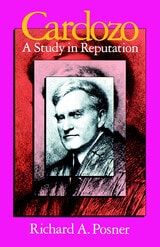
Cardozo
A Study in ReputationRichard A. Posner
University of Chicago Press, 1993
"The present compact and unflaggingly interesting volume . . . is a full-bodied scholarly biography. . . .It is illuminating in itself, and will serve as a significant contribution."—Paul A. Freund, New York Times Book Review
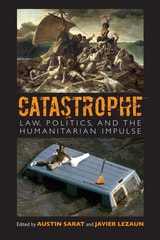
Catastrophe
Law, Politics, and the Humanitarian ImpulseAustin Sarat
University of Massachusetts Press, 2009
At a time when societies are directing an unprecedented level of resources and ingenuity to anticipating and mitigating catastrophic events, Catastrophe: Law, Politics, and the Humanitarian Impulse examines the tests that catastrophe poses to politics and humanitarianism as well as to the law. It explores legal, political, and humanitarian responses during times when the sudden, discontinuous, and disastrous event has become, perhaps paradoxically, a structural component of our political imagination. It asks whether law, politics, and humanitarianism live up to the tests posed by disaster, and the role all of them play in creating a more resilient world.
Taken together the essays in this book ask us to see through and beyond the myths that surround catastrophe and our responses to it. They ask us to rethink our understanding of catastrophe and to imagine new legal, political, and humanitarian responses.
In addition to the editors, contributors include Thomas Birkland, Michele Landis Dauber, Kim Fortun, Edward Rackley, Peter Redfield, Peter H. Schuck, and Susan Sterett.
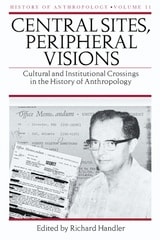
Central Sites, Peripheral Visions
Cultural and Institutional Crossings in the History of AnthropologyEdited by Richard Handler
University of Wisconsin Press, 2006
The terms "center" and "periphery" are particularly relevant to anthropologists, since traditionally they look outward from institutional "centers"-universities, museums, government bureaus-to learn about people on the "peripheries." Yet anthropology itself, as compared with economics, politics, or history, occupies a space somewhat on the margins of academe. Still, anthropologists, who control esoteric knowledge about the vast range of human variation, often find themselves in a theoretically central position, able to critique the "universal" truths promoted by other disciplines.
Central Sites, Peripheral Visions presents five case studies that explore the dilemmas, moral as well as political, that emerge out of this unique position. From David Koester's analysis of how ethnographic descriptions of Iceland marginalized that country's population, to Kath Weston's account of an offshore penal colony where officials mixed prison work with ethnographic pursuits; from Brad Evans's reflections on the "bohemianism" of both the Harlem vogue and American anthropology, to Arthur J. Ray's study of anthropologists who serve as expert witnesses in legal cases, the essays in the eleventh volume of the History of Anthropology Series reflect on anthropology's always problematic status as centrally peripheral, or peripherally central.
Finally, George W. Stocking, Jr., in a contribution that is almost a book in its own right, traces the professional trajectory of American anthropologist Robert Gelston Armstrong, who was unceremoniously expelled from his place of privilege because of his communist sympathies in the 1950s. By taking up Armstrong's unfinished business decades later, Stocking engages in an extended meditation on the relationship between center and periphery and offers "a kind of posthumous reparation," a page in the history of the discipline for a distant colleague who might otherwise have remained in the footnotes.
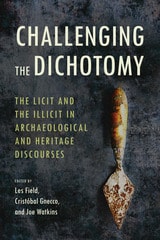
Challenging the Dichotomy
The Licit and the Illicit in Archaeological and Heritage DiscoursesEdited by Les Field, Cristóbal Gnecco, and Joe Watkins
University of Arizona Press, 2016
Utilizing both ethnographic and archaeological examples, contributors ask big questions vital to anyone working in cultural heritage. What are the issues surrounding private versus museum collections? What is considered looting? Is archaeology still a form of colonialization? The contributors discuss this vis-à-vis a global variety of contexts and cultures from the United States, South Africa, Argentina, New Zealand, Honduras, Colombia, Palestine, Greece, Canada, and from the Nasa, Choctaw, and Maori nations.
Challenging the Dichotomy underscores how dichotomies—such as licit/illicit, state/nonstate, public/private, scientific/nonscientific—have been constructed and how they are now being challenged by multiple forces. Throughout the eleven chapters, contributors provide examples of hegemonic relationships of power between nations and institutions. Scholars also reflect on exchanges between Western and non-Western epistemologies and ontologies.
The book’s contributions are significant, timely, and inclusive. Challenging the Dichotomy examines the scale and scope of “illicit” forms of excavation, as well as the demands from minority and indigenous subaltern peoples to decolonize anthropological and archaeological research.
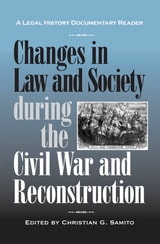
Changes in Law and Society during the Civil War and Reconstruction
A Legal History Documentary ReaderEdited by Christian G. Samito
Southern Illinois University Press, 2009
The first comprehensive collection of legal history documents from the Civil War and Reconstruction, this volume shows the profound legal changes that occurred during the Civil War era and highlights how law, society, and politics inextricably mixed and set American legal development on particular paths that were not predetermined. Editor Christian G. Samito has carefully selected excerpts from legislation, public and legislative debates, court cases, investigations of white supremacist violence in the South, and rare court-martial records, added his expert analysis, and illustrated the selections with telling period artwork to create an outstanding resource that demonstrates the rich and important legal history of the era.
Changing Lives
Delinquency Prevention as Crime-Control PolicyPeter W. Greenwood
University of Chicago Press, 2005
Peter W. Greenwood here demonstrates here that as crimes rates have fallen, researchers have identified more connections between specific risk factors and criminal behavior, while program developers have discovered a wide array of innovative interventions. The result of all this activity, he reveals, has been the revelation of a few prevention models that reduce crime much more cost-effectively than popular approaches such as tougher sentencing, D.A.R.E., boot camps, and "scared straight" programs. Changing Lives expertly presents the most promising of these prevention programs, their histories, the quality of evidence to support their effectiveness, the public policy programs involved in bringing them into wider use, and the potential for investments and developmental research to increase the range and quality of programs.
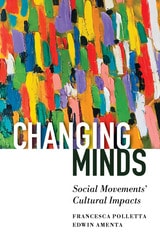
Changing Minds
Social Movements’ Cultural ImpactsFrancesca Polletta
Russell Sage Foundation, 2025
Polletta and Amenta examine the trajectories of U.S. social movements, including the old-age pension movements of the 1930s and 1940s, the Black rights movement of the 1950s and 1960s, the women’s movement of the 1970s, right-wing movements in the 1980s and 1990s, and the environmental movement up to the present, to determine when, why, and how social movements change culture. They find that influential movements are featured in the news, but not only in the news. Movement perspectives may appear also in opinion and commentary outlets, on television talk shows and dramas, in movies, stand-up comedy, and viral memes. Popular culture producers remake movement messages as they transmit them, sometimes in ways that make those messages compelling. For example, while the news largely ignored feminists’ challenge to inequality in the home, popular cultural outlets turned “liberation” into a resonant demand for women’s right to self-fulfillment outside the home and within it. Widespread attention to the movement may lead people to change their minds individually. But more substantial change is likely when companies, schools, and other organizations outside government strive to get out in front of a newly legitimate issue, whether environmental sustainability or racial equity, by adopting movement-supportive norms and practices. Eventually, ideas associated with a movement may become a new common sense—though not always the ideas that the movement intended.
Throughout Changing Minds, Polletta and Amenta provide activists with strategies for getting their message heard and acted on. They suggest how movement actors can get into the news as political players or experts rather than lawbreakers or zealots. They show when it makes sense for activists to work with popular cultural producers and when they should create their own cultural outlets. They explain why the routes to cultural influence have changed and why urging people to take one easy step to save the planet can do more harm than good.
Changing Minds is a fascinating exploration of why and how some social movements have caused profound shifts in society.
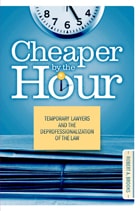
Cheaper by the Hour
Temporary Lawyers and the Deprofessionalization of the LawAuthored by Robert A. Brooks
Temple University Press, 2012
Recent law school graduates often work as temporary attorneys, but law firm layoffs and downsizing have strengthened the temporary attorney industry. Cheaper by the Hour is the first book-length account of these workers.
Drawing from participant observation and interviews, Robert A. Brooks provides a richly detailed ethnographic account of freelance attorneys in Washington, DC. He places their document review work in the larger context of the deprofessionalization of skilled labor and considers how professionals relegated to temporary jobs feel diminished, degraded, or demeaned by work that is often tedious, repetitive, and well beneath their abilities.
Brooks documents how firms break a lawyer's work into discrete components that require less skill to realize maximum profits. Moreover, he argues that information technology and efficiency demands are further stratifying the profession and creating a new underclass of lawyers who do low-end commodity work.
Chicago Lawyers, Revised Edition
The Social Structure of the BarJohn Heinz and Edward Laumann
Northwestern University Press, 1994
Chicago Lawyers
The Social Structure of the BarJohn P. Heinz
Russell Sage Foundation, 1982
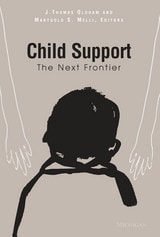
Child Support
The Next FrontierJ. Thomas Oldham and Marygold S. Melli, Editors
University of Michigan Press, 2000
Reforms have moved the child support system from one of minimal effort, based on the assumption that children in single parent households would be supported by their custodial parents or by government welfare, to a formula-based system for calculating child support and an aggressive enforcement program to collect that support from the noncustodial parent.
The essays range from a review of child support history, with a focus on the changing mores of parental responsibility, to empirical studies of whether increased establishment of paternity and child support enforcement results in more father-child contacts, to how child support affects fathers and whether the support obligation impoverishes noncustodial fathers. The essays explore the failure of the current child support reforms to reduce child poverty, consider the need to study how to determine what is a "fair amount" of child support, and debate proposals to follow the example of a number of other industrialized nations and provide more generous public benefits for poor children.
This book will be of interest to public policy makers and professionals--lawyers, legal scholars, social workers, and administrators--who work in and study the child support system.
Contributors are June R. Carbone, John Eekelaar, Martha A. Fineman, Irwin Garfinkel, Marsha Garrison, Paul K. Legler, Mavis Maclean, Marygold S. Melli, Daniel R. Meyer, J. Thomas Oldham, Allen M. Parkman, Judith A. Seltzer, and Andrea Warman.
J. Thomas Oldham is John H. Freeman Professor Law, University of Houston Law School. Marygold S. Melli is Voss-Bascom Professor of Law Emerita, University of Wisconsin-Madison Law School.
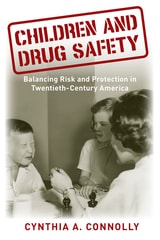
Children and Drug Safety
Balancing Risk and Protection in Twentieth-Century AmericaConnolly, Cynthia A
Rutgers University Press, 2018
Children and Drug Safety traces the development, use, and marketing of drugs for children in the twentieth century, a history that sits at the interface of the state, business, health care providers, parents, and children. This book illuminates the historical dimension of a clinical and policy issue with great contemporary significance—many of the drugs administered to children today have never been tested for safety and efficacy in the pediatric population.
Each chapter of Children and Drug Safety engages with major turning points in pediatric drug development; themes of children’s risk, rights, protection and the evolving context of childhood; child-rearing; and family life in ways freighted with nuances of race, class, and gender. Cynthia A. Connolly charts the numerous attempts by Congress, the Food and Drug Administration, the American Academy of Pediatrics, and leading pediatric pharmacologists, scientists, clinicians, and parents to address a situation that all found untenable.
Open access edition funded by the National Endowment for the Humanities.
The text of this book is licensed under a Creative Commons Attribution NonCommercial-NoDerivatives 4.0 International License: https://creativecommons.org/licenses/by-nc-nd/4.0/
Chilling Effect
A Lucinda Hayes MysteryMarianne Wesson
University Press of Colorado, 2004
When attorney Lucinda Hayes reluctantly agrees to represent the mother of a brutally slain child, she must convince the court that the makers of a pornographic film are liable for the murder. As the case unfolds, Lucinda calls upon all her personal strength and legal talent, facing down her own ghosts as well as the powerful entertainment industry's star lawyers.
In Chilling Effect, Wesson affirms the power of free speech to inspire the best and the worst human behavior and explores the tension between freedom and accountability
Choosing State Supreme Court Justices
Merit Selection and the Consequences of Institutional ReformGreg Goelzhauser
Temple University Press, 2016
Since 1940, more than half of all states have switched at least in part from popular election or elite appointment to experiment with merit selection in choosing some or all of their state supreme court justices. Under merit selection, a commission—often comprising some combination of judges, attorneys, and the general public—is tasked with considering applications from candidates vying to fill a judicial vacancy. Ostensibly, the commission forwards the best candidates to the governor, who ultimately appoints them. Presently, numerous states are debating whether to adopt or abolish merit selection.
In his short, sharp book, Choosing State Supreme Court Justices, Greg Goelzhauser utilizes new data on more than 1,500 state supreme court justices seated from 1960 through 2014 to answer the question, Does merit selection produce better types of judges? He traces the rise of merit selection and explores whether certain judicial selection institutions favor candidates who have better qualifications, are more diverse, and have different types of professional experience.
Goelzhauser’s results ultimately contribute to the broader debate concerning comparative institutional performance with respect to state judicial selection.
Church State Corporation
Construing Religion in US LawWinnifred Fallers Sullivan
University of Chicago Press, 2020
Through readings of the opinions of the US Supreme Court and other legal texts, Sullivan shows how “the church” as a religious collective is granted special privilege in US law. In-depth analyses of Hosanna-Tabor v. EEOC and Burwell v. Hobby Lobby reveal that the law tends to honor the religious rights of the group—whether in the form of a church, as in Hosanna-Tabor, or in corporate form, as in Hobby Lobby—over the rights of the individual, offering corporate religious entities an autonomy denied to their respective members. In discussing the various communities that construct the “church-shaped space” in American law, Sullivan also delves into disputes over church property, the legal exploitation of the black church in the criminal justice system, and the recent case of Masterpiece Cakeshop v. Colorado Civil Rights Commission. Brimming with insight, Church State Corporation provocatively challenges our most basic beliefs about the ties between religion and law in ostensibly secular democracies.
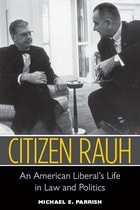
Citizen Rauh
An American Liberal's Life in Law and PoliticsMichael E. Parrish
University of Michigan Press, 2011
"Joe Rauh was the type of lawyer who comes along maybe once in a generation---talented, politically astute, effective, and stubbornly devoted to principles, the type of person who not only could but did make a difference. He deserves a biography that explores not only his persona, but the America in which he lived and worked, and how he made a difference to so many people. Michael Parrish has given us just such a book, an exceedingly fine, well-written story that will make clear to another generation not only who Joe Rauh was, but why we as a nation will always need someone like him."
---Melvin I. Urofsky, Professor of Law and Public Policy, Virginia Commonwealth University
"Michael Parrish has captured the life of this great civil libertarian in splendid fashion. His biography of this energetic New Deal liberal weaves effortlessly between public and private, friend and foe, victory and defeat. With Parrish as a sure guide, Citizen Rauh transports the reader through an American history that begins with Sacco and Vanzetti and ends as he battles CIA skullduggery in the 1980s. This biography should be on your shelf and in your heart."
---Nelson Lichtenstein, MacArthur Foundation Professor of History and Director of the Center for the Study of Work, Labor, and Democracy, University of California, Santa Barbara
"Michael Parrish has fashioned a biography filled with Rauh's spirit, achievements, his losses, and above all, the importance of his presence. This is a wonderful account of a giant of late 20th century political and legal affairs."
---Stanley Kutler, E. Gordon Fox Professor Emeritus of American Institutions, History, and Law, University of Wisconsin, Madison
Citizen Rauh tells the story of American lawyer Joseph L. Rauh Jr., who kept alive the ideals of New Deal liberalism and broadened those ideals to include a commitment to civil rights. Rauh's clients included Arthur Miller, Lillian Hellman, A. Philip Randolph, and the Mississippi Freedom Democratic Party. With good reason Freedom Rider John Lewis once called him "the blackest white man I ever knew."
No lawyer in the post-1945 era did more to protect the economic interests of working-class Americans than Rauh, who fought for the unions as they struggled for legitimacy and against them when they betrayed their own members. No lawyer stood more courageously against repressive anticommunism during the 1950s or advanced the cause of racial justice more vigorously in the 1960s and 1970s. No lawyer did more to defend the constitutional vision of the Warren Court and resist the efforts of Richard Nixon and Ronald Reagan to undo its legacy.
Throughout his life, Rauh continued to articulate a progressive vision of law and politics, ever confident that his brand of liberalism would become vital once again when the cycle of American politics took another turn.
Michael E. Parrish is Distinguished Professor of History at the University of California, San Diego, where he has taught for forty years. A specialist in the legal and constitutional history of the United States, he has also taught at Nanjing University in the People's Republic of China, the University of Edinburgh, the University of Glasgow, and the University of Helsinki, where he was the Fulbright Bicentennial Professor of American Studies.
Parrish is the author of five other books: Securities Regulation and the New Deal; Felix Frankfurter and His Times; Anxious Decades: America in Prosperity and Depression; The Hughes Court: Justices, Rulings, and Legacy; and The Supreme Court and Capital Punishment: Judging Death. His articles have appeared in the American Historical Review, the Historian, Diplomatic History, the Journal of the Supreme Court Historical Society, and the Yale Law Journal.
Jacket design by Paula Newcomb
Jacket photograph: Joseph L. Rauh Jr. with President Lyndon B. Johnson. Courtesy of the Estate of Olie W. Rauh.
Citizenship in Question
Evidentiary Birthright and StatelessnessBenjamin N. Lawrance and Jacqueline Stevens, editors
Duke University Press, 2017
Citizenship, Belonging, and Political Community in Africa
Dialogues between Past and PresentEmma Hunter
Ohio University Press, 2016
Africa, it is often said, is suffering from a crisis of citizenship. At the heart of the contemporary debates this apparent crisis has provoked lie dynamic relations between the present and the past, between political theory and political practice, and between legal categories and lived experience. Yet studies of citizenship in Africa have often tended to foreshorten historical time and privilege the present at the expense of the deeper past.
Citizenship, Belonging, and Political Community in Africa provides a critical reflection on citizenship in Africa by bringing together scholars working with very different case studies and with very different understandings of what is meant by citizenship. By bringing historians and social scientists into dialogue within the same volume, it argues that a revised reading of the past can offer powerful new perspectives on the present, in ways that might also indicate new paths for the future.
The project collects the works of up-and-coming and established scholars from around the globe. Presenting case studies from such wide-ranging countries as Sudan, Mauritius, South Africa, Côte d’Ivoire, and Ethiopia, the essays delve into the many facets of citizenship and agency as they have been expressed in the colonial and postcolonial eras. In so doing, they engage in exciting ways with the watershed book in the field, Mahmood Mamdani’s Citizen and Subject.
Contributors: Samantha Balaton-Chrimes, Frederick Cooper, Solomon M. Gofie, V. Adefemi Isumonah, Cherry Leonardi, John Lonsdale, Eghosa E.Osaghae, Ramola Ramtohul, Aidan Russell, Nicole Ulrich, Chris Vaughan, and Henri-Michel Yéré.
Civic and Uncivic Values in Kosovo
History, Politics, and Value TransformationSabrina P. Ramet
Central European University Press, 2015
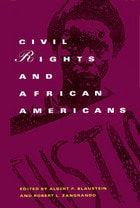
Civil Rights and African Americans
A Documentary HistoryAlbert Blaustein and Robert L. Zangrando
Northwestern University Press, 1991
Many of the documents included were previously scattered in hard-to-find sources, not readily available to instructors and students. Civil Rights and African Americans is the first collection of all the seminal texts of the civil rights struggle, an invaluable scholarly reference and riveting reading for anyone interested in the history of racial conflict in the United States.

Civil Service Law
Oliver P. Field
University of Minnesota Press, 1939
Civil Service Law was first published in 1939. Minnesota Archive Editions uses digital technology to make long-unavailable books once again accessible, and are published unaltered from the original University of Minnesota Press editions.
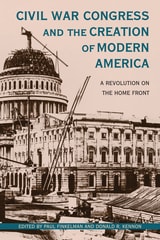
Civil War Congress and the Creation of Modern America
A Revolution on the Home FrontPaul Finkelman
Ohio University Press, 2018
Most literature on the Civil War focuses on soldiers, battles, and politics. But for every soldier in the United States Army, there were nine civilians at home. The war affected those left on the home front in many ways. Westward expansion and land ownership increased. The draft disrupted families while a shortage of male workers created opportunities for women that were previously unknown.
The war also enlarged the national government in ways unimagined before 1861. The Homestead Act, the Land Grant College Act, civil rights legislation, the use of paper currency, and creation of the Internal Revenue Service to collect taxes to pay for the war all illustrate how the war fundamentally, and permanently, changed the nation.
The essays in this book, drawn from a wide range of historical expertise and approaching the topic from a variety of angles, explore the changes in life at home that led to a revolution in American society and set the stage for the making of modern America.
Contributors: Jean H. Baker, Jenny Bourne, Paul Finkelman, Guy Gugliotta, Daniel W. Stowell, Peter Wallenstein, Jennifer L. Weber.
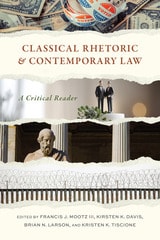
Classical Rhetoric and Contemporary Law
A Critical ReaderEdited by Francis J. Mootz III, Kirsten K. Davis, Brian N. Larson, and Kristen K. Tiscione
University of Alabama Press, 2024
A rigorous interdisciplinary inquiry into how classical rhetorical traditions continue to inform, challenge, and enrich modern legal reasoning and jurisprudence.
Classical Rhetoric and Contemporary Law: A Critical Reader is a rich work that analyzes the interplay between ancient rhetorical traditions and modern legal practice, reestablishing the lost connections between law and classical rhetoric. From Isocrates’s Panegyricus in 380 BCE to the landmark US Supreme Court case Trump v. Hawaii in 2018, and from Antiphon’s fifth century BCE First Tetralogy to 1995’s O. J. Simpson trial, the volume draws on an array of sources to illuminate how ancient rhetorical insights may even today challenge and enrich our grasp of contemporary legal principles.
The collection opens with a brisk review of the historical development of rhetoric. The second part examines a pair of rhetorical theorists whose works frame the period across which classical rhetoric declined as a mode of thought. A contemporary appellate case contrasts with the work of Giambattista Vico, an eighteenth-century professor of rhetoric who warned of the separation of law from rhetoric. The analysis of the work of twentieth-century scholars Chaïm Perelman and Lucie Olbrects-Tyteca shows that where Cartesian rationality fails, the humanistic tradition of rhetoric allows the law to respond to the needs of justice. In the third part, ten case studies bring together a classical rhetorical theorist with a contemporary court case, demonstrating the abiding relevance of the classical tradition to contemporary jurisprudence.
With its cross-disciplinary appeal, Classical Rhetoric and Contemporary Law encompasses the work of legal, rhetorical, English, and communication scholars alike, catalyzing interactive exploration into the profound ways ancient rhetorical insights continue to shape our comprehension of today’s legal landscape.
CONTRIBUTORS
Vasileios Adamidis / Elizabeth C. Britt / Kirsten K. Davis / David A. Frank / Michael Gagarin / Eugene Garver / Mark A. Hannah / Catherine L. Langford / Brian N. Larson / Craig A. Meyer / Francis J. Mootz III / Susan E. Provenzano / Nick J. Sciullo / Kristen K. Tiscione / Laura A. Webb
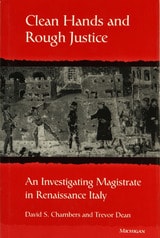
Clean Hands and Rough Justice
An Investigating Magistrate in Renaissance ItalyDavid S. Chambers and Trevor Dean
University of Michigan Press, 1997
Closing Arguments
Clarence Darrow on Religion, Law, and SocietyClarence Darrow
Ohio University Press, 2005
Clarence Darrow, son of a village undertaker and coffinmaker, rose to become one of America’s greatest attorneys—and surely its most famous. The Ohio native gained renown for his central role in momentous trials, including his 1924 defense of Leopold and Loeb and his defense of Darwinian principles in the 1925 Scopes “Monkey Trial.” Some have traced Darrow’s lifelong campaign against capital punishment to his boyhood terror at seeing a Civil War soldier buried—and no client of Darrow’s was ever executed, not even black men who were accused of murder for killing members of a white mob.
Closing Arguments: Clarence Darrow on Religion, Law, and Society collects, for the first time, Darrow’s thoughts on his three main preoccupations, revealing a carefully conceived philosophy expressed with delightful pungency and clarity. His thoughts on social issues, especially on the dangers of religious fundamentalism, are uncannily prescient. A dry humor infuses his essays, and his reflections on himself and his philosophy reveal a quiet dignity at the core of a man better known for provoking Americans during an era of unprecedented tumult. From the wry “Is the Human Race Getting Anywhere?” to the scornful “Patriotism” and his elegiac summing up, “At Seventy-two,” Darrow’s writing still stimulates, pleases and challenges.
A rebel who always sided intellectually and emotionally with the minority, Darrow remains a figure to contend with sixty-seven years after his death. “Inside every lawyer is the wreck of a poet,” Darrow once said. Closing Arguments demonstrates that, in his case, that statement is true.
Cognitive Styles in Law Schools
By Alfred G. Smith
University of Texas Press, 1979
People differ in their cognitive styles—their ways of getting and using information to solve problems and make decisions. Alfred G. Smith and his associates studied these differences in a selected group of over 800 students at a score of law schools throughout the United States. Two major cognitive styles were identified: that of the monopath, who follows a single route of established principles and procedures, and that of the polypath, who takes many routes, as circumstances suggest.
A battery of both original and standard tests was administered to both law students and their professors to investigate differences in cognitive style and their relationships to self-image, anxiety, and academic achievement. This also revealed differences in prevailing styles at different schools.
The results will be of special interest to readers concerned with legal education, to psychologists, and to behavioral scientists. The research format developed here will serve equally well for raising significant questions about the professions of medicine, education, social work, and others in which cognitive and communication styles play a central role in determining outcomes.
Cold War Ruins
Transpacific Critique of American Justice and Japanese War CrimesLisa Yoneyama
Duke University Press, 2016
Collateral Knowledge
Legal Reasoning in the Global Financial MarketsAnnelise Riles
University of Chicago Press, 2011
Who are the agents of financial regulation? Is good (or bad) financial governance merely the work of legislators and regulators? Here Annelise Riles argues that financial governance is made not just through top-down laws and policies but also through the daily use of mundane legal techniques such as collateral by a variety of secondary agents, from legal technicians and retail investors to financiers and academics and even computerized trading programs.
Drawing upon her ten years of ethnographic fieldwork in the Japanese derivatives market, Riles explores the uses of collateral in the financial markets as a regulatory device for stabilizing market transactions. How collateral operates, Riles suggests, is paradigmatic of a class of low-profile, mundane, but indispensable activities and practices that are all too often ignored as we think about how markets should work and be governed. Riles seeks to democratize our understanding of legal techniques, and demonstrate how these day-to-day private actions can be reformed to produce more effective forms of market regulation.
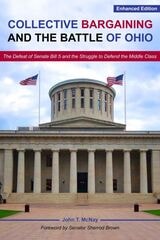
Collective Bargaining and the Battle for Ohio
The Defeat of Senate Bill 5 and the Struggle to Defend the Middle ClassJohn T. McNay
University of Minnesota Press, 2022
In 2011, Ohio Governor John Kasich and his Republican-controlled legislature passed the radical Senate Bill 5 designed to impede the labor movement, particularly targeting unionized professors. Collective Bargaining and the Battle for Ohio is the story of how professors worked alongside firefighters, police, and janitors to defend universities, the value of higher education, and their collective bargaining rights. Faculty across the state joined “We Are Ohio,” a historic coalition of unions and progressive groups that spearheaded efforts to protect employees’ rights to have a voice in the workplace. A massive political struggle ensued, pitting the labor movement against powerful corporate forces, and on election day, Ohioans defended the middle class by repealing Senate Bill 5 by a nearly 2-1 margin.
In this tenth-anniversary edition, historian, higher education expert, and author John T. McNay updates the introduction and pairs his compelling account with video and articles which highlight the struggles of the union battle.
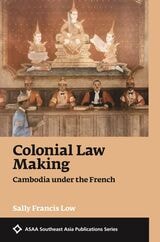
Colonial Law Making
Cambodia under the FrenchSally Frances Low
National University of Singapore Press, 2023
Covering a previously neglected area of Cambodian history, Colonial Law Making explores the structural forces and contingent exchanges that shaped colonial law in Cambodia and examines its post-independence colonial legacy.
The court of King Norodom and the temples of Angkor Wat became orientalist icons in the French colonial imagination, perpetuating an image of the Protectorate (1863–1953) as special and worthy of preservation. This contributed to exceptionalism in the way the Kingdom was colonized, including through law. Drawing on previously unexamined archival material, Sally Low presents a comparative case study of French approaches to colonial law, jurisdiction, and protection. Although the voices of non-elite Cambodians are largely absent from the archives, their influence on colonial law is evident as they resisted efforts to regulate their lives and their land. Low argues that the result was a set of state legal institutions and an indigenous jurisdiction that blended Cambodian and French notions of patronage and royal power as the source and authority for law.
This work is a case study of colonial law as an instrument of control and administration in an indirectly ruled colony. It adds depth to our understanding of the impact of European colonial law and the significance of different forms of colonial rule—direct, indirect, and unofficial. It is easily accessible for non-lawyers and is a must-read for those interested in the recent past of Southeast Asia and the countries that were previously colonized as French Indochina.

Colonial Lives of Property
Law, Land, and Racial Regimes of OwnershipBrenna Bhandar
Duke University Press, 2018

Colonialism Is Crime
Marianne Nielsen
Rutgers University Press, 2019
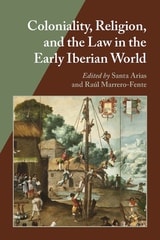
Coloniality, Religion, and the Law in the Early Iberian World
Santa Arias
Vanderbilt University Press, 2013
Hispanic Issues Series
Nicholas Spadaccini, Editor-in-Chief
Hispanic Issues Online
hispanicissues.umn.edu/online_main.html
Color of Law
A NovelDavid Milofsky
University Press of Colorado, 2000

Colorado Water Law for Non-Lawyers
P. Andrew Jones
University Press of Colorado, 2009
This book will appeal to at students, non-lawyers involved with water issues, and general readers interested in Colorado’s complex water rights law.
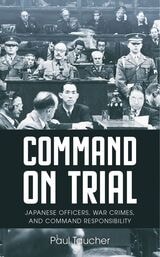
Command on Trial
Japanese Officers, War Crimes, and Command ResponsibilityPaul Taucher
Hong Kong University Press, 2026
An examination of how the legal doctrine of command responsibility was applied during military tribunals for Japanese war criminals, often inconsistently and ineffectively.
Between 1945 and 1951, the Allied powers prosecuted over 5,700 suspected Japanese war criminals across the Asia-Pacific region before one international and many national tribunals using a new legal doctrine known as command responsibility. Command responsibility holds officers criminally liable for the crimes of their subordinates even if they did not order the crimes to occur. Allied authorities believed that the structure of the Japanese military had allowed the crimes to occur and that pursuing guilt for war crimes should extend beyond enlisted soldiers who were the direct perpetrators of war crimes to those who had been in a position of command.
Command on Trial shows that the application of command responsibility in the courtroom was highly unstable and open to manipulation, especially in the trials of lower-ranking officers, resulting in outcomes that were legally, morally, and philosophically inconsistent. A clear illustration of the pitfalls of command responsibility, this book shows that the trials—and command responsibility—did not achieve comprehensive justice and left unanswered the question of who was actually responsible for many of the war crimes that were perpetrated.
Commentaries on the Laws of England, A Facsimile of the First Edition of 1765-1769
William Blackstone
University of Chicago Press, 2002
The Commentaries is divided into four books. The first, introduced by Stanley N. Katz, deals with what Blackstone called "the rights of persons," what a modern lawyer would call constitutional law, the legal structure of government. Book II includes an introduction by A. W. Brian Simpson and describes the law of property. Book III, introduced by John H. Langbein, analyzes civil procedure and remedies. The last book, which is devoted to criminal law and procedure, includes an introduction by Thomas A. Green.
Now regarded as a literary, as well as a legal classic, Blackstone's Commentaries brilliantly laid out the system of English law in the mid-eighteenth century, demonstrating that as a system of justice, it was comparable to Roman law and the civil law of the Continent. Ironically, the work also revealed to the colonists the insufficiencies of the system and became a model for the legal system of the fledgling American nation in 1789. Supplemented with commentary by experts in the field, these classic facsimile volumes belong on every lawyer's bookshelves.
Volume I: Of the Rights of Persons (1765)
Volume II: Of the Rights of Things (1766)
Volume III: Of Private Wrongs (1768)
Volume IV: Of Public Wrongs (1769)
Commentaries on the Laws of England, Volume 1
A Facsimile of the First Edition of 1765-1769William Blackstone
University of Chicago Press, 1979
Previously available only in an expensive hardcover set, Commentaries on the Laws of England is published here in four separate volumes, each one affordably priced in a paperback edition. These works are facsimiles of the eighteenth-century first edition and are undistorted by later interpolations. Each volume deals with a particular field of law and carries with it an introduction by a leading contemporary scholar.
In his introduction to this first volume, Of the Rights of Persons, Stanley N. Katz presents a brief history of Blackstone's academic and legal career and his purposes in writing the Commentaries. Katz discusses Blackstone's treatment of the structure of the English legal system, his attempts to justify it as the best form of government, and some of the problems he encountered in doing so.
Commentaries on the Laws of England, Volume 2
A Facsimile of the First Edition of 1765-1769William Blackstone
University of Chicago Press, 1979
Previously available only in an expensive hardcover set, Commentaries on the Laws of England is published here in four separate volumes, each one affordably priced in a paperback edition. These works are facsimiles of the eighteenth-century first edition and are undistorted by later interpolations. Each volume deals with a particular field of law and carries with it an introduction by a leading contemporary scholar.
Introducing this second volume, Of the Rights of Things, A. W. Brian Simpson discusses the history of Blackstone's theory of various aspects of property rights—real property, feudalism, estates, titles, personal property, and contracts—and the work of his predecessors.
Commentaries on the Laws of England, Volume 3
A Facsimile of the First Edition of 1765-1769William Blackstone
University of Chicago Press, 1979
Previously available only in an expensive hardcover set, Commentaries on the Laws of England is published here in four separate volumes, each one affordably priced in a paperback edition. These works are facsimiles of the eighteenth-century first edition and are undistorted by later interpolations. Each volume deals with a particular field of law and carries with it an introduction by a leading contemporary scholar.
Introducing this third volume, Of Private Wrongs, John H. Langbein discusses Blackstone's account of procedure and jurisdiction, jury trial, and equity. He also examines Blackstone's uneasy attitude toward the celebrated legal frictions of English civil procedure.
Commentaries on the Laws of England, Volume 4
A Facsimile of the First Edition of 1765-1769William Blackstone
University of Chicago Press, 1979
Previously available only in an expensive hardcover set, Commentaries on the Laws of England is published here in four separate volumes, each one affordably priced in a paperback edition. These works are facsimiles of the eighteenth-century first edition and are undistorted by later interpolations. Each volume deals with a particular field of law and carries with it an introduction by a leading contemporary scholar.
Introducing this fourth and final volume, Of Public Wrongs, Thomas A. Green examines Blackstone's attempt to rationalize the severity of the law with what he saw as the essentially humane inspiration of English law. Green discusses Blackstone's ideas on criminal law, criminal procedure, and sentencing.
Commodity & Propriety
Competing Visions of Property in American Legal Thought, 1776-1970Gregory S. Alexander
University of Chicago Press, 1997
In demonstrating how the understanding of property as a private basis for the public good has competed with the better-known market-oriented conception, Alexander radically rewrites the history of property, with significant implications for current political debates and recent Supreme Court decisions.

Communication and Litigation
Case Studies of Famous TrialsJanice Schuetz
Southern Illinois University Press, 1988
Examination of seven famous trials, each concluding with an evaluation of the trial by a lawyer, judge, law professor, or communication scholar.
The Washington Post coverage of the John Hinckley case preceding the trial demonstrates the effects media may have on a trial. The Haymarket riot trial serves as an example of opening statements in a storytelling form.
By analyzing the trial of Bruno Richard Hauptmann, Schuetz and Snedaker explain direct examination according to its purpose, legal rules, ordering of witnesses, verbal and nonverbal techniques of interrogation, and tactics for introducing evidence.
The cross-examination in the Sacco-Vanzetti case shows how advocates enhance or decrease their persuasiveness by adopting communication maneuvers. Closing arguments in the Rosenberg trial took the form of a refutative story with a dual persuasive and instructional content.
The Supreme Court appeal in the Sam Sheppard case demonstrates the procedures, form, content, and style of arguments of appellate briefs. The Chicago Eight trial is an example of trial as theatre.
Communities and Law
Politics and Cultures of Legal IdentitiesGad Barzilai
University of Michigan Press, 2005
--Choice
"A remarkable achievement."
--Malcolm Feeley, University of California, Berkeley
"A rich, subtle, and wide-ranging analysis of the complex interaction between law and culture in Israeli society."
--Pnina Lahav, Boston University School of Law
"Barzilai makes a major contribution to thinking about state-society relations, pointing researchers to the plurality of communities harboring different sorts of legal identities, consciousness, and practices."
--Joel Migdal, University of Washington
Communities and Law examines the intersection of communities, cultures, and laws in public life, asking important questions about how nonruling communities confront the law in their efforts to achieve political goals.
Compact Copyright
Quick Answers to Common QuestionsSara R. Benson
American Library Association, 2021
Included in Choice's Top 75 Titles and Resources for Community College Libraries
Faculty, students, and colleagues come to you with copyright questions, both simple and complex. And they all want reliable answers—as fast as you can get them. With this guide, designed for ready access, you’ll be prepared to deliver. Lawyer, copyright librarian, and iSchool instructor Benson presents succinct explanations ideal for both on-the-fly reference and staff training. Copyright specialists will appreciate excerpts from the law itself alongside tools and resources for digging deeper. Practical discussions of key legal concepts, illustrated using 52 scenarios, will lead you to fast, accurate answers on a range of topics, such as
- barriers to using the TEACH Act provisions in content for online teaching;
- showing a full-length movie in a university class;
- public domain and the 1998 Sonny Bono Copyright Term Extension Act;
- your legal options when receiving a DMCA take-down notice;
- court interpretations of fair use in three key recent cases;
- Creative Commons licenses, complete with a quick reference chart;
- library rights to license photographs in a digital collection;
- using letters under copyright in a special collections display case;
- a grad student’s right to use in a thesis writing published in their professor’s journal article;
- applying the implied license option to post historical student dissertations in institutional repositories;
- the Marrakesh Treaty provision supporting transfer of accessible works internationally; and
- limiting factors for interlibrary loan.