Results by title
59 books match the query 'Lawyers & Judges' and 4 start with c
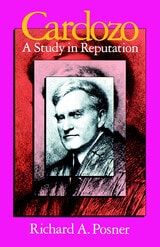
Cardozo
A Study in ReputationRichard A. Posner
University of Chicago Press, 1993
"The present compact and unflaggingly interesting volume . . . is a full-bodied scholarly biography. . . .It is illuminating in itself, and will serve as a significant contribution."—Paul A. Freund, New York Times Book Review
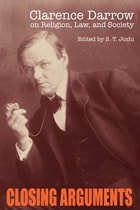
Closing Arguments
Clarence Darrow on Religion, Law, and SocietyClarence Darrow
Ohio University Press, 2005
Clarence Darrow, son of a village undertaker and coffinmaker, rose to become one of America’s greatest attorneys—and surely its most famous. The Ohio native gained renown for his central role in momentous trials, including his 1924 defense of Leopold and Loeb and his defense of Darwinian principles in the 1925 Scopes “Monkey Trial.” Some have traced Darrow’s lifelong campaign against capital punishment to his boyhood terror at seeing a Civil War soldier buried—and no client of Darrow’s was ever executed, not even black men who were accused of murder for killing members of a white mob.
Closing Arguments: Clarence Darrow on Religion, Law, and Society collects, for the first time, Darrow’s thoughts on his three main preoccupations, revealing a carefully conceived philosophy expressed with delightful pungency and clarity. His thoughts on social issues, especially on the dangers of religious fundamentalism, are uncannily prescient. A dry humor infuses his essays, and his reflections on himself and his philosophy reveal a quiet dignity at the core of a man better known for provoking Americans during an era of unprecedented tumult. From the wry “Is the Human Race Getting Anywhere?” to the scornful “Patriotism” and his elegiac summing up, “At Seventy-two,” Darrow’s writing still stimulates, pleases and challenges.
A rebel who always sided intellectually and emotionally with the minority, Darrow remains a figure to contend with sixty-seven years after his death. “Inside every lawyer is the wreck of a poet,” Darrow once said. Closing Arguments demonstrates that, in his case, that statement is true.
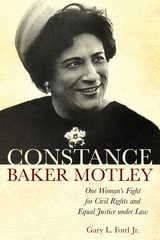
Constance Baker Motley
One Woman's Fight for Civil Rights and Equal Justice under LawGary L. Ford Jr.
University of Alabama Press, 2017
The story of NAACP’s sole female attorney. She shaped civil rights history as lead strategist and litigator from 1946–1964, arguing landmark desegregation cases and defending Martin Luther King Jr. and countless freedom fighters.
Constance Baker Motley was an African American woman; the daughter of immigrants from Nevis, British West Indies; a wife; and a mother who became a pioneer and trailblazer in the legal profession. She broke down barriers, overcame gender constraints, and operated outside the boundaries placed on black women by society and the civil rights movement. In Constance Baker Motley: One Woman’s Fight for Civil Rights and Equal Justice under Law, Gary L. Ford Jr. explores the key role Motley played in the legal fight to desegregate public schools as well as colleges, universities, housing, transportation, lunch counters, museums, libraries, parks, and other public accommodations.
The only female attorney at the NAACP Legal Defense and Educational Fund, Inc., Motley was also the only woman who argued desegregation cases in court during much of the civil rights movement. From 1946 through 1964, she was a key litigator and legal strategist for landmark civil rights cases including the Montgomery Bus Boycott and represented Martin Luther King Jr. as well as other protesters arrested and jailed as a result of their participation in sit-ins, marches, and freedom rides.
Motley was a leader who exhibited a leadership style that reflected her personality traits, skills, and strengths. She was a visionary who formed alliances and inspired local counsel to work with her to achieve the goals of the civil rights movement. As a leader and agent of change, she was committed to the cause of justice and she performed important work in the trenches in the South and behind the scene in courts that helped make the civil rights movement successful.
"Highly recommended."
—CHOICE
Courting History
A Supreme Court Historian Reflects on His Life and CareerJames F. Simon
University of Texas Press, 2025
A Supreme Court historian’s memoir places court events in the larger context of American history.
Legal scholar James F. Simon has written many acclaimed books on the history of the US Supreme Court, but in this memoir, he turns his attention to a more personal subject: himself. Simon, a native of Fort Worth, details what it was like growing up in segregated Texas. He left home for college and law school at Yale, interspersed with travels abroad to build a schoolhouse in Ghana, work at an Israeli kibbutz, and spend a year on a fellowship in India.
Simon worked as a legal journalist for Time magazine before embarking on a career as a Supreme Court historian. He later was appointed professor of constitutional law and served as dean of New York Law School. Meanwhile, he continued his work on what became his specialty, well-researched books on the history of the Supreme Court that place events at the court in the larger context of American history. Much of this research is included in his papers, which are now housed at the Briscoe Center for American History.
In this engaging memoir, Simon describes the challenges of interviewing Supreme Court justices and researching constitutional history for his books and juggling his law school and family responsibilities, all the while reflecting on changing American perspectives on civil rights and liberties.