Results by title
127 books match the query 'Leadership' and 8 start with c

Charismatic Monks of Lanna Buddhism
Edited by Paul T. Cohen
National University of Singapore Press, 2017

Charting Your Path to Full
A Guide for Women Associate ProfessorsVicki L. Baker
Rutgers University Press, 2020

Corporate Dreams
Big Business in American Democracy from the Great Depression to the Great RecessionHoopes, James
Rutgers University Press, 2011
Public trust in corporations plummeted in the wake of the 2008 financial crisis, when “Lehman Brothers” and “General Motors” became dirty words for many Americans. In Corporate Dreams, James Hoopes argues that Americans still place too much faith in corporations and, especially, in the idea of “values-based leadership” favored by most CEOs. The danger of corporations, he suggests, lies not just in their economic power, but also in how their confused and undemocratic values are infecting Americans’ visions of good governance.
Corporate Dreams proposes that Americans need to radically rethink their relationships with big business and the government. Rather than buying into the corporate notion of “values-based leadership,” we should view corporate leaders with the same healthy suspicion that our democratic political tradition teaches us to view our political leaders. Unfortunately, the trend is moving the other way. Corporate notions of leadership are invading our democratic political culture when it should be the reverse.
To diagnose the cause and find a cure for our toxic attachment to corporate models of leadership, Hoopes goes back to the root of the problem, offering a comprehensive history of corporate culture inAmerica, from the Great Depression to today’s Great Recession. Combining a historian’s careful eye with an insider’s perspective on the business world, this provocative volume tracks changes in government economic policy, changes in public attitudes toward big business, and changes in how corporate executives view themselves.
Whether examining the rise of Leadership Development programs or recounting JFK’s Pyrrhic victory over U.S. Steel, Hoopes tells a compelling story of how America lost its way, ceding authority to the policies and values of corporate culture. But he also shows us how it’s not too late to return to our democratic ideals—and that it’s not too late to restore the American dream.
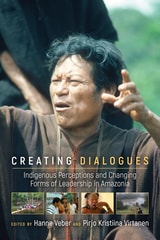
Creating Dialogues
Indigenous Perceptions and Changing Forms of Leadership in AmazoniaHanne Veber
University Press of Colorado, 2017
Creating Dialogues discusses contemporary forms of leadership in a variety of Amazonian indigenous groups. Examining the creation of indigenous leaders as political subjects in the context of contemporary state policies of democratization and exploitation of natural resources, the book addresses issues of resilience and adaptation at the level of local community politics in lowland South America.
Contributors investigate how indigenous peoples perceive themselves as incorporated into the structures of states and how they tend to see the states as accomplices of the private companies and non-indigenous settlers who colonize or devastate indigenous lands. Adapting to the impacts of changing political and economic environments, leaders adopt new organizational forms, participate in electoral processes, become adept in the use of social media, experiment with cultural revitalization and new forms of performance designed to reach non-indigenous publics, and find allies in support of indigenous and human rights claims to secure indigenous territories and conditions for survival. Through these multiple transformations, the new styles and manners of leadership are embedded in indigenous notions of power and authority whose shifting trajectories predate contemporary political conjunctures.
Despite the democratization of many Latin American countries and international attention to human rights efforts, indigenous participation in political arenas is still peripheral. Creating Dialogues sheds light on dramatic, ongoing social and political changes within Amazonian indigenous groups. The volume will be of interest to students and scholars of anthropology, ethnology, Latin American studies, and indigenous studies, as well as governmental and nongovernmental organizations working with Amazonian groups.
Contributors: Jean-Pierre Chaumeil, Gérard Collomb, Luiz Costa, Oscar Espinosa, Esther López, Valéria Macedo, José Pimenta, Juan Pablo Sarmiento Barletti, Terence Turner, Hanne Veber, Pirjo Kristiina Virtanen

Creating Leaders An Examinati On Of Academic And Research Li
Irene Herold
American Library Association, 2015

Creating Leaders
An Examination of Academic and Research Library Leadership InstitutesIrene M. H. Herold
Assoc of College & Research Libraries, 2015

Creating a Framework for Developing Sessional Teachers in Higher Education
A practical guide for education leadersEdited by Neil Sutherland and Alex Standen
University College London, 2026
Addressing a critical yet underserved community in higher education, this volume is the first of its kind to focus on the professional development of sessional and atypically contracted teaching staff.
Across higher education, a significant proportion of teaching is carried out by non-permanent staff, be they graduate teaching assistants, associate lecturers, visiting lecturers, postdoctoral researchers, or hourly paid staff. Their work is invaluable to the sector, yet they frequently lack access to structured professional development and institutional support.
Creating a Framework for Developing Sessional Teachers in Higher Education aims to address this problem with guidance for the higher education leaders who support and manage sessional teachers. It offers a comprehensive framework that will enable education leaders to improve the experience and effectiveness of sessional staff through practical guidance, evidence-informed recommendations, best practice case studies, sector-wide research, and the lived experience of academic leaders. The book explores key areas including induction, teaching, learning and assessment practices, mentoring, reward and recognition, community building and ongoing professional development. It presents strategies for embedding consistency and quality across departments and disciplines while recognizing the individuality and diverse contributions of sessional teachers. With clear, actionable guidance and insights from across the higher education sector, this book is an essential resource for education leaders such as program directors, department heads, faculty managers, and anyone involved in academic staffing and teaching development. It champions an inclusive, sustainable approach to educational leadership—one that values and rewards all contributors to student learning.
Crisis Leadership in Higher Education
Theory and PracticeRalph A. Gigliotti
Rutgers University Press, 2020