Results by title
124 books match the query 'Learning' and 7 start with c
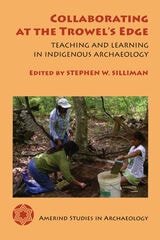
Collaborating at the Trowel's Edge
Teaching and Learning in Indigenous ArchaeologyEdited by Stephen W. Silliman
University of Arizona Press, 2008
Eighteen contributors—many with tribal ties—cover the current state of collaborative indigenous archaeology in North America to show where the discipline is headed. Continent-wide cases, from the Northeast to the Southwest, demonstrate the situated nature of local practice alongside the global significance of further decolonizing archaeology. And by probing issues of indigenous participation with an eye toward method, theory, and pedagogy, many show how the archaeological field school can be retailored to address politics, ethics, and critical practice alongside traditional teaching and research methods.
These chapters reflect the strong link between politics and research, showing what can be achieved when indigenous values, perspectives, and knowledge are placed at the center of the research process. They not only draw on experiences at specific field schools but also examine advances in indigenous cultural resource management and in training Native American and non-native students.
Theoretically informed and practically grounded, Collaborating at the Trowel’s Edge is a virtual guide for rethinking field schools and is an essential volume for anyone involved in North American archaeology—professionals, students, tribal scholars, or avocationalists—as well as those working with indigenous peoples in other parts of the world. It both reflects the rapidly changing landscape of archaeology and charts new directions to ensure the ongoing vitality of the discipline.
Collection Management for Youth
Equity, Inclusion, and LearningSandra Hughes-Hassell
American Library Association, 2020
With a renewed emphasis on facilitating learning, supporting multiple literacies, and advancing equity and inclusion, the thoroughly updated and revised second edition of this trusted text provides models and tools that will enable library staff who serve youth to create and maintain collections that provide equitable access to all youth. And as Hughes-Hassell demonstrates, the only way to do this is for collection managers to be learner-centered, confidently acting as information guides, change agents, and leaders. Based on the latest educational theory and research, this book
- presents the argument for why collection management decisions and practices should focus on equity, exploring systemic inequities, educational paradigm shifts, developments in the information environment, and other key factors;
- lays out the theoretical foundation for developing and managing a library collection that facilitates learning, supports the development of multiple literacies, and provides equitable access to an increasingly diverse group of young learners;
- touches upon current competencies and standards by AASL, YALSA, and ALSC;
- uses a learner-centered and equity perspective to cover core issues and criteria such as selection and removal of materials, budgeting, and cooperation among libraries;
- shows how a business viewpoint can assist the learner-centered collector in articulating the central significance of the collection to learning;
- discusses how library staff can work collaboratively to create policy and negotiate budgets; and
- includes customizable tools and templates, including a Stakeholder Contact/SWOT Analysis, Decision-Making Model for Selecting Resources and Access Points that Support Learning and Advance Equity, and Collection Development Analysis Worksheet.
This resource will be as useful to current school librarians and supervisors, youth librarians in public libraries, and educators as it will to LIS students.
Communities of Practice
An Alaskan Native Model for Language Teaching and LearningEdited by Patrick E. Marlow and Sabine Siekmann
University of Arizona Press, 2013
In Alaska, the Second Language Acquisition Teacher Education (SLATE) project was designed to enable Indigenous communities and schools to improve the quality of native-language and English-language instruction and assessment by focusing on the elimination of barriers that have historically hindered degree completion for Indigenous and rural teachers. The Guided Research Collaborative (GRC) model, was employed to support the development of communities of practice through near-peer mentoring and mutual scaffolding. Through this important new model, teachers of both the heritage language, in this case Central Yup’ik, and English were able to situate their professional development into a larger global context based on current notions of multilingualism.
In Communities of Practice contributors show how the SLATE program was developed and implemented, providing an important model for improving second-language instruction and assessment. Through an in-depth analysis of the program, contributors show how this project can be successfully adapted in other communities via its commitment to local control in language programming and a model based on community-driven research.
Communities of Practice demonstrates how an initial cohort of Yup’ik- and English-language teachers collaborated to negotiate and ultimately completed the SLATE program. In so doing, these educators enhanced the program and their own effectiveness as teachers through a greater understanding of language learning. It is these understandings that will ultimately allow heritage- and English-language teachers to work together to foster their students’ success in any language.

Control, Learning, and Optimization with Applications in Connected and Autonomous Vehicles
Weinan Gao
The Institution of Engineering and Technology, 2026

Creating Contexts for Learning and Self-Authorship
Constructive-Developmental PedagogyMarcia B. Baxter Magolda
Vanderbilt University Press, 2000
This book is intended to help college faculty create conditions in which students learn to construct knowledge in their disciplines and achieve self-authorship. A significant, and often overlooked, dimension mediating learning and self-authorship centers on learners' ways of knowing, or their assumptions about the nature, limits, and certainty of knowledge. A learner who assumes that all knowledge is certain expects to hear answers from an authority figure; in contrast, a learner who views knowledge as relative expects to explore multiple viewpoints. By taking a constructive-developmental approach, Baxter Magolda demonstrates how students' ability to construct knowledge is intertwined with the development of their assumptions about knowledge itself and their role in creating it. She shows how the structure of constructive-developmental teaching hinges on three principles: validating students' ability to know, situating learning in students' experience, and defining learning as teachers and students mutually constructing meaning.
Unlike most of the literature on the subject, this book takes abstract pedagogical principles and translates them into practical methods. By observing four semester-length college courses in mathematics, zoology, human development, and education and intensively interviewing students and their instructors, Baxter Magolda provides much-needed, concrete principles that will lead to valuable improvements in the classroom environment. With an enhanced level of understanding of the teaching-learning relationship, professors will be able to teach better, and students will be able to learn better, thus preparing them to meet the demands inherent in adulthood and preparing them to take an active role in creating a better society.
Those actively involved in higher education, whether college faculty or students in graduate programs, as well as anyone focused on education in general will find much of interest in this book.

Cubs' Fans Leadership Secrets
Learning to Win From a Cursed Team's ErrorsJohn Charles Kunich and Richard I. Lester
Parkhurst Brothers, Inc., 2009
Cubs fans have often focused on one or two star performers, to the detriment of the team's overall performance.
Stars have often been selfish and devoted to their own success. Leaders have toleratged them, often at a price
to the whole team. Effective leadership recognizes the dangers in this situation. Here's their antidote--in a
highly-readable book that's hot off the press! Foreword by bestselling-author Ken Blanchard.
Curriculum as Conversation
Transforming Traditions of Teaching and LearningArthur N. Applebee
University of Chicago Press, 1996
“Applebee's central point, the need to teach 'knowledge in context,' is absolutely crucial for the hopes of any reformed curriculum. His experience and knowledge give his voice an authority that makes many of the current proposals on both the left and right seem shallow by comparison.”—Gerald Graff, University of Chicago