Results by title
94 books match the query 'Lessons' and 4 start with c
COVID Diagnosed the System
Lessons from the Pandemic in Massachusetts PrisonsBridget Conley
Rutgers University Press, 0
The American criminal justice system was in flux in 2020, a clash of possibilities for reform, retrenchment, and radical change—nowhere more so than in Massachusetts, which had just passed major criminal justice reform. The COVID-19 pandemic interrupted the moment with life-threatening force, ravaging people held in prisons and jails across the country. However, it did not so much create new deprivations and suffering as it exposed prisons as sites of physical, institutional, and psychological violence that do not make communities safer. At the same time, advocates for people in prisons—including many incarcerated and formerly incarcerated people—seized on the pandemic’s disruptions to demand change. Detailing the first year of the pandemic inside the Massachusetts state prison system, this book argues that the history of the pandemic inside prisons exposed both the cruelties of incarceration and the power of change when it is led by directly affected people.
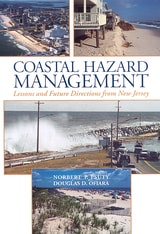
Coastal Hazard Management
Lessons and Future Directions from New JerseyPsuty, Norbert P.
Rutgers University Press, 2002
As with most shorelines around the world, New Jersey beaches are slowly, but inexorably, being eroded, threatening coastal structures and development. In some years more sand is deposited than removed, but all of the state’s monitoring devices show that sea level is gradually rising and pushing the New Jersey shoreline inland. The shore is a valuable resource, and its natural, cultural, and economic attractions draw a multitude of permanent and temporary residents each year, extending housing and commercial development onto areas that were once swampland. Not surprisingly, development at the water’s edge has been accompanied by an increasing exposure to the natural hazards of the coastal zone--erosion, flooding, and wind damage.
In this book, Norbert Psuty and Douglas Ofiara incorporate perspectives from the areas of coastal sciences, economics, public policy, and land-use planning in creating a systematic plan for coastal management and protection. It has been more than a decade since New Jersey developed the nation’s first state shore protection plan, and this volume provides a timely evaluation of its achievements and future challenges. This self-contained book provides all of the relevant theories, models, and examples so the reader will not need to refer to any other literature to gain an understanding of the issues and policies surrounding shore protection. It is the authoritative handbook for practitioners and policy makers in many fields, including coastal science and management and engineering, as well as public policy and economics.
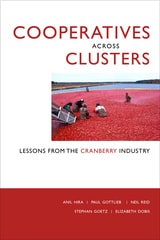
Cooperatives across Clusters
Lessons from the Cranberry IndustryAnil Hira
Oregon State University Press, 2024
Most agricultural production is of commodity or undifferentiated products. Producers suffer from a roller-coaster ride of price swings, over- or under-production, weather and pest threats, and the inability of family famers to capture anything beyond a small percentage of the final price.
Cooperatives Across Clusters provides lessons from the cranberry industry, a commodity product organized mostly into family farms in seven different clusters around North America. The industry is remarkable in that it's substantially organized around one large cooperative, Ocean Spray. The authors examine how the cooperative came to be, the challenges of coordination and industry leadership across the diverging clusters, and the lessons for cooperation for other agricultural industries.
The book provides a multi-layered contribution to agricultural economics. First, it examines location decisions and what factors supersede growing conditions to allow industries to arise around production. Second, it explores pathways available for farmers to try to overcome, through cooperative organization, the natural boom-bust cycles of commodity price swings. Third, it looks at how cooperative decisions are made, and the challenges of providing industry leadership, including research and development and collective marketing, through a cooperative that faces continual defections and new problems. Finally, through in-depth historical, statistical, and field research, it provides a comprehensive study of the cranberry industry and suggests ways farmers can grow the industry. Agricultural policymakers, farmers, industry specialists, and researchers of agriculture and clusters more generally will find this to be an important and informative new resource.
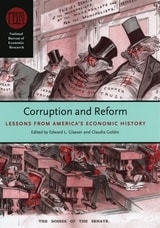
Corruption and Reform
Lessons from America's Economic HistoryEdited by Edward L. Glaeser and Claudia Goldin
University of Chicago Press, 2006
Contributors to this volume address the measurement and consequences of fraud and corruption and the forces that ultimately led to their decline within the United States. They show that various approaches to reducing corruption have met with success, such as deregulation, particularly “free banking,” in the 1830s. In the 1930s, corruption was kept in check when new federal bureaucracies replaced local administrations in doling out relief. Another deterrent to corruption was the independent press, which kept a watchful eye over government and business. These and other facets of American history analyzed in this volume make it indispensable as background for anyone interested in corruption today.