Results by title
97 books match the query 'Literature, Modern' and 10 start with c
Chaos and Order
Complex Dynamics in Literature and ScienceEdited by N. Katherine Hayles
University of Chicago Press, 1991
N. Katherine Hayles traces shifts in meaning that chaos has undergone within the Western tradition, suggesting that the science of chaos articulates categories that cannot be assimilated into the traditional dichotomy of order and disorder. She and her contributors take the relation between order and disorder as a theme and develop its implications for understanding texts, metaphors, metafiction, audience response, and the process of interpretation itself. Their innovative and diverse work opens the interdisciplinary field of chaotics to literary inquiry.
Cigarettes Are Sublime
Richard Klein
Duke University Press, 1993
Climate Lyricism
Min Hyoung Song
Duke University Press, 2022
Complaint
Grievance among FriendsAvital Ronell
University of Illinois Press, 2018
Avital Ronell considers how literature and philosophy treat bellyachers, wailers, and grumps—and the complaints they lavish on the rest of us. Combining her trademark jazzy panache with a fearless range of readings, Ronell opens a dialogue with readers that discusses thinkers with whom she has directly engaged. Beginning with Hamlet, and with a candid awareness of her own experiences, Ronell proceeds to show how complaining is aggravated, distracted, stifled, and transformed. She moves on to the exemplary complaints of Friedrich Nietzsche, Hannah Arendt, and Barbara Johnson and examines the complaint-riven history of deconstruction.
Infused with the author’s trademark wit, Complaint takes friends, colleagues, and all of us on a courageous philosophical journey.
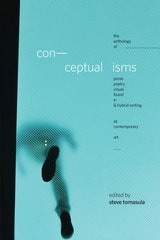
Conceptualisms
The Anthology of Prose, Poetry, Visual, Found, E- & Hybrid Writing as Contemporary ArtEdited by Steve Tomasula
University of Alabama Press, 2022
A wide-ranging anthology of experimental writing—prose, poetry, and hybrid—from its most significant practitioners and innovators
A variety of names have been used to describe fiction, poetry, and hybrid writing that explore new forms and challenges mainstream traditions. Those phrases include experimental, conceptual, avant-garde, hybrid, surfiction, fusion, radical, slip-stream, avant-pop, postmodern, self-conscious, innovative, L=A=N=G=U=A=G=E writing, alternative, and anti- or new literature. Conceptualisms: The Anthology of Prose, Poetry, Visual, Found, E- & Hybrid Writing as Contemporary Art is the first major anthology of writing that offers readers an overview of this other tradition as it lives in the early decades of the 21st century.
Featuring over 100 pieces from more than 90 authors, this anthology offers a plethora of aesthetics and approaches to a wide variety subjects. Editor Steve Tomasula has gathered poems, prose, and hybrid pieces that all challenge our understanding of what literature means. Intended as a collection of the most exciting and bold literary work being made today, Tomasula has put a spotlight on the many possibilities available to writers and readers wishing for a glimpse of literature’s future.
Readers will recognize authors who have shaped contemporary writing, as among them Lydia Davis, Charles Bernstein, Jonathan Safran Foer, Shelley Jackson, Nathaniel Mackey, David Foster Wallace, and Claudia Rankine. Even seasoned readers will find authors, and responses to the canon, not yet encountered. Conceptualisms is a book of ideas for writers, teachers and scholars, as well as readers who wonder how many ways literature can live.
The text features headnotes to chapters on themes such as sound writing, electronic literature, found text, and other forms, offering accessible introductions for readers new to this work. An online companion presents statements about the work and biographies of the authors in addition to audio, video, and electronic writing that can’t be presented in print. Visit www.conceptualisms.info to read more.
Contemporary Poetics
Louis Armand
Northwestern University Press, 2007
Charles Bernstein's Swiftian satire of generative poetics and the textual apparatus, together with Marjorie Perloff's critical-historical treatment of "writing after" Bernstein and other proponents of language poetry, provides an itinerary of contemporary poetics in terms of both theory and practice. The other essays consider "precursors," recognizable figures within the histories or prehistories of contemporary poetics, from Kafka and Joyce to Wallace Stevens and Kathy Acker; "conjunctions," in which more strictly theoretical and poetical texts enact a concerted engagement with rhetoric, prosody, and the vicissitudes of "intelligibility"; "cursors," which points to the open possibilities of invention, from Augusto de Campos's "concrete poetics" to the "codework" of Alan Sondheim; and "transpositions," defining the limits of poetic invention by way of technology.
Content Machines
Reading and Writing in the Platform EraSarah Brouillette
Duke University Press, 2026
Crack Wars
LITERATURE ADDICTION MANIAAvital Ronell
University of Illinois Press, 1992
It is a commonplace of modern culture to presume that there is a subculture or counterculture deeply saturated with drugs, but such modern cultures need subcultures, and need drugs on every level. Culture defines itself, its classes, its power structures, and its economy in terms of how it allows and encourages drugs to circulate. If drugs are dangerous, that danger seems to increase their appeal for millions. If drugs are unnatural and addictive, gasoline is a drug. What is art but a kind of drug, and what is art criticism but a kind of criticism of drugs and drug-induced states?
Gustave Flaubert's Madame Bovary takes up the problems of drugs and addiction in numerous ways, which Ronnell unpacks and presents as examples of the safe and unsafe. From Emma Bovary's romantic hallucinations to her suicide by arsenic, she moves through this realistic novel constantly reaching for the unreal. For Ronell, Emma Bovary represents the first addict, embodying a yearning that calls from the bottom of her humanity, and which it seems can only be satisfied by some sort of drug.
Crimes of Art and Terror
Frank Lentricchia and Jody McAuliffe
University of Chicago Press, 2003
Crimes of Art and Terror reveals how the desire beneath many romantic literary visions is that of a terrifying awakening that would undo the West's economic and cultural order. This is also the desire, of course, of what is called terrorism. As the authority of writers and artists recedes, it is criminals and terrorists, Lentricchia and McAuliffe suggest, who inherit this romantic, destructive tradition. Moving freely between the realms of high and popular culture, and fictional and actual criminals, the authors describe a web of impulses that catches an unnerving spirit.
Lentricchia and McAuliffe's unorthodox approach pairs Dostoevsky's Crime and Punishment with Martin Scorsese's King of Comedy and connects the real-life Unabomber to the surrealist Joseph Cornell and to the hero of Bret Easton Ellis's bestselling novel American Psycho. They evoke a desperate culture of art through thematic dialogues among authors and filmmakers as varied as Don DeLillo, Joseph Conrad, Francis Ford Coppola, Jean Genet, Frederick Douglass, Hermann Melville, and J. M. Synge, among others. And they conclude provocatively with an imagined conversation between Heinrich von Kleist and Mohamed Atta. The result is a brilliant and unflinching reckoning with the perilous proximity of the impulse to create transgressive art and the impulse to commit violence.
Critical Essays
Roland Barthes
Northwestern University Press, 1972