Results by title
124 books match the query 'Macroeconomics' and 6 start with c
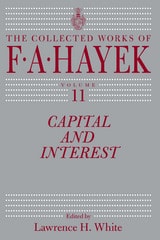
Capital and Interest
F. A. Hayek
University of Chicago Press, 2015
Produced throughout the first fifteen years of Hayek’s career, the writings collected in Capital and Interest see Hayek elaborate upon and extend his landmark lectures that were published as Prices and Production and work toward the technically sophisticated line of thought seen in his later Pure Theory of Capital. Illuminating the development of Hayek’s detailed contributions to capital and interest theory, the collection also sheds light on how Hayek’s work related to other influential economists of the time. Highlights include the 1936 article “The Mythology of Capital”—presented here alongside Frank Knight’s criticisms of the Austrian theory of capital that prompted it—and “The Maintenance of Capital,” with subsequent comments by the English economist A. C. Pigou. These and other familiar works are accompanied by lesser-known articles and lectures, including a lecture on technological progress and excess capacity. An introduction by the book’s editor, leading Hayek scholar Lawrence H. White, places Hayek’s contributions in careful historical context, with ample footnotes and citations for further reading, making this a touchstone addition to the University of Chicago Press’s Collected Works of F. A. Hayek series.
[more]
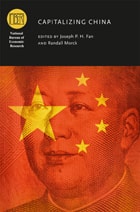
Capitalizing China
Edited by Joseph P. H. Fan and Randall Morck
University of Chicago Press, 2012
China’s economic boom over the last two decades has taken many analysts by surprise, given the ongoing role of central government planning. Its current growth trajectory suggests that the size of its economy could soon surpass that of the United States. Some argue that continued growth and the expanding middle class will ultimately exert pressure on the government to bring about greater openness of the financial market.
To better understand China’s recent economic performance, this volume examines the distinctive system it has developed: “market socialism with Chinese characteristics.” While its formal institutional makeup resembles that of a free-market economy, many of its practices remain socialist, including strategically placed state-owned enterprises that wield influence both directly and through controlled business groups, and Communist Party cells whose purpose is to maintain control of many segments of the economy. China’s economic system, the contributors find, also retains many historical characteristics that play a central role in managing the economy. These and other issues are examined in chapters on China’s financial regulations, corporate governance codes, bankruptcy laws, taxation, and disclosure rules.
[more]

Comparative National Balance Sheets
A Study of Twenty Countries, 1688-1979Raymond W. Goldsmith
University of Chicago Press, 1985
Raymond W. Goldsmith has combined his experience, good sense, and flair with figures to construct this groundbreaking comparative study of the balance sheets of twenty of the largest nations. A pioneer in the field of national accounts, Goldsmith now presents a work that will be a valuable tool in tracking the economic progress of and between nations.
The majority of the balance sheets were created especially for this project, their components gleaned from fragmentary and heterogeneous data. There are approximately 3,500 entries, each measuring the value of one type of tangible or financial asset or liability at a given date. Goldsmith's estimates are keyed to fifteen benchmark dates in the economic progress of the cited nations, and for twelve nations he was able to construct balance sheets dating back to the nineteenth century or earlier. Combined, worldwide balance sheet are included for 1950 and 1978.
Comparative National Balance Sheets will provide an essential basis for the quantitative analysis of the long-term financial development of these nations. In addition to national balance sheets for all large countries except Brazil and China, sectoral balance sheets for France, Germany, Great Britain, India, Japan, and the United States in the postwar period are also included.
[more]
Conceptualizing Capitalism
Institutions, Evolution, FutureGeoffrey M. Hodgson
University of Chicago Press, 2015
A few centuries ago, capitalism set in motion an explosion of economic productivity. Markets and private property had existed for millennia, but what other key institutions fostered capitalism’s relatively recent emergence? Until now, the conceptual toolkit available to answer this question has been inadequate, and economists and other social scientists have been diverted from identifying these key institutions.
With Conceptualizing Capitalism, Geoffrey M. Hodgson offers readers a more precise conceptual framework. Drawing on a new theoretical approach called legal institutionalism, Hodgson establishes that the most important factor in the emergence of capitalism—but also among the most often overlooked—is the constitutive role of law and the state. While private property and markets are central to capitalism, they depend upon the development of an effective legal framework. Applying this legally grounded approach to the emergence of capitalism in eighteenth-century Europe, Hodgson identifies the key institutional developments that coincided with its rise. That analysis enables him to counter the widespread view that capitalism is a natural and inevitable outcome of human societies, showing instead that it is a relatively recent phenomenon, contingent upon a special form of state that protects private property and enforces contracts. After establishing the nature of capitalism, the book considers what this more precise conceptual framework can tell us about the possible future of capitalism in the twenty-first century, where some of the most important concerns are the effects of globalization, the continuing growth of inequality, and the challenges to America’s hegemony by China and others.
With Conceptualizing Capitalism, Geoffrey M. Hodgson offers readers a more precise conceptual framework. Drawing on a new theoretical approach called legal institutionalism, Hodgson establishes that the most important factor in the emergence of capitalism—but also among the most often overlooked—is the constitutive role of law and the state. While private property and markets are central to capitalism, they depend upon the development of an effective legal framework. Applying this legally grounded approach to the emergence of capitalism in eighteenth-century Europe, Hodgson identifies the key institutional developments that coincided with its rise. That analysis enables him to counter the widespread view that capitalism is a natural and inevitable outcome of human societies, showing instead that it is a relatively recent phenomenon, contingent upon a special form of state that protects private property and enforces contracts. After establishing the nature of capitalism, the book considers what this more precise conceptual framework can tell us about the possible future of capitalism in the twenty-first century, where some of the most important concerns are the effects of globalization, the continuing growth of inequality, and the challenges to America’s hegemony by China and others.
[more]
Confidence Regained
Economics, Mrs. Thatcher, and the British VoterHelmut Norpoth
University of Michigan Press, 1992
Elected to office at the end of a decade of economic decline, Prime Minister Margaret Thatcher set out to cure Britain's ills with daring new free-market policies. Putting financial stability first on the agenda of macroeconomic priorities, the Thatcher government pursued this goal with rare tenacity. In Confidence Regained, Helmut Norpoth examines the electoral risks and rewards of this economic strategy.Professor Norpoth paints a vivid picture of the fierce battle over the economic policies and record of the Thatcher government. Using electoral surveys, Norpoth reveals how British voters sorted out the competing claims of economists and politicians in their various partisan choices. Turning from election outcomes to government popularity between elections, Professor Norpoth charts the rise and decline of Margaret Thatcher's approval ratings and Conservative party support, showing how responsive these ratings were to economic performance. The statistical evidence presented shows that economic views significantly affected voter choices in the Thatcher elections. But the author reveals that the Conservatives under Mrs. Thatcher owed their ability to regain the confidence of the British electorate not only to the nation’s economic success, but also, in large measure, to the British victory in the Falkland Islands.Confidence Regained is an invaluable source to scholars of electoral politics, especially of British elections, but it will also interest historians of Thatcherism and scholars studying the role of macroeconomics in elections.
[more]
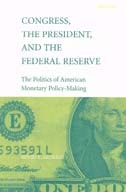
Congress, the President, and the Federal Reserve
The Politics of American Monetary Policy-MakingIrwin L. Morris
University of Michigan Press, 2002
Congress, the President, and the Federal Reserve is a study of the politics of monetary policy making at the Federal Reserve--widely considered the most important and most powerful federal bureaucracy. Ostensibly, the Federal Reserve is independent of the political branches of government; however, Congress, the President, and the Federal Reserve clearly demonstrates-- from both a theoretical and empirical standpoint--how the preferences of members of Congress and the President impact decisionmaking at the Fed.
Current formal theories of the general policy-making process are utilized to construct an explanatory framework that identifies the mechanisms through which congressional and executive influence is exercised. The theoretical framework presented in the text also helps to explain the political dynamics of several of the most significant policy decisions of the Federal Reserve during the last half-century. In addition, this book provides a unique perspective on the manner in which Fed policymakers attempt to shield themselves from unwelcome political influence.
While the main focus of Congress, the President, and the Federal Reserve is monetary policy-making, it also speaks to the political nature of policy-making in a more general sense and provides a guide for the future study of the political dynamics in a wide variety of substantive policy areas. Thus it will interest not only political scientists and economists interested in monetary policy-making specifically but also those interested in the nature of public policy-making more generally.
Irwin L. Morris is Assistant Professor of Political Science, University of Maryland.
[more]