98 books match the query 'Marginality, Social' and 7 start with c
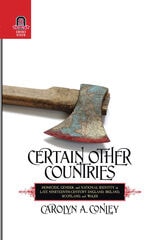
cover of CERTAIN OTHER COUNTRIES: Homicide, Gender, and National Identity in Late Nineteenth-Century England, Ireland, Scotland, and Wales

CERTAIN OTHER COUNTRIES

Homicide, Gender, and National Identity in Late Nineteenth-Century England, Ireland, Scotland, and Wales

Carolyn A. Conley

The Ohio State University Press, 2007

Even though England, Ireland, Scotland, and Wales were under a common Parliament in the nineteenth century, cultural, economic, and historical differences led to very different values and assumptions about crime and punishment. For example, though the Scots were the most likely to convict accused killers, English, Welsh, and Irish killers were two and a half times more likely to be executed for their crimes. In Certain Other Countries, Carolyn A. Conley explores how the concepts of national identity and criminal violence influenced each other in the Victorian-era United Kingdom. It also addresses the differences among the nations as well as the ways that homicide trials illuminate the issues of gender, ethnicity, family, privacy, property, and class. Homicides reflect assumptions about the proper balance of power in various relationships. For example, Englishmen were ten times more likely to kill women they were courting than were men in the Celtic nations.         

By combining quantitative techniques in the analysis of over seven thousand cases, as well as careful and detailed readings of individual cases, the book exposes trends and patterns that might not have been evident in works using only one method. For instance, by examining all homicide trials rather than concentrating exclusively on a few highly celebrated ones, it becomes clear that most female killers were not viewed with particular horror, but were treated much like their male counterparts.

The conclusions offer challenges and correctives to existing scholarship on gender, ethnicity, class, and violence. The book also demonstrates that the Welsh, Scots, and English remained quite distinct long after their melding as Britons was announced and celebrated. By blending a study of trends in violent behavior with ideas about national identity, Conley brings together rich and hotly debated fields of modern history. This book will be valuable both for scholars of crime and violence as well as for those studying British history.
[more]
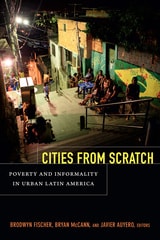
cover of Cities From Scratch: Poverty and Informality in Urban Latin America

Cities From Scratch

Poverty and Informality in Urban Latin America

Brodwyn Fischer, Bryan McCann, Javier Auyero, eds.

Duke University Press, 2014

This collection of essays challenges long-entrenched ideas about the history, nature, and significance of the informal neighborhoods that house the vast majority of Latin America's urban poor. Until recently, scholars have mainly viewed these settlements through the prisms of crime and drug-related violence, modernization and development theories, populist or revolutionary politics, or debates about the cultures of poverty. Yet shantytowns have proven both more durable and more multifaceted than any of these perspectives foresaw. Far from being accidental offshoots of more dynamic economic and political developments, they are now a permanent and integral part of Latin America's urban societies, critical to struggles over democratization, economic transformation, identity politics, and the drug and arms trades. Integrating historical, cultural, and social scientific methodologies, this collection brings together recent research from across Latin America, from the informal neighborhoods of Rio de Janeiro and Mexico City, Managua and Buenos Aires. Amid alarmist exposés, Cities from Scratch intervenes by considering Latin American shantytowns at a new level of interdisciplinary complexity.

Contributors. Javier Auyero, Mariana Cavalcanti, Ratão Diniz, Emilio Duhau, Sujatha Fernandes, Brodwyn Fischer, Bryan McCann, Edward Murphy, Dennis Rodgers
[more]
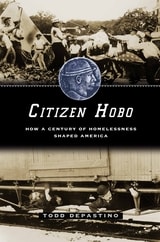
cover of Citizen Hobo: How a Century of Homelessness Shaped America

Citizen Hobo

How a Century of Homelessness Shaped America

Todd DePastino

University of Chicago Press, 2003

In the years following the Civil War, a veritable army of homeless men swept across America's "wageworkers' frontier" and forged a beguiling and bedeviling counterculture known as "hobohemia." Celebrating unfettered masculinity and jealously guarding the American road as the preserve of white manhood, hoboes took command of downtown districts and swaggered onto center stage of the new urban culture. Less obviously, perhaps, they also staked their own claims on the American polity, claims that would in fact transform the very entitlements of American citizenship.

In this eye-opening work of American history, Todd DePastino tells the epic story of hobohemia's rise and fall, and crafts a stunning new interpretation of the "American century" in the process. Drawing on sources ranging from diaries, letters, and police reports to movies and memoirs, Citizen Hobo breathes life into the largely forgotten world of the road, but it also, crucially, shows how the hobo army so haunted the American body politic that it prompted the creation of an entirely new social order and political economy. DePastino shows how hoboes—with their reputation as dangers to civilization, sexual savages, and professional idlers—became a cultural and political force, influencing the creation of welfare state measures, the promotion of mass consumption, and the suburbanization of America. Citizen Hobo's sweeping retelling of American nationhood in light of enduring struggles over "home" does more than chart the change from "homelessness" to "houselessness." In its breadth and scope, the book offers nothing less than an essential new context for thinking about Americans' struggles against inequality and alienation.
[more]
cover of Coded Encounters: Writing, Gender, and Ethnicity in Colonial Latin America

Coded Encounters

Writing, Gender, and Ethnicity in Colonial Latin America

Francisco Javier Cevallos

University of Massachusetts Press, 1994

Much has been written about the ways in which Columbus's "discovery" of America began a process of inventing a new world in European consciousness. But far less has been published about those on the margins of the dominant European discourse--Amerindians, Africans, and women--whose experience is reflected in documents written during the early years of European rule in Latin America. This volume brings together essays by leading scholars of colonial Latin America who address a series of topics relating to both the marginal and European-dominant discourses. The book is divided into five sections: "Representing the New World," "The Institutionalization of the Colony," "Amerindian Texts," "Women in Colonial Latin America," and "The Later Colony and the Caribbean Experience." The essays range from a consideration of Amerindian codes of mapmaking to the career of a transvestite nun, from confessional "sin lists" used by priests to examine the transgressions of their American charges to a new view of colonial women's lives based on birth records, dowry agreements, and wills. Contributors include Walter Mignolo, Maureen Ahern, Abel Alves, Rolena Adorno, Lúcia Helena Santiago Costigan, Pedro Lasarte, Raquel Chang-Rodríguez, Regina Harrison, Asunción Lavrin, Stephanie Merrim, Nina M. Scott, Antonio Carreño, Julie Greer Johnson, Karen Stolley, and Antonio Benítez-Rojo.
[more]
cover of Color of Privilege: Three Blasphemies on Race and Feminism

Color of Privilege

Three Blasphemies on Race and Feminism

Aida Hurtado

University of Michigan Press, 1996
This groundbreaking and important book explores how women of different ethnic/racial groups conceive of feminism. Aída Hurtado advances the theory of relational privilege to explain those differing conceptions. Previous theories about feminism have predominantly emphasized the lives and experiences of middle-class white women. Aída Hurtado argues that the different responses to feminism by women of color are not so much the result of personality or cultural differences between white women and women of color, but of their differing relationship to white men. For Hurtado, subordination and privilege must be conceived as relational in nature, and gender subordination and political solidarity must be examined in the framework of culture and socioeconomic context. Hurtado's analysis of gender oppression is written from an interdisciplinary, multicultural standpoint and is enriched by selections from poems by Sandra Cisneros, Gloria Anzaldúa, Lorna Dee Cervantes, and Elba Sanchez, and from plays by El Teatro Campesino, the United Farm Workers theater group. A final chapter proposes that progressive scholarship, and especially feminist scholarship, must have at its core a reflexive theory of gender oppression that allows writers to simultaneously document oppression while taking into account the writer's own privilege, to analyze the observed as well as the observer. Aída Hurtado is Associate Professor of Psychology, University of California, Santa Cruz.
[more]
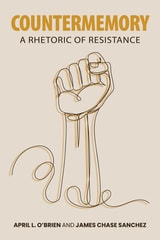
cover of Countermemory: A Rhetoric of Resistance

Countermemory

A Rhetoric of Resistance

April L. O'Brien and James Chase Sanchez

University of Alabama Press, 2025

Investigates the interdisciplinary dimensions of countermemory through a rhetorical lens

Countermemory: A Rhetoric of Resistance by April L. O’Brien and James Chase Sanchez is a groundbreaking monograph that explores the concept of countermemory from an interdisciplinary and rhetorical perspective. The authors define “countermemory” as remembrance that resituates often overlooked or erased narratives of marginalized groups by positioning these memories as equally significant to dominant historical narratives. This work investigates how countermemories emerge in response to public memories, highlighting the tensions and resistance that arise when marginalized voices challenge mainstream historical accounts.

Through a mixed-methodological approach—incorporating site-based analysis, participant observation, textual analysis, and historiography—O’Brien and Sanchez examine countermemory in both physical and digital spaces. From memorial sites and museums to music videos, TV shows, and digital maps, they reveal the various ways countermemory operates and persists. The authors focus particularly on countermemory in the American South, centering on the experiences and histories of Black, Latinx, and Indigenous communities.

Countermemory is essential reading for scholars and students of rhetoric and public memory. The book also offers rich insights to readers who are passionate about addressing issues of racial inequality, people interested in examining their own experiences and the role they can play in promoting social change, and those interested in exploring the ways in which history is constructed and presented, and how marginalized perspectives are often excluded or distorted.
[more]
cover of Cultivating Livability: Food, Class, and the Urban Future in Bengaluru

Cultivating Livability

Food, Class, and the Urban Future in Bengaluru

Camille Frazier

University of Minnesota Press, 2024

What urban food networks reveal about middle class livability in times of transformation

In recent years, the concept of “livability” has captured the global imagination, influencing discussions about the implications of climate change on human life and inspiring rankings of “most livable cities” in popular publications. But what really makes for a livable life, and for whom?


Cultivating Livability takes Bengaluru, India, as a case study—a city that is alternately described as India’s most and least livable megacity, where rapid transformation is undergirded by inequalities evident in the food networks connecting peri-urban farmers and the middle-class public. Anthropologist Camille Frazier probes the meaning of “livability” in Bengaluru through ethnographic work among producers and consumers, corporate intermediaries and urban information technology professionals.


Examining the varying efforts to reconfigure processes of food production, distribution, retail, and consumption, she reveals how these intersections are often rooted in and exacerbate ongoing forms of disenfranchisement that privilege some lives at the expense of others.

[more]