Results by title
55 books match the query 'Maritime History & Piracy' and 5 start with c
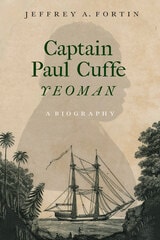
Captain Paul Cuffe, Yeoman
A BiographyJeffrey A. Fortin
University of Massachusetts Press, 2024
Paul Cuffe is best understood as a member of the Black founding fathers—a group of pre-eminent African Americans who built institutions and movements during the first decades of the United States. While he is known amongst scholars, his astounding life story deserves a much wider audience. Jeffrey A. Fortin has crafted a beautiful, moving portrait of this important maritime figure that will appeal to anyone interested in early American history and who loves great story telling.
Born on Cuttyhunk Island, Massachusetts in 1759 to a formerly enslaved African father and a Wampanoag Indian mother, Cuffe emerged from anonymity to become the most celebrated African-American sea captain during the Age of Sail. An abolitionist, veteran, and community activist, celebrity followed Cuffe as he built a shipping empire that traded both in American coastal waters and across the wider Atlantic Ocean. Cuffe and his Black crews shook the foundations of systemic racism, challenging norms by sailing into Charleston and other ports where slavery was legal, and thus demonstrating that business and profits were more powerful than social limitations. He founded America’s first racially integrated school in Westport, Massachusetts, and is considered the leader of the nation’s first back-to-Africa movement. Newspapers in England, the United States, and the Caribbean reported his whereabouts and adventures, and abolitionists hailed him for his Quaker beliefs, sobriety, and commitment to advancing opportunities for persons of African descent.
Drawing on pamphlets, letters, and other documents, and painstakingly reconstructing his genealogy, Fortin vividly describes Cuffe’s experiences and places them within the broader history of the Early Republic to help reveal the central role of African Americans in the founding of the United States. Unlike previous biographies, Fortin situates Cuffe within an Atlantic world where race and identity were fluid, and Africans and African Americans sought to build and govern a free Black nation in West Africa.
Charles Johnson's "General History of the Pyrates" and Global Commerce
Noel Chevalier
Bucknell University Press, 2025
This study explores how General History of the Pyrates was at the heart of early eighteenth-century British debates about commerce, colonialism, and law. Examining how pirates are depicted as both monsters and Great Men, Noel Chevalier untangles the contradictions within a Britain emerging as a colonial superpower, where ruthlessness and ambition were both feared and praised. Traveling the high seas to plunder treasure from foreign lands, pirates were not so different from the British capitalists who built fortunes from resource extraction, the plantation economy, and the transatlantic slave trade. Connecting the work to later books like Gulliver’s Travels and The Beggar’s Opera that satirized the era and its power-hungry prime minister Robert Walpole, Chevalier shows how the pirate became an iconic figure in 1720s Britain, a time of cold-hearted capitalism and rapacious colonial expansion.
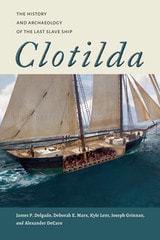
Clotilda
The History and Archaeology of the Last Slave ShipJames P. Delgado, Deborah E. Marx, Kyle Lent, Joseph Grinnan, and Alexander DeCaro
University of Alabama Press, 2023
Documents the maritime historical research and archaeological fieldwork used to identify the wreck of the notorious schooner Clotilda
Clotilda: The History and Archaeology of the Last Slave Ship is the first definitive work to examine the maritime historical and archaeological record of one of the most infamous ships in American history. Clotilda was owned by Alabama businessman Timothy Meaher, who, on a dare, equipped it to carry captured Africans from what is now Benin and bring them to Alabama in 1860—some fifty years after the import of captives to be enslaved was banned. To hide the evidence, Clotilda was set afire and sunk.
What remained was a substantially intact, submerged, and partially buried shipwreck located in a backwater of the Mobile River. The site of the wreck was an open secret to some people who knew Meaher, but its identity remained unknown for more than a century as various surveys through the years failed to locate the ship.
This volume, authored by the archaeological team who conducted a comprehensive, systematic survey of a forgotten “ship graveyard,” details the exhaustive forensic work that conclusively identified the wreck, as well as the stories and secrets that have emerged from the partly burned hulk. James P. Delgado and his coauthors discuss the various searches for Clotilda, sharing the forensic data and other analyses showing how those involved concluded that this wreck was indeed Clotilda. Additionally, they offer physical evidence not previously shared that situates the schooner and its voyage in a larger context of the slave trade.
Clotilda: The History and Archaeology of the Last Slave Ship serves as a nautical biography of the ship as well. After reviewing the maritime trade in and out of Mobile Bay, this account places Clotilda within the larger landscape of American and Gulf of Mexico schooners and chronicles its career before being used as a slave ship. All of its voyages had a link to slavery, and one may have been another smuggling voyage in violation of federal law. The authors have also painstakingly reconstructed Clotilda’s likely appearance and characteristics.
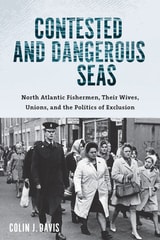
Contested and Dangerous Seas
North Atlantic Fishermen, Their Wives, Unions, and the Politics of ExclusionColin J. Davis
University of Massachusetts Press, 2019
During the 1960s and 1970s, these seafaring workers experienced new hardships. As modern fleets from many nations intensified their hunt for fish, they found themselves in increasing competition for disappearing prey. Colin J. Davis details the unfolding drama as New England and British fishermen and their wives, partners, and families reacted to this competition. Rather than acting as bystanders to these crises, the men and women chronicled in Contested and Dangerous Seas became fierce advocates for the health of the Atlantic Ocean fisheries and for their families' livelihoods.
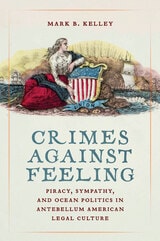
Crimes Against Feeling
Piracy, Sympathy, and Ocean Politics in Antebellum American Legal CultureMark B. Kelley
University of Massachusetts Press, 2026
Demonstrating how emotion became central to the legal and literary meanings of piracy in nineteenth-century America
Pirates have long occupied a central yet unstable place in American law and national identity. In the decades leading up to and including the U.S. Civil War, the charge of piracy was leveled against an unusually wide range of figures: foreign heads of state, imperial filibusters, transoceanic enslavers, enslaved mutineers, radical abolitionists, and others who challenged established forms of authority. Early American literature reflects this instability, portraying pirates who vary dramatically in politics, race, gender, and allegiance. As Mark B. Kelley shows, these characters are united less by ideology than by their challenge to landed social norms and fixed national belonging. The pirate, in both law and literature, emerges as an individual defined by multiplicity rather than political coherence.
Crimes Against Feeling examines how Americans made sense of this ambiguous figure by turning to emotion. Drawing on legal materials including treaties, trial transcripts, congressional debates, and U.S. Supreme Court decisions, as well as popular sentimental fiction (often written by women), Kelley argues that piracy was codified as an offense against moral feeling rather than being a singular political position. Legal thinkers and writers such as John Quincy Adams, Abraham Lincoln, Jefferson Davis, Catharine Maria Sedgwick, Harriet Beecher Stowe, and Maria S. Cummins relied on shared affective frameworks—sympathy, sentiment, and domestic vulnerability—to render piracy legible and punishable. American pirate law, Kelley demonstrates, was shaped by the same emotional logics that structured the era’s popular fiction.
By tracing piracy across debates over domestic sovereignty, global enslavement and abolition, imperial expansion, postbellum reparations, and international copyright, Crimes Against Feeling reveals the pirate as a key figure for understanding gender, home, family, and nation in early America. Reading law and literature together, the book shows how emotional judgment—not political consensus—became a foundational tool for managing oceanic violence and transnational disorder in the nineteenth-century United States.