Results by title
175 books match the query 'Marriage' and 11 start with c

Can This Marriage Be Saved?
A MemoirNancy McCabe
University of Missouri Press, 2020
Caring for Each Other
Family Caregiving Across the Generations: Groves Monographs on Marriage and Family (Volume 8)Christine A. Readdick
Michigan Publishing Services, 2023
Carol and John Steinbeck
Portrait of a MarriageSusan Shillinglaw
University of Nevada Press, 2024
Chapters on Marriage and Divorce
Responses of Ibn Hanbal and Ibn RahwayhTranslated with introduction and notes by Susan A. Spectorsky
University of Texas Press, 1993
While western-derived legal codes have superseded Islamic law in many parts of the Muslim world, Islamic, Koran-based law still retains its force in the area of marriage and family relations, the area that is key to the status of women. This work makes available for the first time in English three compilations of responses to questions about family law given by two prominent Muslim jurists of the ninth century (third century of Islam)—Ahmad b. Hanbal, the eponymous founder of the Hanbali rite of Sunni Islam (the one dominant in Saudi Arabia), and Ishaq b. Rahwayh. These compilations are basic sources for the study of the development of legal thinking in Islam.
The introduction to the translation locates the compilations in a historical context and elucidates how the various issues of family law are treated. An appendix contains a collation of the significant variants among the manuscripts and printed versions of the Arabic texts. The volume concludes with a topical index and an index of names.
Chinese Marriages in Transition
From Patriarchy to New FamilismXiaoling Shu
Rutgers University Press, 2023
This book is freely available in an open access edition thanks to TOME (Toward an Open Monograph Ecosystem)— a collaboration of the Association of American Universities, the Association of University Presses, and the Association of Research Libraries—and the generous support of the University of California, Davis. Learn more at the TOME website, available at: openmonographs.org.
Download the open access book here.
Conjugal Rights
Marriage, Sexuality, and Urban Life in Colonial Libreville, GabonRachel Jean-Baptiste
Ohio University Press, 2014
Conjugations
Marriage and Form in New Bollywood CinemaSangita Gopal
University of Chicago Press, 2011
Bollywood movies have been long known for their colorful song-and-dance numbers and knack for combining drama, comedy, action-adventure, and music. But when India entered the global marketplace in the early 1990s, its film industry transformed radically. Production and distribution of films became regulated, advertising and marketing created a largely middle-class audience, and films began to fit into genres like science fiction and horror. In this bold study of what she names New Bollywood, Sangita Gopal contends that the key to understanding these changes is to analyze films’ evolving treatment of romantic relationships.
Consensual Incapacity to Marry
Catherine Godfrey-Howell
St. Augustine's Press, 2019
The anthropology that supports marriage perceives justice to be a particular reality, and for this reason marriage will always be a subject of law and of great interest to jurists and sociologists alike. With respect to the realization of justice in marriage, understood as the moment the bond is created, Catholic ecclesiology and canon law articulate an original legal category––namely, the consensual incapacity to marry. In the last fifty years, however, and despite the juridical innovations provided by the current Code of Canon Law promulgated in 1983, American canonical practice in the sphere of marriage law has lost its foundation. The consequences of this include mechanisms of judgment that are rendered incoherent although not inactive, particularly in local tribunals reviewing claims of marriage nullity. In other words, the application of law in the Catholic Church moves forward without a clear indication of its anthropological basis. Canon law, then, on the issue of marriage is perceived to be purposefully oppressive or absolutely meaningless.
Jurists, scholars, and members of the Roman Curia acknowledge that, more than a general response to this crisis of law and marriage, what might be needed most is greater scrutiny of the canon in which the formula for consensual incapacity appears. It is furthermore acknowledged that American canonical practice is perhaps the most influential in the world, and is responsible for shaping and sustaining the global attention given to this issue. To fully grasp the crisis and the best way forward, a profile of this canon in American jurisprudence is fundamental and demanded presently. The new course charted by canonical studies and formation of jurists, as well as the new developments in ecclesiastical legislation, will find guidance in this study provided by Catherine Godfrey-Howell, and further insight in the foreword given by the American Cardinal prelate and former Prefect of the Apostolic Signatura, Raymond Leo Cardinal Burke.
Contemporary Marriage
Kingsley Davis
Russell Sage Foundation, 1985
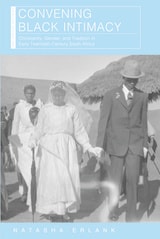
Convening Black Intimacy
Christianity, Gender, and Tradition in Early Twentieth-Century South AfricaNatasha Erlank
Ohio University Press, 2022
An unprecedented study of how Christianity reshaped Black South Africans’ ideas about gender, sexuality, marriage, and family during the first half of the twentieth century.
This book demonstrates that the primary affective force in the construction of modern Black intimate life in early twentieth-century South Africa was not the commonly cited influx of migrant workers but rather the spread of Christianity. During the late nineteenth and early twentieth centuries, African converts developed a new conception of intimate life, one that shaped ideas about sexuality, gender roles, and morality.
Although the reshaping of Black intimacy occurred first among educated Africans who aspired to middle-class status, by the 1950s it included all Black Christians—60 percent of the Black South African population. In turn, certain Black traditions and customs were central to the acceptance of sexual modernity, which gained traction because it included practices such as lobola, in which a bridegroom demonstrates his gratitude by transferring property to his bride’s family. While the ways of understanding intimacy that Christianity informed enjoyed broad appeal because they partially aligned with traditional ways, other individuals were drawn to how the new ideas broke with tradition. In either case, Natasha Erlank argues that what Black South Africans regard today as tradition has been unequivocally altered by Christianity.
In asserting the paramount influence of Christianity on unfolding ideas about family, gender, and marriage in Black South Africa, Erlank challenges social historians who have attributed the key factor to be the migrant labor system. Erlank draws from a wide range of sources, including popular Black literature and the Black press, African church and mission archives, and records of the South African law courts, which she argues have been underutilized in histories of South Africa. The book is sure to attract historians and other scholars interested in the history of African Christianity, African families, sexuality, and the social history of law, especially colonial law.
Courting Desire
Litigating for Love in North IndiaRama Srinivasan
Rutgers University Press, 2020