Results by title
58 books match the query 'Media & Internet' and 5 start with c
Cheap Talk
Disability and the Politics of CommunicationJoshua St. Pierre
University of Michigan Press, 2022
China and the Internet
Using New Media for Development and Social ChangeSong Shi
Rutgers University Press, 2024
Combative Politics
The Media and Public Perceptions of LawmakingMary Layton Atkinson
University of Chicago Press, 2017
By the time a bill is pushed through Congress or ultimately defeated, we’ve often been exposed to weeks, months—even years—of media coverage that underscores the unpopular process of policymaking, and Mary Layton Atkinson argues that this leads us to reject the bill itself. Contrary to many Americans’ understandings of the policymaking process, the best answer to a complex problem is rarely self-evident, and politicians must weigh many potential options, each with merits and drawbacks. As the public awaits a resolution, the news media tend to focus not on the substance of the debate but on descriptions of partisan combat. This coverage leads the public to believe everyone in Washington has lost sight of the problem altogether and is merely pursuing policies designed for individual political gain. Politicians in turn exacerbate the problem when they focus their objections to proposed policies on the lawmaking process, claiming, for example, that a bill is being pushed through Congress with maneuvers designed to limit minority party input. These negative portrayals become linked in many people’s minds with the policy itself, leading to backlash against bills that may otherwise be seen as widely beneficial. Atkinson argues that journalists and educators can make changes to help inoculate Americans against the idea that debate always signifies dysfunction in the government. Journalists should strive to better connect information about policy provisions to the problems they are designed to ameliorate. Educators should stress that although debate sometimes serves political interests, it also offers citizens a window onto the lawmaking process that can help them evaluate the work their government is doing.
Creating Chaos Online
Disinformation and Subverted Post-PublicsAsta Zelenkauskaite
University of Michigan Press, 2022
With the prevalence of disinformation geared to instill doubt rather than clarity, Creating Chaos Online unmasks disinformation when it attempts to pass as deliberation in the public sphere and distorts the democratic processes. Asta Zelenkauskaitė finds that repeated tropes justifying Russian trolling were found to circulate across not only all analyzed media platforms’ comments but also across two analyzed sociopolitical contexts suggesting the orchestrated efforts behind messaging. Through a dystopian vision of publics that are expected to navigate in the sea of uncertain both authentic and orchestrated content, pushed by human and nonhuman actors, Creating Chaos Online offers a concept of post-publics. The idea of post-publics is reflected within the continuum of treatment of public, counter public, and anti-public. This book argues that affect-instilled arguments used in public deliberation in times of uncertainty, along with whataboutism constitute a playbook for chaos online.
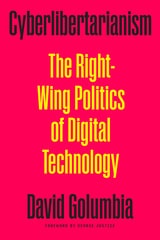
Cyberlibertarianism
The Right-Wing Politics of Digital TechnologyDavid Golumbia
University of Minnesota Press, 2024
An urgent reckoning with digital technology’s fundamentally right-wing legal and economic underpinnings
In a timely challenge to the potent political role of digital technology, Cyberlibertarianism argues that right-wing ideology was built into both the technical and social construction of the digital world from the start. Leveraging more than a decade of research, David Golumbia traces how digital evangelism has driven the worldwide shift toward the political right, concealing inequality, xenophobia, dishonesty, and massive corporate concentrations of wealth and power beneath the utopian presumption of digital technology as an inherent social good.
Providing an incisive critique of the push for open access and open-source software and the legal battles over online censorship and net neutrality, Cyberlibertarianism details how the purportedly democratic internet has been employed as an organizing tool for terror and hate groups and political disinformation campaigns. As he unpacks our naively utopian conception of the digital world, Golumbia highlights technology’s role in the advancement of hyperindividualist and antigovernment agendas, demonstrating how Silicon Valley corporations and right-wing economists; antiestablishment figures such as Julian Assange, Elon Musk, Peter Thiel, Edward Snowden, and Mark Zuckerberg; and seemingly positive voices such as John Perry Barlow, Cory Doctorow, the Electronic Freedom Foundation, and Wikipedia all have worked to hamper regulation and weaken legal safeguards against exploitation.
Drawing from a wide range of thought in digital theory, economics, law, and political philosophy as well as detailed research and Golumbia’s own experience as a software developer, Cyberlibertarianism serves as a clarion call to reevaluate the fraught politics of the internet. In the hope of providing a way of working toward a more genuinely democratic and egalitarian future for digital technology, this magisterial work insists that we must first understand the veiled dogmas from which it has been constructed.
Retail e-book files for this title are screen-reader friendly.