Results by title
80 books match the query 'Medical (incl. Patients)' and 3 start with c

Chronicling Childhood Cancer
A Collection of Personal Stories by Children and Teens with CancerTrisha Karena Paul
Michigan Publishing Services, 2014
In this narrative collection, ten children and teens use their own words and colorful drawings to share their personal experiences with cancer. This diverse collection of patient stories provides insight into the unique lives of these individuals; some are recently diagnosed and undergoing treatment for cancer while others are in remission or have relapsed. These children and teens are honest and perceptive, their stories told with heartfelt emotion.
This book is a resource for all those interested in learning more about childhood cancer, including health practitioners, family, and friends. These stories also have the potential to help other youth diagnosed with cancer.
All of the proceeds received by the University of Michigan Division of Pediatric Hematology/Oncology for this book will be donated: 50% to the Block Out Cancer campaign for pediatric cancer research at the University of Michigan and 50% to the Child and Family Life Program at the University of Michigan C.S. Mott Children’s Hospital.
[more]

Constance Pascal (1877–1937)
Authority, Femininity and Feminism in French PsychiatryFelicia Gordon
University of London Press, 2014
Constance Pascal’s career in French psychiatry from 1908 to 1937 exemplifies the opportunities open to women in the French Third Republic as well as the prejudices they encountered. As the first woman psychiatrist in France, Pascal, of Romanian origin, attained professional success at the cost of suppressing her personal life. Best known for her work on dementia praecox, she founded one of the first schools in France for children with severe learning difficulties, and made remarkable contributions in the reform of asylum practices and, influenced by Freudian psychoanalysis, in psychotherapeutic intervention. Her feminism is demonstrated by her distinguished, often contentious, career in a hitherto all male profession and by her support for other women in their professional roles. Her unjustly neglected life story illuminates many of the conflicts experienced by women entering the professions during the belle époque and the inter-war years. The study’s scholarly authority and ambitious theoretical range do not detract from its lively sense of the person and life struggles of the subject making this a fine demonstration of life history research enthralling for the general reader and expert alike.
[more]
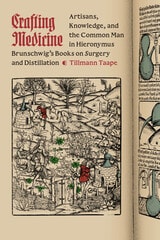
Crafting Medicine
Artisans, Knowledge, and the Common Man in Hieronymus Brunschwig's Books on Surgery and DistillationTillmann Taape
University of Chicago Press, 2025
How an early modern surgeon and his accessible writings changed medical expertise and the communication of medical knowledge.
Between 1497 and 1512, Hieronymus Brunschwig (ca. 1450–ca. 1530), an obscure craftsman from Strasbourg, wrote books on surgery and pharmacy that transformed medical expertise, how it was codified in print, and how it was communicated to new audiences. Brunschwig was an unlikely author. He apprenticed as a surgeon in the local guild and dispensed medicines from his own shop. But he was remarkably well-read in surgery, alchemy, and medical theory, even if he lacked a university education. His unique authorial voice spoke to the healing practices of craftsmen and common people in a down-to-earth German dialect.
Crafting Medicine, by Tillmann Taape, is the first in-depth study of Brunschwig and his works. In it, Taape argues that Brunschwig’s writings shaped a nascent tradition of vernacular medicine. Brunschwig’s books represent a key moment in the history of medical print, for they conveyed medical expertise to a new readership of nonacademic practitioners, who became a key audience for a flood of vernacular medical publications during the sixteenth century. Using Brunschwig’s books as a unique window into the past, Crafting Medicine beautifully reconstructs the world of science inhabited by Brunschwig, his fellow craftsmen, his translators, and his readers.
[more]