Results by title
164 books match the query 'Medical care' and 12 start with c
Care without Pathology
How Trans- Health Activists Are Changing MedicineChristoph Hanssmann
University of Minnesota Press, 2023
Examining trans- healthcare as a key site through which struggles for health and justice take shape
Over the past two decades, medical and therapeutic approaches to transgender patients have changed radically, from treating a supposed pathology to offering gender-affirming care. Based on ethnographic fieldwork in New York City and Buenos Aires, Care without Pathology moves across the Americas to show how trans- health activists have taken on the project of depathologization.
In New York, Christoph Hanssmann examines activist attempts to overturn bans on using public health dollars to fund trans- health care. In Argentina, he traces how trans- activists marshaled medical statistics and personal biographies to reveal state violence directed against trans- people and travestis. Hanssmann also demonstrates the importance of understanding transphobia in the broader context of gendered racism, ableism, and antipoverty, arguing for the rise of a thoroughly coalition-based mass mobilization.
Care without Pathology highlights the distributive arguments activists made to access state funding for health care, combating state arguments that funding trans- health care is too specialized, too expensive, and too controversial. Hanssmann situates trans- health as a crucible within which sweeping changes are taking place—with potentially far-reaching effects on the economic and racial barriers to accessing care.
Chemical Heroes
Pharmacological Supersoldiers in the US MilitaryAndrew Bickford
Duke University Press, 2020

Children of the Atomic Bomb
An American Physician’s Memoir of Nagasaki, Hiroshima, and the Marshall IslandsJames N. Yamazaki and Louis B. Fleming
Duke University Press, 1995
Children of the Atomic Bomb is Dr. Yamazaki’s account of a lifelong effort to understand and document the impact of nuclear explosions on children, particularly the children conceived but not yet born at the time of the explosions. Assigned in 1949 as Physician-in-Charge of the United States Atomic Bomb Casualty Commission in Nagasaki, Yamazaki had served as a combat surgeon at the Battle of the Bulge where he had been captured and held as a prisoner of war by the Germans. In Japan he was confronted with violence of another dimension—the devastating impact of a nuclear blast and the particularly insidious effects of radiation on children.
Yamazaki’s story is also one of striking juxtapositions, an account of a Japanese-American’s encounter with racism, the story of a man who fought for his country while his parents were interned in a concentration camp in Arkansas. Once the object of discrimination at home, Yamazaki paradoxically found himself in Japan for the first time as an American, part of the Allied occupation forces, and again an outsider. This experience resonates through his work with the children of Nagasaki and Hiroshima and with the Marshallese people who bore the brunt of America’s postwar testing of nuclear weapons in the Pacific.
Recalling a career that has spanned five decades, Dr. Yamazaki chronicles the discoveries that helped chart the dangers of nuclear radiation and presents powerful observations of both the medical and social effects of the bomb. He offers an indelible picture of human tragedy, a tale of unimaginable suffering, and a dedication to healing that is ultimately an unwavering, impassioned plea for peace.
Chris Gets Ear Tubes
Betty Pace
Gallaudet University Press, 1987
Civil War Nurse Narratives, 1863-1870
Daneen Wardrop
University of Iowa Press, 2015
As a subgenre of war literature, the Civil War nurse narrative offered realistic reportage of medical experiences and declined to engage with military strategies or Congressional politics. Instead, nurse narrators chronicled the details of attending wounded soldiers in the hospital, where a kind of microcosm of US democracy-in-progress emerged. As the war reshaped the social and political ideologies of the republic, nurses labored in a workplace that reflected cultural changes in ideas about gender, race, and class. Through interactions with surgeons and other officials they tested women’s rights convictions, and through interactions with formerly enslaved workers they wrestled with the need to live up to their own often abolitionist convictions and support social equality.
By putting these accounts in conversation with each other, Civil War Nurse Narratives productively explores a developing genre of war literature that has rarely been given its due and that offers refreshing insights into women’s contributions to the war effort. Taken together, these stories offer an impressive and important addition to the literary history of the Civil War.
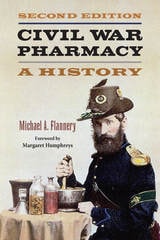
Civil War Pharmacy
A HistoryMichael A. Flannery, with a foreword by Margaret Humphreys
Southern Illinois University Press, 2017
Winner (first edition), Archivists and Librarians in the History of the Health Sciences, Best Book Award
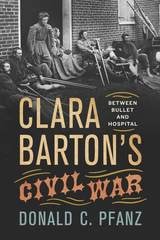
Clara Barton's Civil War
Between Bullet and HospitalDonald C. Pfanz
Westholme Publishing, 2018
“I always tried to succor the wounded until medical aid and supplies could come up—I could run the risk; it made no difference to anyone if I were shot or taken prisoner.” So recorded Clara Barton, the most famous woman to emerge from the American Civil War. In an age when few women worked in hospitals, much less at the front, Barton served in at least four Union armies, providing food and assistance to wounded soldiers on battlefields stretching from Maryland to South Carolina. Thousands of soldiers benefited from her actions, and she is unquestionably an American heroine. But how much do we really know about her actual wartime service? Most information about Barton’s activities comes from Barton herself. After the war, she toured the country recounting her wartime experiences to overflowing audiences. In vivid language, she described crossing the Rappahannock River under fire to succor wounded Union soldiers at Fredericksburg, transporting critical supplies to field hospitals at Antietam, and enduring searing heat and brackish water on the sunscorched beaches of South Carolina. She willingly braved hardship and danger in order to help the young men under her care, receiving in return their love and respect. Most of Barton’s biographers have accepted her statements at face value, but in doing so, they stand on shaky ground, for Barton was a relentless selfpromoter and often embellished her stories in an effort to enhance her accomplishments.
In Clara Barton’s Civil War: Between Bullet and Hospital, distinguished historian Donald Pfanz revisits Barton’s claims, comparing the information in her speeches with contemporary documents, including Barton’s own wartime diary and letters. In doing so, he provides the first balanced and accurate account of her wartime service—a service that in the end needed no exaggeration.
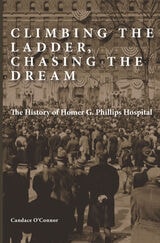
Climbing the Ladder, Chasing the Dream
The History of Homer G. Phillips HospitalCandace O’Connor
University of Missouri Press, 2022
When the beautiful, up-to-date hospital opened, it attracted more black residents than any other such program in the United States. Patients also flocked to the hospital, as did nursing students who found there excellent training, ready employment, and a boost into the middle class. For decades, the hospital thrived; by the 1950s, three-quarters of African-American babies in St. Louis were born at Homer G.
But the 1960s and 1970s brought less need for all-black hospitals, as faculty, residents, and patients were increasingly welcome in the many newly integrated institutions. Ever-tightening city budgets meant less money for the hospital, and in 1979, despite protests from the African-American community, HGPH closed. Years later, the venerated, long-vacant building came to life again as the Homer G. Phillips Senior Living Community.
Candace O’Connor draws upon contemporary newspaper articles, institutional records, and dozens of interviews with former staff members to create the first, full history of the Homer G. Phillips Hospital. She also brings new facts and insights into the life and mysterious murder (still an unsolved case) of the hospital’s namesake, a pioneering Black attorney and civil rights activist who led the effort to build the sorely needed medical facility in the Ville neighborhood.
Clinical Labor
Tissue Donors and Research Subjects in the Global BioeconomyMelinda Cooper and Catherine Waldby
Duke University Press, 2014
Cooper and Waldby examine the rapidly expanding transnational labor markets surrounding assisted reproduction and experimental drug trials. As they discuss, the pharmaceutical industry demands ever greater numbers of trial subjects to meet its innovation imperatives. The assisted reproductive market grows as more and more households look to third-party providers for fertility services and sectors of the biomedical industry seek reproductive tissues rich in stem cells. Cooper and Waldby trace the historical conditions, political economy, and contemporary trajectory of clinical labor. Ultimately, they reveal clinical labor to be emblematic of labor in twenty-first-century neoliberal economies.
Community Health Equity
A Chicago ReaderEdited by Fernando De Maio, Raj C. Shah, MD, John Mazzeo, and David A. Ansell, MD
University of Chicago Press, 2019
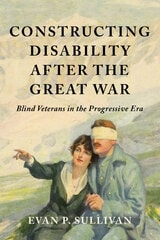
Constructing Disability after the Great War
Blind Veterans in the Progressive EraEvan P. Sullivan
University of Illinois Press, 2024
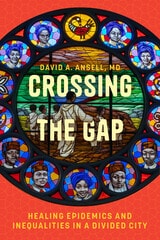
Crossing the Gap
Healing Epidemics and Inequalities in a Divided CityDavid A. Ansell, MD
University of Chicago Press, 2026
A doctor, a disinvested neighborhood, and a radical experiment to close America’s death gap.
Two girls are born in the same Chicago hospital. Their neighborhoods—just seven train stops apart—will shape their futures and help determine how long they live. One will celebrate her eighty-fifth birthday. The other will die before sixty-five.
This is the death gap: lives lost too soon. Crossing the Gap asks how a city with world-class hospitals can tolerate an epidemic of premature death—and tells the story of the people fighting to end it.
In his landmark book The Death Gap, physician and health equity leader David A. Ansell exposed how structural racism and poverty shorten lives. He moves beyond diagnosis in Crossing the Gap to explore what happens when a major medical center joins forces with pastors, community organizers, residents, and young leaders on Chicago’s West Side to redefine what a hospital owes its neighbors. Part medical memoir and part urban chronicle, Crossing the Gap follows groundbreaking initiatives such as West Side United and the Sankofa Wellness Village as they confront decades of disinvestment and work to build healthier communities.
Through stories of collaboration, courage, conflict, and community leadership, Ansell shows how neighborhood voices, rigorous data, and moral imagination can transform health systems from bystanders into partners for change—not just in one city but throughout the nation.