Results by title
85 books match the query 'Men's Studies' and 6 start with c
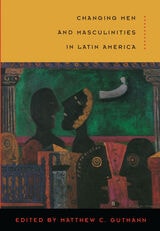
Changing Men and Masculinities in Latin America
Matthew C. Gutmann ed.
Duke University Press, 2003
The contributors look at Mexico, Argentina, Ecuador, Brazil, Colombia, Peru, Venezuela, Chile, and the United States. They bring to bear a number of disciplines—anthropology, history, literature, public health, and sociology—and a variety of methodologies including ethnography, literary criticism, and statistical analysis. Whether analyzing rape legislation in Argentina, the unique space for candid discussions of masculinity created in an Alcoholics Anonymous group in Mexico, the role of shame in shaping Chicana and Chicano identities and gender relations, or homosexuality in Brazil, Changing Men and Masculinities highlights the complex distinctions between normative conceptions of masculinity in Latin America and the actual experiences and thoughts of particular men and women.
Contributors. Xavier Andrade, Daniel Balderston, Peter Beattie, Stanley Brandes, Héctor Carrillo, Miguel Díaz Barriga, Agustín Escobar, Francisco Ferrándiz, Claudia Fonseca, Norma Fuller, Matthew C. Gutmann, Donna Guy, Florencia Mallon, José Olavarría, Richard Parker, Mara Viveros
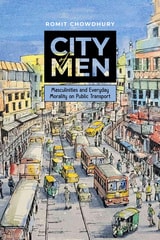
City of Men
Masculinities and Everyday Morality on Public TransportRomit Chowdhury
Rutgers University Press, 2023

Cold Warriors
Manliness on Trial in the Rhetoric of the WestSuzanne Clark
Southern Illinois University Press, 2000
Cold Warriors: Manliness on Trial in the Rhetoric of the West returns to familiar cultural forces—the West, anticommunism, and manliness—to show how they combined to suppress dissent and dominate the unruliness of literature in the name of a national identity after World War II. Few realize how much the domination of a “white male” American literary canon was a product not of long history, but of the Cold War. Suzanne Clark describes here how the Cold War excluded women writers on several levels, together with others—African American, Native American, poor, men as well as women—who were ignored in the struggle over white male identity.
Clark first shows how defining national/individual/American identity in the Cold War involved a brand new configuration of cultural history. At the same time, it called upon the nostalgia for the old discourses of the West (the national manliness asserted by Theodore Roosevelt) to claim that there was and always had been only one real American identity.
By subverting the claims of a national identity, Clark finds, many male writers risked falling outside the boundaries not only of public rhetoric but also of the literary world: men as different from one another as the determinedly masculine Ernest Hemingway and the antiheroic storyteller of the everyday, Bernard Malamud. Equally vocal and contentious, Cold War women writers were unwilling to be silenced, as Clark demonstrates in her discussion of the work of Mari Sandoz and Ursula Le Guin.
The book concludes with a discussion of how the silencing of gender, race, and class in Cold War writing maintained its discipline until the eruptions of the sixties. By questioning the identity politics of manliness in the Cold War context of persecution and trial, Clark finds that the involvement of men in identity politics set the stage for our subsequent cultural history.
Conceiving Masculinity
Male Infertility, Medicine, and IdentityLiberty Walther Barnes
Temple University Press, 2014
In Conceiving Masculinity, Liberty Walther Barnes puts the world of male infertility under the microscope to examine how culturally pervasive notions of gender shape our understanding of disease, and how disease impacts our personal ideas about gender.
Taking readers inside male infertility clinics, and interviewing doctors and couples dealing with male infertility, Barnes provides a rich account of the social aspects of the confusing and frustrating diagnosis of infertility. She explains why men resist a stigmatizing label like "infertile," and how men with poor fertility redefine for themselves what it means to be manly and masculine in a society that prizes male virility. Conceiving Masculinity also details how and why men embrace medical technologies and treatment for infertility.
Broaching a socially taboo topic, Barnes emphasizes that infertility is not just a women's issue. She shows how gender and disease are socially constructed within social institutions and by individuals.
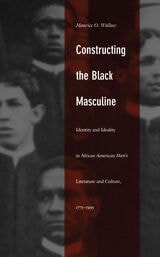
Constructing the Black Masculine
Identity and Ideality in African American Men’s Literature and Culture, 1775–1995Maurice O. Wallace
Duke University Press, 2002
Highlighting their chronic objectification under the gaze of white eyes, Wallace argues that black men suffer a social and representational crisis in being at once seen and unseen, fetish and phantasm, spectacle and shadow in the American racial imagination. Invisible and disregarded on one hand, black men, perceived as potential threats to society, simultaneously face the reality of hypervisibility and perpetual surveillance. Paying significant attention to the sociotechnologies of vision and image production over two centuries, Wallace shows how African American men—as soldiers, Freemasons, and romantic heroes—have sought both to realize the ideal image of the American masculine subject and to deconstruct it in expressive mediums like modern dance, photography, and theatre. Throughout, he draws on the experiences and theories of such notable figures as Frederick Douglass, W. E. B. Du Bois, Booker T. Washington, and James Baldwin.
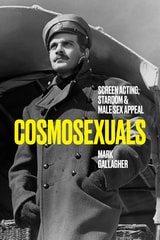
Cosmosexuals
Screen Acting, Stardom, and Male Sex AppealMark Gallagher
University of Texas Press, 2025
An examination of male screen sex appeal and the ways that race, ethnicity, and national origin combine with performance tools and film and television style to aid or inhibit actors’ circulation on an increasingly global stage.
Sex appeal is complicated, especially for screen actors. Looking good is not enough. Charisma and charm have to register when the camera rolls. And sexiness has to travel. Today’s heartthrobs are expected to raise temperatures all around the world.
Cosmosexuals theorizes male sex appeal as a form of capital in an age of international stardom. Screen scholar Mark Gallagher assembles a diverse cast—Idris Elba, Pedro Pascal, Simu Liu, Ryan Gosling, and more—analyzing how each actor uses his appearance, voice, and movement to perform in ways that viewers across cultural divides register as sexually appealing. Cosmosexuals also explores the intersection of global sex appeal and exoticism in historical and contemporary contexts—from the malleable racial identities of Omar Sharif and Conrad Veidt to Mads Mikkelsen’s “accented whiteness”—and assesses the barriers that confine nonwhite actors, in spite of their talent or celebrity. Far more than handsome faces and chiseled abs, male sex symbols emerge as laborers subject to disciplinary regimes steeped in patriarchy, racism, and structural inequity. As such, they have much to tell us about the economies of taste at work in the construction of screen masculinity and the terms of human desire.