Results by title
153 books match the query 'Metaphysics' and 8 start with c

Cannibal Metaphysics
Eduardo Viveiros de Castro
University of Minnesota Press, 2017
The iconoclastic Brazilian anthropologist and theoretician Eduardo Viveiros de Castro, well known in his discipline for helping initiate its “ontological turn,” offers a vision of anthropology as “the practice of the permanent decolonization of thought.” After showing that Amazonian and other Amerindian groups inhabit a radically different conceptual universe than ours—in which nature and culture, human and nonhuman, subject and object are conceived in terms that reverse our own—he presents the case for anthropology as the study of such “other” metaphysical schemes, and as the corresponding critique of the concepts imposed on them by the human sciences. Along the way, he spells out the consequences of this anthropology for thinking in general via a major reassessment of the work of Claude Lévi-Strauss, arguments for the continued relevance of Deleuze and Guattari, dialogues with the work of Philippe Descola, Bruno Latour, and Marilyn Strathern, and inventive treatments of problems of ontology, translation, and transformation. Bold, unexpected, and profound, Cannibal Metaphysics is one of the chief works marking anthropology’s current return to the theoretical center stage.
Cartesian Questions
Method and MetaphysicsJean-Luc Marion
University of Chicago Press, 1999
"Besides the impact of their content, the clarity and reach of these essays force one to consider foundational questions concerning philosophy and its history."—Richard Watson, Journal of the History of Philosophy
Categories
Historical and Systematic Essays (Studies in Philosophy and the History of Philosophy, Volume 41)Michael Gorman
Catholic University of America Press, 2004
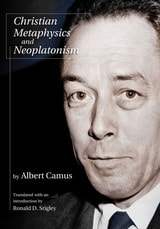
Christian Metaphysics and Neoplatonism
Albert Camus, Translated & Intro by Ronald D. Srigley
University of Missouri Press, 2007
Contemporary scholarship tends to view Albert Camus as a modern, but he himself was conscious of the past and called the transition from Hellenism to Christianity “the true and only turning point in history.” For Camus, modernity was not fully comprehensible without an examination of the aspirations that were first articulated in antiquity and that later received their clearest expression in Christianity. These aspirations amounted to a fundamental reorientation of human life in politics, religion, science, and philosophy.
Understanding the nature and achievement of that reorientation became the central task of Christian Metaphysics and Neoplatonism. Primarily known through its inclusion in a French omnibus edition, ithas remained one of Camus’ least-read works, yet it marks his first attempt to understand the relationship between Greek philosophy and Christianity as he charted the movement from the Gospels through Gnosticism and Plotinus to what he calls Augustine’s “second revelation” of the Christian faith.
Ronald Srigley’s translation of this seminal document helps illuminate these aspects of Camus’ work. His freestanding English edition exposes readers to an important part of Camus’ thought that is often overlooked by those concerned primarily with the book’s literary value and supersedes the extant McBride translation by retaining a greater degree of literalness.
Srigley has fully annotated Christian Metaphysics to include nearly all of Camus’ original citations and has tracked down many poorly identified sources. When Camus cites an ancient primary source, whether in French translation or in the original language, Srigley substitutes a standard English translation in the interest of making his edition accessible to a wider range of readers. His introduction places the text in the context of Camus’ better-known later work, explicating its relationship to those mature writings and exploring how its themes were reworked in subsequent books.
Arguing that Camus was one of the great critics of modernity through his attempt to disentangle the Greeks from the Christians, Srigley clearly demonstrates the place of Christian Metaphysics in Camus’ oeuvre. As the only stand-alone English version of this important work—and a long-overdue critical edition—his fluent translation is an essential benchmark in our understanding of Camus and his place in modern thought.
Cogito and the Unconscious
sic 2Slavoj Žižek, ed.
Duke University Press, 1998
Noting that for Lacan the Cartesian construct is the same as the Freudian "subject of the unconscious," the contributors follow Lacan's plea for a psychoanalytic return to the cogito. Along the path of this return, they examine the ethical attitude that befits modern subjectivity, the inherent sexualization of modern subjectivity, the impasse in which the Cartesian project becomes involved given the enigmatic status of the human body, and the Cartesian subject's confrontation with its modern critics, including Althusser, Bataille, and Dennett. In a style that has become familiar to Žižek's readers, these essays bring together a strict conceptual analysis and an approach to a wide range of cultural and ideological phenomena—from the sadist paradoxes of Kant's moral philosophy to the universe of Ayn Rand's novels, from the question "Which, if any, is the sex of the cogito?" to the defense of the cogito against the onslaught of cognitive sciences.
Challenging us to reconsider fundamental notions of human consciousness and modern subjectivity, this is a book whose very Lacanian orthodoxy makes it irreverently transgressive of predominant theoretical paradigms. Cogito and the Unconscious will appeal to readers interested in philosophy, psychoanalysis, cultural studies, and theories of ideology.
Contributors. Miran Bozovic, Mladen Dolar, Alain Grosrichard, Marc de Kessel, Robert Pfaller, Renata Salecl, Slavoj Žižek, Alenka Zupancic
Common Values
Sissela Bok
University of Missouri Press, 2002
Conquest of Abundance
A Tale of Abstraction versus the Richness of BeingPaul Feyerabend
University of Chicago Press, 1999
Prepared from drafts of the manuscript left at his death, working notes, and lectures and articles Feyerabend wrote while the larger work was in progress, Conquest of Abundance offers up rich exploration and startling insights with the charm, lucidity, and sense of mischief that are his hallmarks. Feyerabend is fascinated by how we attempt to explain and predict the mysteries of the natural world, and he looks at the ways in which we abstract experience, explain anomalies, and reduce wonder to formulas and equations. Through his exploration of the positive and negative consequences of these efforts, Feyerabend reveals the "conquest of abundance" as an integral part of the history and character of Western civilization.
"Paul Feyerabend . . . was the Norman Mailer of philosophy. . . . brilliant, brave, adventurous, original and quirky."—Richard Rorty, New Republic
"As much a smudged icon as a philosophical position holder, [Feyerabend] was alluring and erotic, a torch singer for philosophical anarchy."—Nancy Maull, New York Times Book Review
"[A] kind of final testament of Feyerabend's thought . . . Conquest of Abundance is as much the product of a brilliant, scintillating style as of an immense erudition and culture. . . . This book is as abundant and rich as the world it envisions."—Arkady Plotnitsky, Chicago Tribune
Crossings
Nietzsche and the Space of TragedyJohn Sallis
University of Chicago Press, 1991
The Birth of Tragedy is a rethinking of art at the
limit of metaphysics. His close reading focuses on the
complexity of the Apollinian/Dionysian dyad and on the
crossing of these basic art impulses in tragedy.
"Sallis effectively calls into question some commonly
accepted and simplistic ideas about Nietzsche's early
thinking and its debt to Schopenhauer, and proposes
alternatives that are worth considering."—Richard
Schacht, Times Literary Supplement