Results by title
67 books match the query 'Mexican American women' and 8 start with c
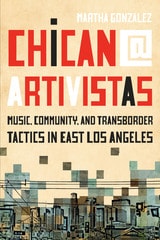
Chican@ Artivistas
Music, Community, and Transborder Tactics in East Los AngelesMartha Gonzalez
University of Texas Press, 2020
As the lead singer of the Grammy Award–winning rock band Quetzal and a scholar of Chicana/o and Latina/o studies, Martha Gonzalez is uniquely positioned to articulate the ways in which creative expression can serve the dual roles of political commentary and community building. Drawing on postcolonial, Chicana, black feminist, and performance theories, Chican@ Artivistas explores the visual, musical, and performance art produced in East Los Angeles since the inception of NAFTA and the subsequent anti-immigration rhetoric of the 1990s.
Showcasing the social impact made by key artist-activists on their communities and on the mainstream art world and music industry, Gonzalez charts the evolution of a now-canonical body of work that took its inspiration from the Zapatista movement, particularly its masked indigenous participants, and that responded to efforts to impose systems of labor exploitation and social subjugation. Incorporating Gonzalez’s memories of the Mexican nationalist music of her childhood and her band’s journey to Chiapas, the book captures the mobilizing music, poetry, dance, and art that emerged in pre-gentrification corners of downtown Los Angeles and that went on to inspire flourishing networks of bold, innovative artivistas.
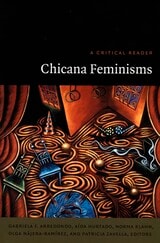
Chicana Feminisms
A Critical ReaderGabriela F. Arredondo, Aida Hurtado, Norma Klahn, Olga Nájera-Ramírez, and Patricia Zavella, eds.
Duke University Press, 2003
The contributors contemplate a number of facets of Chicana experience: life on the Mexico-U.S. border, bilingualism, the problems posed by a culture of repressive sexuality, the ranchera song, and domesticana artistic production. They also look at Chicana feminism in the 1960s and 1970s, the history of Chicanas in the larger Chicano movement, autobiographical writing, and the interplay between gender and ethnicity in the movie Lone Star. Some of the essays are expansive; others—such as Norma Cantú’s discussion of the writing of her fictionalized memoir Canícula—are intimate. All are committed to the transformative powers of critical inquiry and feminist theory.
Contributors. Norma Alarcón, Gabriela F. Arredondo, Ruth Behar, Maylei Blackwell, Norma E. Cantú, Sergio de la Mora, Ann duCille, Michelle Fine, Rosa Linda Fregoso, Rebecca M. Gámez, Jennifer González, Ellie Hernández, Aída Hurtado, Claire Joysmith, Norma Klahn, Amalia Mesa-Bains, Olga Nájera-Ramírez, Anna Nieto Gomez, Renato Rosaldo, Elba Rosario Sánchez, Marcia Stephenson, Jose Manuel Valenzuela, Patricia Zavella
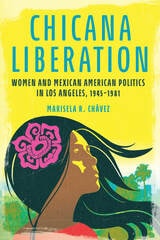
Chicana Liberation
Women and Mexican American Politics in Los Angeles, 1945-1981Marisela R. Chávez
University of Illinois Press, 2024
Mexican American women reached across generations to develop a bridging activism that drew on different methods and ideologies to pursue their goals. Marisela R. Chávez uses a wealth of untapped oral histories to reveal the diverse ways activist Mexican American women in Los Angeles claimed their own voices and space while seeking to leverage power. Chávez tells the stories of the people who honed beliefs and practices before the advent of the Chicano movement and the participants in the movement after its launch in the late 1960s. As she shows, Chicanas across generations challenged societal traditions that at first assumed their place on the sidelines and then assigned them second-class status within political structures built on their work. Fueled by a surging pride in their Mexican heritage and indigenous roots, these activists created spaces for themselves that acknowledged their lives as Mexicans and women.
Vivid and compelling, Chicana Liberation reveals the remarkable range of political beliefs and life experiences behind a new activism and feminism shaped by Mexican American women.
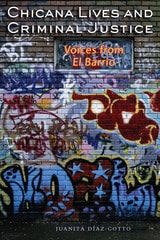
Chicana Lives and Criminal Justice
Voices from El BarrioBy Juanita Díaz-Cotto
University of Texas Press, 2006
This first comprehensive study of Chicanas encountering the U.S. criminal justice system is set within the context of the international war on drugs as witnessed at street level in Chicana/o barrios. Chicana Lives and Criminal Justice uses oral history to chronicle the lives of twenty-four Chicana pintas (prisoners/former prisoners) repeatedly arrested and incarcerated for non-violent, low-level economic and drug-related crimes. It also provides the first documentation of the thirty-four-year history of Sybil Brand Institute, Los Angeles' former women's jail.
In a time and place where drug war policies target people of color and their communities, drug-addicted Chicanas are caught up in an endless cycle of police abuse, arrest, and incarceration. They feel the impact of mandatory sentencing laws, failing social services and endemic poverty, violence, racism, and gender discrimination. The women in this book frankly discuss not only their jail experiences, but also their family histories, involvement with gangs, addiction to drugs, encounters with the juvenile and adult criminal justice systems, and their successful and unsuccessful attempts to recover from addiction and reconstitute fractured families. The Chicanas' stories underscore the amazing resilience and determination that have allowed many of the women to break the cycle of abuse. Díaz-Cotto also makes policy recommendations for those who come in contact with Chicanas/Latinas caught in the criminal justice system.
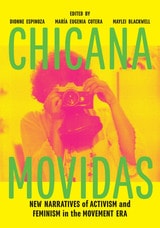
Chicana Movidas
New Narratives of Activism and Feminism in the Movement EraEdited by Dionne Espinoza, María Eugenia Cotera, and Maylei Blackwell
University of Texas Press, 2018
Winner, Best Multiauthor Nonfiction Book, International Latino Book Awards, 2019
With contributions from a wide array of scholars and activists, including leading Chicana feminists from the period, this groundbreaking anthology is the first collection of scholarly essays and testimonios that focuses on Chicana organizing, activism, and leadership in the movement years. The essays in Chicana Movidas: New Narratives of Activisim and Feminism in the Movement Era demonstrate how Chicanas enacted a new kind of politica at the intersection of race, class, gender, and sexuality, and developed innovative concepts, tactics, and methodologies that in turn generated new theories, art forms, organizational spaces, and strategies of alliance.
These are the technologies of resistance documented in Chicana Movidas, a volume that brings together critical biographies of Chicana activists and their bodies of work; essays that focus on understudied organizations, mobilizations, regions, and subjects; examinations of emergent Chicana archives and the politics of collection; and scholarly approaches that challenge the temporal, political, heteronormative, and spatial limits of established Chicano movement narratives. Charting the rise of a field of knowledge that crosses the boundaries of Chicano studies, feminist theory, and queer theory, Chicana Movidas: New Narratives of Activisim and Feminism in the Movement Era offers a transgenerational perspective on the intellectual and political legacies of early Chicana feminism.
Chicana Sexuality and Gender
Cultural Refiguring in Literature, Oral History, and ArtDebra J. Blake
Duke University Press, 2008
Blake looks at how the Chicana professional intellectuals and the U.S. Mexicana women refigure confining and demeaning constructions of female gender roles and racial, ethnic, and sexual identities. She organizes her analysis around re-imaginings of La Virgen de Guadalupe, La Llorona, indigenous Mexica goddesses, and La Malinche, the indigenous interpreter for Hernán Cortés during the Spanish conquest. In doing so, Blake reveals how the professional intellectuals and the working-class and semiprofessional women rework or invoke the female icons to confront the repression of female sexuality, limiting gender roles, inequality in male and female relationships, and violence against women. While the representational strategies of the two groups of women are significantly different and the U.S. Mexicanas would not necessarily call themselves feminists, Blake nonetheless illuminates a continuum of Chicana feminist thinking, showing how both groups of women expand lifestyle choices and promote the health and well-being of women of Mexican origin or descent.
Chicana Ways
Conversations With Ten Chicana WritersKarin Rosa Ikas
University of Nevada Press, 2001
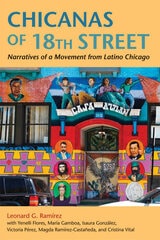
Chicanas of 18th Street
Narratives of a Movement from Latino ChicagoLeonard G. Ramirez
University of Illinois Press, 2011