Results by title
364 books match the query 'Michigan' and 12 start with c
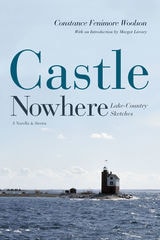
Castle Nowhere
Lake-Country SketchesConstance Fenimore Woolson
University of Michigan Press, 2004
Castle Nowhere is Constance Woolson's collection of stories set for the most part in the Great Lakes, in particular northern Lake Michigan and Lake Huron near Detroit.
Several themes inhabit Woolson's writing: an environmental consciousness and concern with landscapes; an awareness of the complexities of race; and an abidingly careful eye for the shallowness that sometimes accompanies wealth or social pretensions. She also had a unique perspective as a woman who pioneered the use of controversial subjects---such as unrequited or misplaced passion---and methods in fiction during a time that valorized domesticity.
As Margot Livesey notes in her introduction, reading about thwarted love is only one of the pleasures to be found in Castle Nowhere. "The majority of these stories are set in remote areas on the shores of Lake Michigan, which Woolson evokes with great vividness and beauty while always remaining keenly aware that beauty in no way mitigates hardship. As a writer, she was nearly always looking over her shoulder, and many, if not all, of these stories were written at a time when she no longer visited the Lake and her beloved Mackinac Island."
Contemporary readers will find a curiously modern atmosphere in Woolson's stories, as well as a distinct regional flavor in her careful renderings of the Great Lakes landscape. As such, Castle Nowhere represents a rare woman's voice in literature of its period and setting.
Constance Fenimore Woolson (1840-1894) was born in New Hampshire and moved to Cleveland shortly thereafter. She spent time on Mackinac Island, Michigan, then traveled to Florida before moving to Europe. Much of her time there was spent in Italy. She died in Venice in 1894. Novelist Margot Livesey is the author of Eva Moves the Furniture and Homework.
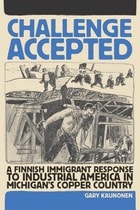
Challenge Accepted
A Finnish Immigrant Response to Industrial America in Michigan's Copper CountryGary Kaunonen
Michigan State University Press, 2010
The copper mines of Michigan's Copper Country, in the Upper Peninsula, were active for 150 years, from 1845 until 1995. Many of the mine workers attempted to unionize, in order to obtain better working conditions, wages, and hours.
The Michigan miners were unsuccessful in their struggles with mine owners, which came to a climax in the 1913–14 Copper Country Strike. This nine-month battle between workers represented by the Western Federation of Miners (WFM) and the three major mining companies in the region took a particularly nasty turn on Christmas Eve, 1913, at a party for strikers and their families organized by the WFM. As many as 500 people were in the Italian Benevolent Society hall in Calumet, Michigan, when someone reportedly shouted "fire." There was no fire, but it is estimated that 73–79 people, more than 60 of them children, died in the stampede for the exit.
Against this dramatic backdrop, Gary Kaunonen tells the story of Finnish immigrants to Copper Country. By examining the written record and material culture of Finnish immigrant proletarians-analyzing buildings, cultural institutions, and publications of the socialist-unionist media—Kaunonen adds a new depth to our understanding of the time and place, the events and a people.

Cheers to Michigan
A Celebration of Cocktail Culture and Craft DistillersTammy Coxen and Lester Graham
University of Michigan Press, 2019
Learn how to mix a Bullshot, the Detroit-born cocktail containing Campbell’s Beef Broth—Marilyn Monroe famously called the drink “a horrible thing to do to vodka.” Or try out the authors’ Whiskey Sour recipe honoring the true story of Valentine Goesaert, a Dearborn woman who challenged the constitutionality of a Michigan law prohibiting female bartenders and in 1948 took her case before the U.S. Supreme Court. Whether you’re a fan of whiskey, gin, or vodka—of the latest cocktail trends or all-time classic drinks—there’s something in this book for all tastes. What’s constant is that each drink showcases a uniquely Michigan twist, making this book perfect for anyone who loves the state, its history and culture, or simply the delicious, delightful, and distinctive cocktails it has inspired.
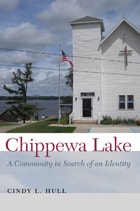
Chippewa Lake
A Community in Search of an IdentityCindy L. Hull
Michigan State University Press, 2012
Chippewa Lake is an idyllic waterfront community in north-central Michigan, popular with retirees and weekenders. The lake is surrounded by a rural farming community, but the area is facing a difficult transition as local demographics shift, and as it transforms from an agriculture-based economy to one that relies on wage labor. As farms have disappeared, local residents have employed a variety of strategies to adapt to a new economic structure. The community, meanwhile, has been indelibly affected by the advent of newcomers and retirees challenging the rural cultural values. An anthropologist with a background in sociology, Cindy L. Hull deftly weaves together oral accounts, historic documents, and participant surveys compiled from her nearly thirty years of living in the area to create a textured portrait of a community in flux.

Cinema Ann Arbor
How Campus Rebels Forged a Singular Film CultureFrank Uhle
University of Michigan Press, 2023
Featuring interviews with filmmaker Ken Burns, Oscar-nominated editor Jay Cassidy, producer John Sloss, and more, this masterpiece provides insights into how a Midwestern college town developed a robust underground art film community that inspired those across the country. Variety’s Owen Glieberman says, “Frank Uhle has captured the moment when cinema became, for a new generation, a kind of religion, with its own rituals and sacred texts and a spirit of exploratory mystery that has all but vanished from the culture.”
This is a must-have book for cinema and media aficionados, film archivists, and anyone interested in the cultural history of Ann Arbor.
This book was published in collaboration with Fifth Avenue Press at Ann Arbor District Library. Learn more about their publishing program here. You can also see their collection, including vintage flyers, photos, film schedules, here.

Citizenship and Crisis
Arab Detroit After 9/11Russell Sage Foundation, 2009

Communists and Community
Activism in Detroit's Labor Movement, 1941-1956Ryan S. Pettengill
Temple University Press, 2020
Communists and Community seeks to reframe the traditional chronology of the Communist Party in the United States as a means to better understand the change that occurred in community activism in the mid-twentieth century. Ryan Pettengill argues that Popular Front activism continued to flourish throughout the war years and into the postwar period. In Detroit, where there was a critical mass of heavy industry, Communist Party activists mobilized support for civil rights and affordable housing, brought attention to police brutality, sought protection for the foreign-born, and led a movement for world peace.
Communists and Community demonstrates that the Communist Party created a social space where activists became effective advocates for the socioeconomic betterment of a multiracial work force. Pettengill uses Detroit as a case study to examine how communist activists and their sympathizers maintained a community to enhance the quality of life for the city’s working class. He investigates the long-term effects of organized labor’s decision to force communists out of the unions and abandon community-based activism. Communists and Community recounts how leftists helped workers, people of color, and other under-represented groups became part of the mainstream citizenry in America.
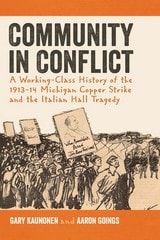
Community in Conflict
A Working-class History of the 1913-14 Michigan Copper Strike and the Italian Hall TragedyGary Kaunonen
Michigan State University Press, 2013
A mirror of great changes that were occurring on the national labor rights scene, the 1913–14 Michigan Copper Strike was a time of unprecedented social upheaval in Michigan’s Upper Peninsula. With organized labor taking an aggressive stance against the excesses of unfettered capitalism, the stage was set for a major struggle between labor and management. The Michigan Copper Strike received national attention and garnered the support of luminaries in organized labor like Mother Jones, John Mitchell, Clarence Darrow, and Charles Moyer. The hope of victory was overshadowed, however, by violent incidents like the shooting of striking workers and their family members, and the bitterness of a community divided. No other event came to symbolize or memorialize the strike more than the Italian Hall tragedy, in which dozens of workers and working-class children died. In Community in Conflict, the efforts of working people to gain a voice on the job and in their community through their unions, and the efforts of employers to crush those unions, take center stage. Previously untapped historical sources such as labor spy reports, union newspapers, coded messages, and artifacts shine new light on this epic, and ultimately tragic, period in American labor history.

Conquering Heroines
How Women Fought Sex Bias at Michigan and Paved the Way for Title IXSara Fitzgerald
University of Michigan Press, 2020
Galvanized by their shared experiences with sex discrimination, the Ann Arbor women organized a group called FOCUS on Equal Employment for Women, led by activist Jean Ledwith King. Working with Bernice Sandler of the Women’s Equity Action League, they developed a strategy to unleash the power of another powerful institution—the federal government—to demand change at U-M and, they hoped, across the world of higher education. Prompted by a complaint filed by FOCUS, the U.S. Department of Health, Education, and Welfare soon documented egregious examples of discrimination in Michigan’s practices toward women and threatened to withhold millions of dollars in contracts unless the school adopted remedies. Among the hundreds of similar complaints filed against U.S. colleges in 1970–1971, the one brought by the Michigan women achieved the breakthrough that provided the historic template for settlements with other institutions.
Drawing on oral histories from archives as well as new interviews with living participants, Conquering Heroines chronicles this pivotal period in the histories of the University of Michigan and the women’s movement. An incredible story of grassroots activism and courageous women, the book highlights the kind of relentless effort that has helped make inclusivity an ongoing goal at U-M.

Copts in Michigan
Eliot Dickinson
Michigan State University Press, 2008
The Copts, or Egyptian Christians, are a relatively small and tight-knit ethno-religious group, numbering perhaps three thousand people and living mostly in the Detroit metropolitan area. Since they began immigrating to Michigan in the mid-1960s, their community has grown exponentially.
Granted exceptional access to the Coptic community, Eliot Dickinson provides the first in- depth profile of this unique and remarkably successful immigrant group. Drawing on personal interviews to infuse the book with warmth and depth. Copts in Michigan offers readers a compelling view into this vibrant community.
Cornish in Michigan
Russell M. Magnaghi
Michigan State University Press, 2007
Several ethnic groups have come to Michigan from the British Isles. Each group of immigrants from this region—the Cornish, English, Irish, and Welsh—has played a significant role in American history.
Historic records show that some early nineteenth-century Cornish immigrants were farmers and settled in the Lower Peninsula of Michigan. However, the majority of early Cornish immigrants were miners, and much of their influence was felt in the Upper Peninsula of the state. Many of the underground miners from Cornwall got their start in this region before they migrated to other mining regions throughout the United States.
Hard-working families came from throughout the peninsula of Cornwall, bringing their history, recipes, songs, religions, and other traditions to Michigan’s northern mining country. This nineteenth-century migration brought them to new homes in Keweenaw County, Houghton County, Copper Harbor, Eagle Harbor, and Presque Isle. In the 1830s, newly arrived immigrants also settled in the lower parts of Michigan, in Macomb, Washtenaw, Lenawee, and Oakland counties. The automobile boom of the 1920s sent many of these immigrants and their children to Metro Detroit from the Upper Peninsula, where their traditions are perpetuated today.

Craftsmanship and the Michigan Union Carpenter
Philip A. Korth
University of Wisconsin Press, 1991